










Fine Organics lifts H1 FY27 consolidated EBITDA margin to 25.4%
Key highlights
- Fine Organics reported H1 FY27 consolidated revenue of Rs 1,423.6 crore, up 20.1% year on year.
- Fine Organics' H1 FY27 consolidated EBITDA rose 39.5% to Rs 360.9 crore and margin reached 25.4%.
- Fine Organics' H1 FY27 gross profit margin increased to 44.3% from 41.0% a year earlier.
- Fine Organics completed its Rs 80.17 crore acquisition of 80% of Oleofine Organics Sdn. Bhd. on September 9, 2026.
powered by IRIS
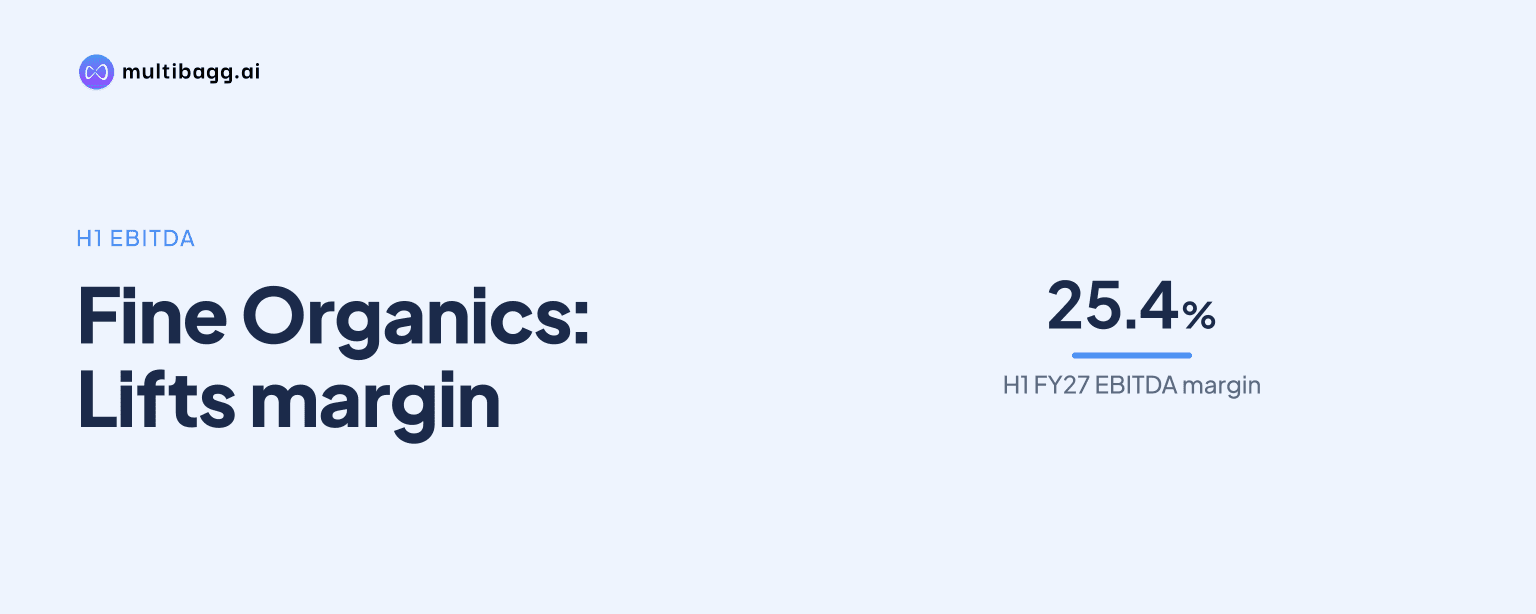
Fine Organic Industries Ltd. lifted consolidated EBITDA margin to 25.4% in H1 FY27 from 21.8% in H1 FY26, as revenue from operations rose 20.1% to Rs 1,423.6 crore and EBITDA increased 39.5% to Rs 360.9 crore. Fine Organics reported this expansion despite substantially higher raw-material and utility costs and rising ocean freight during the half year.
Know Fine Organic Industries inside out
Results, valuation, peers and who's buying, in one view.
How much did Fine Organics' H1 FY27 margin improve?
Fine Organics' consolidated EBITDA margin increased 3.6 percentage points year on year to 25.4% in H1 FY27, while gross profit margin rose to 44.3% from 41.0%. EBITDA rose by Rs 102.1 crore to Rs 360.9 crore, exceeding the Rs 237.9 crore increase in revenue from operations to Rs 1,423.6 crore.
The improvement extended below EBITDA. Consolidated profit after tax, or PAT, rose 28.6% to Rs 290.3 crore in H1 FY27, and PAT margin increased to 20.4% from 19.0%. Earnings per share were Rs 94.67 for the half year, against Rs 73.60 in H1 FY26; the earlier period included a Rs 6.98 crore insurance settlement for business interruption recorded as an exceptional item.
What happened to Fine Organics' input and logistics costs?
Fine Organics said raw-material prices increased substantially in H1 FY27 compared with H1 FY26, while utility costs also increased substantially because of higher fuel prices related to the West Asia crisis. Ocean freight costs increased substantially year on year and continued to rise quarter on quarter, which the company attributed to geopolitical supply-chain disruption.
Costs increased in absolute terms, but gross profit grew faster than revenue. Consolidated raw-material consumption was Rs 793.0 crore in H1 FY27 versus Rs 699.6 crore a year earlier, employee cost was Rs 91.3 crore versus Rs 77.2 crore, and other expenses were Rs 178.4 crore versus Rs 150.2 crore. Gross profit still increased 29.7% to Rs 630.5 crore, raising gross margin by 3.3 percentage points to 44.3%.
The Q2 FY27 sequence showed differing cost movements. Fine Organics said raw-material prices rose marginally in Q2 FY27 from Q1 FY27, while utility costs stabilised marginally, but ocean freight continued to rise. Q2 raw-material consumption increased to Rs 413.9 crore from Rs 379.2 crore in Q1, while revenue rose to Rs 729.4 crore from Rs 694.2 crore.
Did Fine Organics sustain margins in Q2 FY27?
Fine Organics sustained a consolidated EBITDA margin of 25.4% in Q2 FY27, compared with 25.3% in Q1 FY27 and 22.6% in Q2 FY26. Q2 EBITDA increased 36.8% year on year to Rs 184.9 crore, while revenue from operations rose 22.1% to Rs 729.4 crore.
Q2 gross margin was 43.3%, lower than 45.4% in Q1 FY27 but higher than 41.6% in Q2 FY26. Other expenses declined sequentially to Rs 86.2 crore from Rs 92.2 crore, and employee cost fell to Rs 44.4 crore from Rs 46.9 crore. The company disclosed that freight costs continued to increase quarter on quarter during this period.
Q2 PAT increased 40.1% year on year to Rs 152.1 crore and rose 10.1% from Rs 138.1 crore in Q1 FY27. Finance cost was Rs 2.1 crore in Q2, compared with Rs 0.9 crore in Q1 and Rs 0.4 crore a year earlier. The share of loss from joint ventures was Rs 2.4 crore, compared with Rs 1.9 crore in Q1 FY27.
Got a follow-up? Ask IRIS
How did Fine Organics' consolidated result compare with standalone operations?
Fine Organics' consolidated H1 FY27 EBITDA margin of 25.4% was 0.2 percentage points above its standalone EBITDA margin of 25.2%. Consolidated revenue was Rs 1,423.6 crore against standalone revenue of Rs 1,361.6 crore, while consolidated EBITDA was Rs 360.9 crore compared with standalone EBITDA of Rs 342.5 crore.
The group perimeter changed during the period through the acquisition of an 80% stake in Malaysia-based Oleofine Organics Sdn. Bhd. Fine Organics completed the acquisition on September 9, 2026, at a cost of Rs 80.17 crore. Following the transaction, Fine Organic Industries (Thailand) Co. Ltd. became a subsidiary because Fine Organics directly and indirectly controlled about 53% of its voting power.
Consolidated PAT margin of 20.4% was also above the standalone PAT margin of 19.9% in H1 FY27. The consolidated statement included a Rs 4.4 crore share of loss from joint ventures, compared with Rs 1.8 crore in H1 FY26, while consolidated depreciation rose to Rs 28.3 crore from Rs 24.6 crore.
What capital commitments and balance-sheet changes should investors track?
Fine Organics reported a consolidated net cash position at H1 FY27, with net debt to equity of negative 0.46 times, compared with negative 0.52 times at FY26. At September 2026, consolidated cash and cash equivalents were Rs 252.6 crore and other bank balances were Rs 1,277.0 crore, against non-current borrowings of Rs 149.4 crore and current borrowings of Rs 5.3 crore.
Fine Organics infused Rs 55 crore into wholly owned subsidiary Fine Organic Industries (SEZ) Pvt. Ltd. in Q2 FY27 through 1% non-convertible, non-cumulative, non-participating redeemable preference shares. Cumulative investment reached Rs 247.5 crore under a board-approved Rs 300 crore infusion, and the board additionally approved Rs 120 crore for the ongoing SEZ project.
Consolidated capital work-in-progress rose to Rs 170.7 crore at September 2026 from Rs 62.5 crore at March 2026. Total consolidated assets increased to Rs 3,422.9 crore from Rs 2,998.8 crore over the same period, while total liabilities increased to Rs 455.2 crore from Rs 334.3 crore, including higher non-current borrowings.
Conclusion
Fine Organics combined 20.1% H1 FY27 revenue growth with 39.5% EBITDA growth despite reporting substantial increases in raw-material and utility costs and higher ocean freight. Gross margin rose to 44.3% from 41.0%, consolidated EBITDA margin reached 25.4%, and PAT rose 28.6% to Rs 290.3 crore.
The disclosed items to watch next are execution of the ongoing SEZ project, for which the board has approved an additional Rs 120 crore of equity infusion, and utilisation of the remaining Rs 52.5 crore under the earlier Rs 300 crore approval. Fine Organics also identified geopolitical supply-chain disruption and rising ocean freight as continuing cost factors after Q2 FY27.