










Finkurve retail gold loans reached 96% of loan book in Q2FY27
Key highlights
- Finkurve’s gold-loan share rose from 39% in FY23 to 96% in Q2FY27.
- Gold loans accounted for 95% of Finkurve’s loan book in Q4FY26 and 96% in both Q1FY27 and Q2FY27.
- Finkurve reported 122 branches in H1 FY27, compared with 105 in FY26.
- Average gold-loan AUM per branch reached Rs 10.4 crore in H1 FY27, versus Rs 2.8 crore in FY23.
powered by IRIS
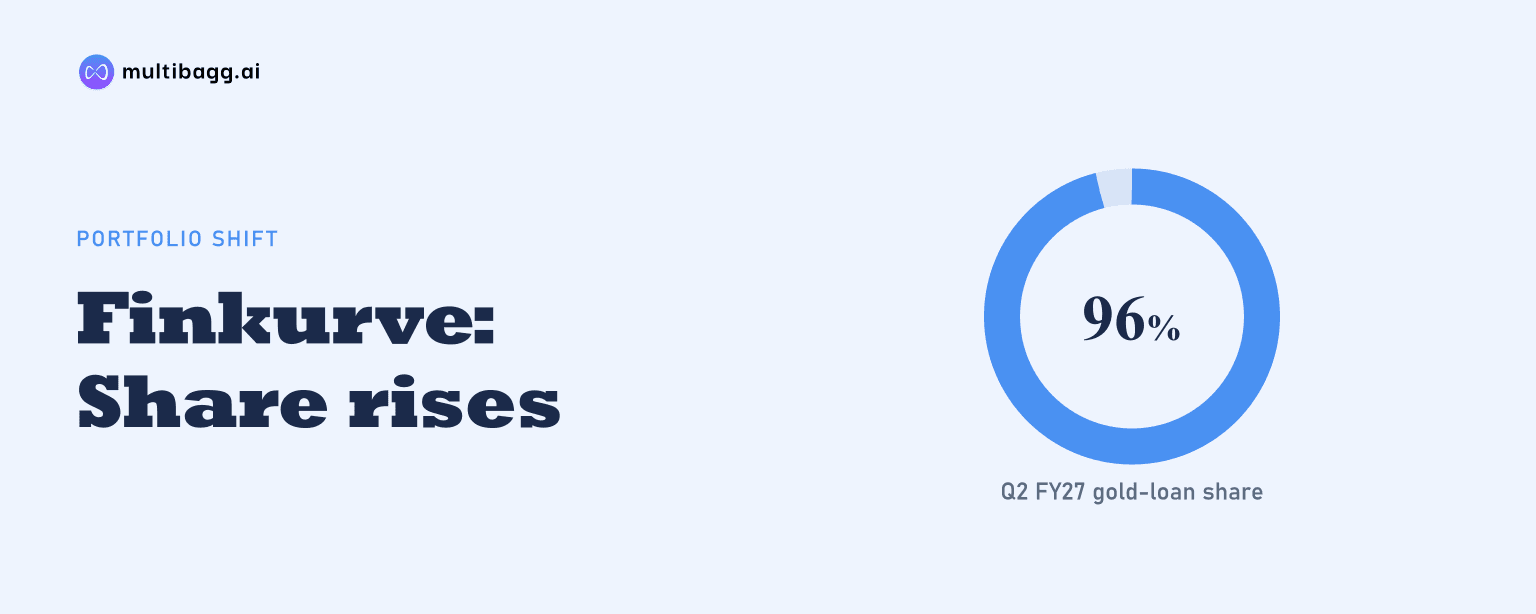
Finkurve Financial Services shifted its loan book toward retail gold loans, which reached 96% of total loans in Q2FY27, the second quarter of financial year FY27, from 39% in FY23. The presentation shows a move away from legacy corporate lending toward collateral-backed retail credit, with the gold-loan share rising to 96% after reaching 89% in FY25.
Know Finkurve Financial Services inside out
Results, valuation, peers and who's buying, in one view.
How did Finkurve change its loan book?
Finkurve changed its loan book by making retail gold loans its dominant product, lifting their share by 57 percentage points from FY23 to Q2FY27. Gold loans accounted for 39% of the book in FY23, when the presentation describes the business as reflecting a predominantly corporate-lending posture. The share then reached 75% in FY24 and 89% in FY25, showing that most of the portfolio transition occurred during those two financial years.
The shift continued after FY25, although the pace slowed as gold loans became the overwhelming part of the portfolio. The mix was 91% in both Q1FY26 and Q2FY26, rose to 93% in Q3FY26 and 95% in Q4FY26, then reached 96% in Q1FY27 and remained at that level in Q2FY27. The reported share therefore increased by 7 percentage points during FY26, compared with 50 percentage points from FY23 to FY25.
What replaced Finkurve’s corporate-lending focus?
Finkurve replaced its legacy focus on high-value, lower-volume institutional loans with retail lending secured by physical gold. The presentation identifies corporate loans as the earlier model and describes them as having concentrated risk exposure. Its stated strategic shift was toward retail gold loans, where loan exposure is anchored to underlying physical gold rather than solely to an institutional borrower.
Finkurve says loan amounts are determined by collateral value and Reserve Bank of India, or RBI, loan-to-value, or LTV, norms. LTV is the proportion of collateral value that may be lent. This differs from Finkurve’s unsecured cash-flow-based credit, where eligibility is assessed through bureau records, bank statements, affordability checks, customer cash flow, credit behaviour and repayment capacity.
The presentation describes a dual-engine lending strategy rather than a fully secured-only portfolio. For gold loans, Finkurve uses direct, branch-led origination, collateral-led underwriting and continuous monitoring of asset coverage during the loan lifecycle. For unsecured credit, it cites a partnership-led origination model intended to support capital-efficient expansion and a diversified retail portfolio; however, the 96% gold-loan share in Q2FY27 shows secured retail lending accounted for nearly all of the book at that date.
Got a follow-up? Ask IRIS
What operating controls support Finkurve’s gold loans?
Finkurve says its gold-loan operations use a centralised platform that tracks loans, disbursals and repayments in real time across branches. Vault access requires dual one-time passwords, or OTPs, from both the branch and head office. The mechanism adds a second control point to the direct-branch origination model used for secured lending.
Finkurve also describes a maker-checker process in which every transaction and vault-access event is verified by two independent parties. Head-office approval combined with branch verification is presented as a security and compliance measure. These controls relate directly to a loan book that was 96% gold loans in Q2FY27 because the product requires gold appraisal, physical storage and continuing collateral coverage.
The company lists continuous video monitoring, in-person verification and artificial intelligence, or AI, tools as part of the operating framework. Its AI applications include face detection, crowd monitoring, object detection and image processing to screen and assess gold. The customer journey covers sourcing, know-your-customer, or KYC, approvals, gold appraisal and disbursal, with an average turnaround time of 25 minutes.
How is Finkurve expanding its retail gold-loan model?
Finkurve reported 122 branches in H1 FY27, or the first half of FY27, across Telangana, Andhra Pradesh, Karnataka and Tamil Nadu, alongside a digital presence. Telangana had 57 touchpoints, Andhra Pradesh 44, Karnataka 13 and Tamil Nadu eight. This footprint supports direct gold-loan origination, where appraisal and custody of physical collateral are part of the lending process.
The branch count rose from 17 in FY22 to 31 in FY23, 60 in FY24, 73 in FY25 and 105 in FY26 before reaching 122 in H1 FY27. Average gold-loan assets under management, or AUM, per branch were Rs 3.0 crore in FY22 and Rs 10.4 crore in H1 FY27. That was an increase of Rs 7.4 crore per branch while the network added 105 branches.
Finkurve’s stated plan is cluster-led expansion in high-gold-ownership Tier-2 and Tier-3 markets, including underbanked locations. Management says its standardised, technology-led model can take 30 to 45 days from planning to branch launch. The plan also includes digitised origination and servicing, data-driven underwriting and pricing, and centralised risk, compliance and analytics.
Conclusion
Finkurve’s disclosed product-mix data show a substantial business-model transformation: retail gold loans moved from 39% of the loan book in FY23 to 96% in Q2FY27. The change reduced the relative role of legacy corporate lending and made collateral valuation, branch-led origination, vault controls and asset-coverage monitoring central to the operating model. The increase from 105 branches in FY26 to 122 in H1 FY27 coincided with average gold-loan AUM per branch reaching Rs 10.4 crore.
What to watch next is execution of the stated Tier-2 and Tier-3 branch-expansion plan, including the management-stated 30-to-45-day rollout model. Future disclosures can show whether the gold-loan share remains near the 96% reported in both Q1FY27 and Q2FY27, whether average AUM per branch rises beyond Rs 10.4 crore, and whether portfolio-performance data are provided alongside the operational-control framework.