










Arvog reaches 122 branches and Rs 10.4 crore AUM each
Key highlights
- Arvog reported 122 gold-loan branches in H1 FY27, compared with 105 in FY26.
- Average gold-loan AUM per Arvog branch rose to Rs 10.4 crore in H1 FY27 from Rs 9.9 crore in FY26.
- Telangana and Andhra Pradesh accounted for 101 of Arvog's 122 disclosed touchpoints.
- Gold loans represented 96% of Arvog's loan book in Q2 FY27, up from 39% in FY23.
powered by IRIS
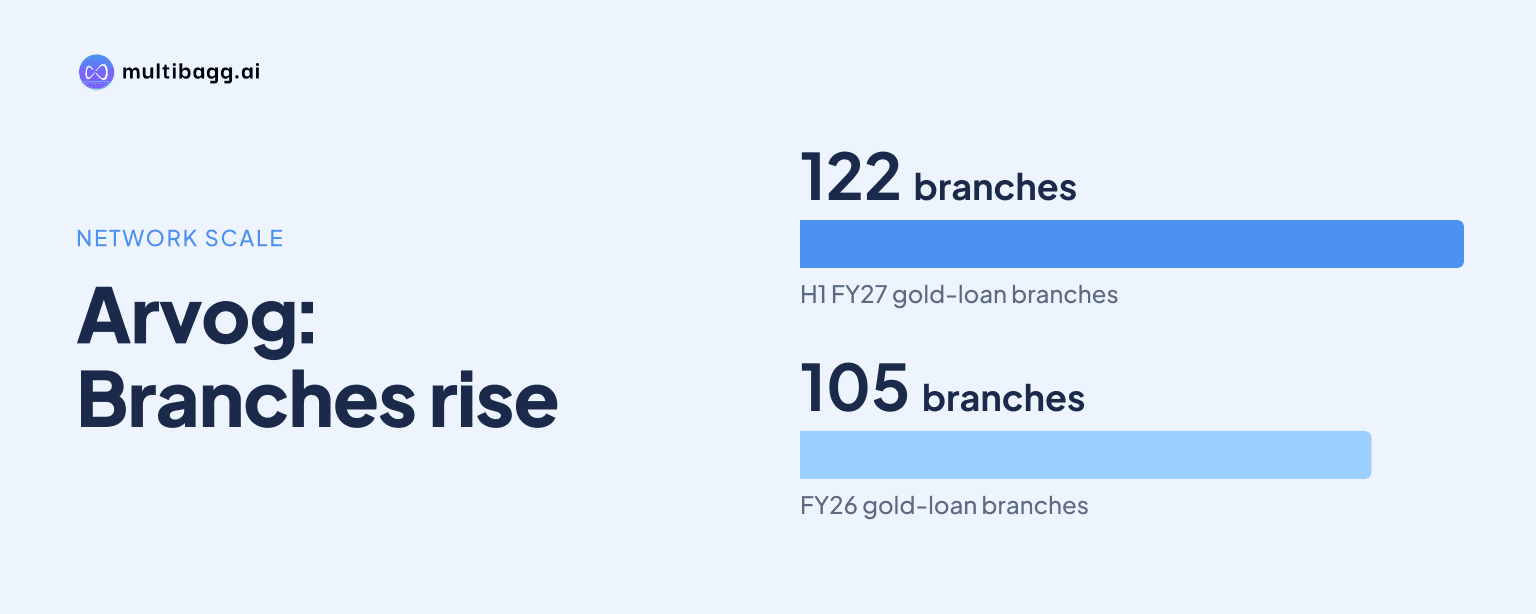
In H1 FY27, Arvog reported 122 gold-loan branches and average gold-loan assets under management, or AUM, of Rs 10.4 crore per branch, compared with 105 branches and Rs 9.9 crore per branch in FY26. The figures show that the network expanded while the reported average AUM per location increased.
Know Finkurve Financial Services inside out
Results, valuation, peers and who's buying, in one view.
How quickly has Arvog expanded its gold-loan branch network?
Arvog expanded its gold-loan network to 122 branches in H1 FY27 from 105 in FY26, 73 in FY25 and 60 in FY24. The presentation shows 17 branches in FY22, meaning the disclosed network added 105 locations between FY22 and H1 FY27. Arvog also reports a digital presence alongside its branch network.
The annual pace of additions changed across the reported periods. The branch base rose by 14 in FY23, by 29 in FY24, by 13 in FY25 and by 32 in FY26; H1 FY27 added a further 17 branches from the FY26 count. FY26 delivered the largest full-year increase in the displayed series, while the H1 FY27 addition already exceeded the 13 locations added in FY25.
Has Arvog increased AUM per branch while opening locations?
Yes, Arvog reported average gold-loan AUM of Rs 10.4 crore per branch in H1 FY27, up from Rs 9.9 crore in FY26. The Rs 50 lakh increase followed a rise of Rs 4.6 crore per branch between FY25, when the average was Rs 5.3 crore, and FY26. Branches increased from 73 to 105 over that FY25-to-FY26 interval.
The reported average did not rise in every year. It declined from Rs 3.0 crore in FY22 to Rs 2.8 crore in FY23, then increased to Rs 3.2 crore in FY24, Rs 5.3 crore in FY25 and Rs 9.9 crore in FY26. By H1 FY27, the average was Rs 7.4 crore above the FY22 figure, while the branch base was 122 compared with 17.
Arvog had 62 more branches in H1 FY27 than in FY24, alongside average AUM per branch that was Rs 7.2 crore higher than the Rs 3.2 crore reported for FY24. These are reported average branch figures rather than a separately disclosed calculation of total AUM from the table. The comparison indicates that the disclosed productivity measure increased alongside the distribution base.
Where is Arvog building its gold-loan footprint?
Arvog reported 57 touchpoints in Telangana, 44 in Andhra Pradesh, 13 in Karnataka and eight in Tamil Nadu. Telangana and Andhra Pradesh therefore accounted for 101 of the 122 disclosed touchpoints, while Karnataka and Tamil Nadu accounted for the remaining 21. The network is consequently concentrated in the two largest disclosed state markets.
Arvog says its expansion plan is cluster-led and focused on Tier-2 and Tier-3 markets with high household gold ownership. Management describes repeat borrowing, operating leverage and predictable AUM growth as intended outcomes, and says it aims to enter underbanked locations where organised gold loans can replace informal lending. The presentation does not disclose a future numerical branch target beyond 122 locations in H1 FY27.
The branch buildout coincides with a larger retail gold-loan mix. Gold loans accounted for 39% of Arvog's loan book in FY23, rising to 75% in FY24, 89% in FY25 and 96% in both Q1 FY27 and Q2 FY27. The disclosed product mix therefore shifted by 57 percentage points from FY23 to Q2 FY27 as the company moved away from its earlier corporate-lending focus.
Got a follow-up? Ask IRIS
How does Arvog aim to launch branches within 30 to 45 days?
Arvog says its standardised technology-led model enables branch rollout within 30 to 45 days from planning to launch. The presentation links this timetable to digitised origination and servicing, data-driven underwriting and pricing, and centralised risk, compliance and analytics. It presents the timeline as a feature of its planned scaling model in Tier-2 and Tier-3 cities, not as a guaranteed opening rate for every location.
Arvog says all branches use a centralised platform with real-time tracking of loans, disbursals and repayments. Vault access requires dual one-time passwords, or OTPs, from the branch and head office, while a maker-checker process requires two independent parties for transaction and vault-access verification. The company also cites artificial intelligence-based face detection, crowd monitoring, object detection and image processing for gold assessment.
The presentation places the average customer turnaround time, or TAT, at 25 minutes from sourcing through know-your-customer, or KYC, approval, gold appraisal and disbursal. That 25-minute measure concerns the customer loan process, whereas the 30-to-45-day figure concerns branch planning and launch. Both measures rely on the digitised and centralised operating mechanisms described by Arvog.
Conclusion
Arvog's H1 FY27 disclosures combine a network of 122 gold-loan branches with average gold-loan AUM of Rs 10.4 crore per branch, up from Rs 9.9 crore in FY26. The expansion follows a rise from 17 branches in FY22, while gold loans increased from 39% of the loan book in FY23 to 96% in Q2 FY27, placing the branch programme within a predominantly retail gold-loan model.
The next measure to watch is whether Arvog can continue opening locations under its stated 30-to-45-day rollout model while maintaining or increasing the Rs 10.4 crore average AUM per branch reported in H1 FY27. The presentation does not provide a branch-count target, so subsequent disclosures on additions, state distribution and average branch AUM will show how the stated Tier-2 and Tier-3 expansion plan is progressing.