










Finkurve collection efficiency fell to 90.1% in Q2FY27
Key highlights
- Finkurve’s collection efficiency fell to 90.1% in Q2FY27 from 98.0% in Q1FY27.
- Finkurve’s GNPA rose to 2.63% and NNPA rose to 2.37% in Q2FY27.
- Finkurve’s gold-loan LTV ratio increased to 80.4% from 77.3% in Q1FY27.
- Finkurve’s total AUM reached Rs 1,312 crore, including Rs 78 crore of off-book AUM, in Q2FY27.
powered by IRIS
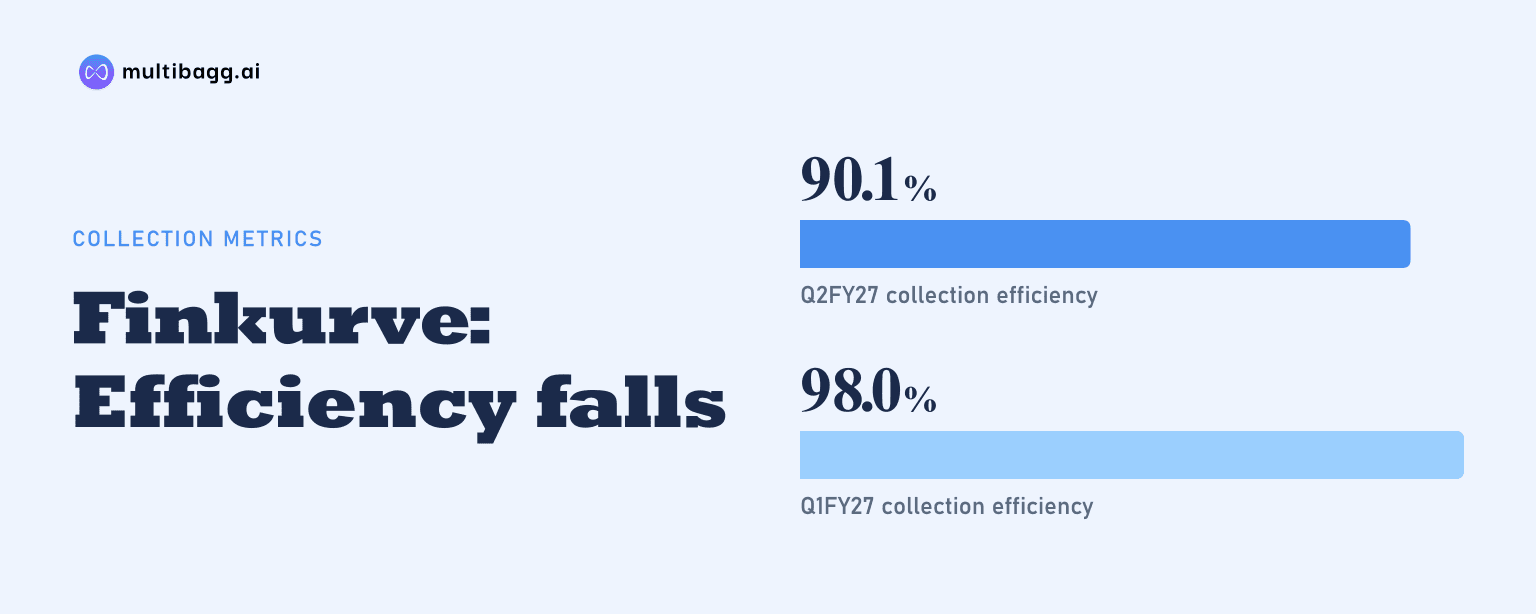
Finkurve’s collection efficiency declined to 90.1% in Q2FY27 from 98.0% in Q1FY27, while gross non-performing assets reached 2.63% from 0.54%. The change coincided with its gold-loan loan-to-value ratio rising to 80.4% and total assets under management reaching Rs 1,312 crore.
Know Finkurve Financial Services inside out
Results, valuation, peers and who's buying, in one view.
What changed in Finkurve’s collections and asset quality in Q2FY27?
Finkurve’s collections and reported asset-quality ratios deteriorated in Q2FY27. Collection efficiency fell 7.9 percentage points quarter on quarter, from 98.0% in Q1FY27 to 90.1%, while gross non-performing assets, or GNPA, increased 2.09 percentage points from 0.54% to 2.63%.
Net non-performing assets, or NNPA, rose to 2.37% in Q2FY27 from 0.48% in Q1FY27. Across the five quarters shown, Q2FY27 recorded the highest GNPA and NNPA ratios, compared with lows of 0.12% and 0.08%, respectively, in Q4FY26.
The Q2FY27 collection-efficiency reading was also below 93.5% in Q2FY26, although assets under management, or AUM, rose to Rs 1,312 crore from Rs 671 crore over that period. Finkurve does not identify borrower cohorts, geographies, products or recovery timing behind the latest decline.
How did loan-to-value change in Finkurve’s gold-loan book?
Finkurve’s gold-loan loan-to-value ratio, or LTV, rose to 80.4% in Q2FY27 from 77.3% in Q1FY27 and 64.4% in Q2FY26. LTV measures the loan amount relative to the value of pledged gold, and the 16.0-percentage-point year-on-year increase occurred as GNPA rose from 1.13% to 2.63%.
Gold loans were Rs 1,257 crore of Finkurve’s Rs 1,312 crore AUM in Q2FY27, including off-book AUM. They represented 95.6% of AUM, versus 95.8% in Q1FY27 and 91.0% in Q2FY26; personal loans accounted for Rs 48 crore, or 3.9%, and other loans for Rs 6 crore, or 0.5%.
Gold holdings declined to 1,162 kilograms in Q2FY27 from 1,167 kilograms in Q1FY27, even as gold-loan AUM rose by Rs 38 crore. The average gold-loan ticket size fell to Rs 1.79 lakh from Rs 1.87 lakh sequentially, but remained above Rs 1.34 lakh in Q2FY26.
Did Finkurve’s AUM growth continue despite lower collections?
Finkurve’s AUM continued to increase in Q2FY27, but the sequential addition slowed to Rs 42 crore from Rs 174 crore in Q1FY27. Total AUM rose to Rs 1,312 crore from Rs 1,270 crore in Q1FY27, after growing from Rs 1,096 crore in Q4FY26.
Gold loans drove the quarter’s increase, rising to Rs 1,257 crore from Rs 1,219 crore in Q1FY27. Personal-loan AUM increased by Rs 6 crore to Rs 48 crore, while other AUM declined by Rs 3 crore to Rs 6 crore, leaving gold loans at 95.6% of the portfolio.
Off-book AUM reached Rs 78 crore in Q2FY27, up from Rs 38 crore in Q1FY27 and Rs 10 crore in Q2FY26. Finkurve includes off-book AUM in total AUM, and the Rs 40 crore sequential increase in off-book AUM accounted for most of the Rs 42 crore total-AUM increase; it does not provide separate collection or non-performing asset ratios for the on-book and off-book portfolios.
Got a follow-up? Ask IRIS
What do yields and interest income show about Finkurve’s portfolio?
Finkurve’s gold-loan yield on average book increased to 20.8% in Q2FY27 from 20.0% in Q1FY27. Gold-loan interest income rose to Rs 64.5 crore from Rs 56.4 crore, while its share of segment interest income declined to 72.6% from 75.5%.
Personal-loan interest income increased to Rs 23.7 crore in Q2FY27 from Rs 18.2 crore in Q1FY27, lifting its segment-income share to 26.7% from 24.4%. In Q2FY26, gold-loan interest income was Rs 27.9 crore and personal-loan interest income was Rs 19.3 crore.
The presentation places the Q2FY27 rise in asset-quality ratios alongside a Rs 1,257 crore gold-loan portfolio, a 20.8% yield and an 80.4% LTV. It does not disclose GNPA, NNPA or collection efficiency by product, so the data do not show whether reported delinquencies were concentrated in gold loans, personal loans or other lending.
Which Finkurve indicators should readers track next?
Finkurve’s next quarterly disclosures should show whether collection efficiency, GNPA and NNPA move from Q2FY27 levels of 90.1%, 2.63% and 2.37%, respectively. Those metrics changed from 98.0%, 0.54% and 0.48% in Q1FY27, even as total AUM increased by Rs 42 crore.
The gold-loan LTV also warrants tracking because it increased in each reported year-on-year comparison, from 64.4% in Q2FY26 to 80.4% in Q2FY27. Future disclosures can be compared with Q2FY27 gold-loan AUM of Rs 1,257 crore, holdings of 1,162 kilograms and an average ticket size of Rs 1.79 lakh.
Conclusion
Finkurve reported continued AUM expansion in Q2FY27, led by a Rs 1,257 crore gold-loan book, while collection and reported asset-quality measures moved in the opposite direction. Collection efficiency fell to 90.1%, GNPA rose to 2.63%, NNPA reached 2.37% and gold-loan LTV increased to 80.4%; the presentation does not provide a product-level explanation for these movements.
The unresolved issue is whether collections and non-performing asset ratios reverse in subsequent quarters as LTV and off-book AUM evolve. Management has also set a strategic target for co-lending to contribute up to 30% of AUM over the next few years, compared with 5.97% in Q2FY27, making the future mix of on-book and co-lending AUM a disclosed point to watch.