










Finolex Cables says communication margins will normalise
Key highlights
- Communication-cable revenue rose 116% year on year to Rs 230 crore from Rs 106 crore.
- Communication-cable EBIT increased to about Rs 69 crore from Rs 1.2 crore a year earlier.
- Management said the segment’s near-30% EBIT margin should normalise to the mid-teens.
- Exports contributed about Rs 25 crore to Rs 28 crore of Rs 230 crore communication-cable revenue.
powered by IRIS
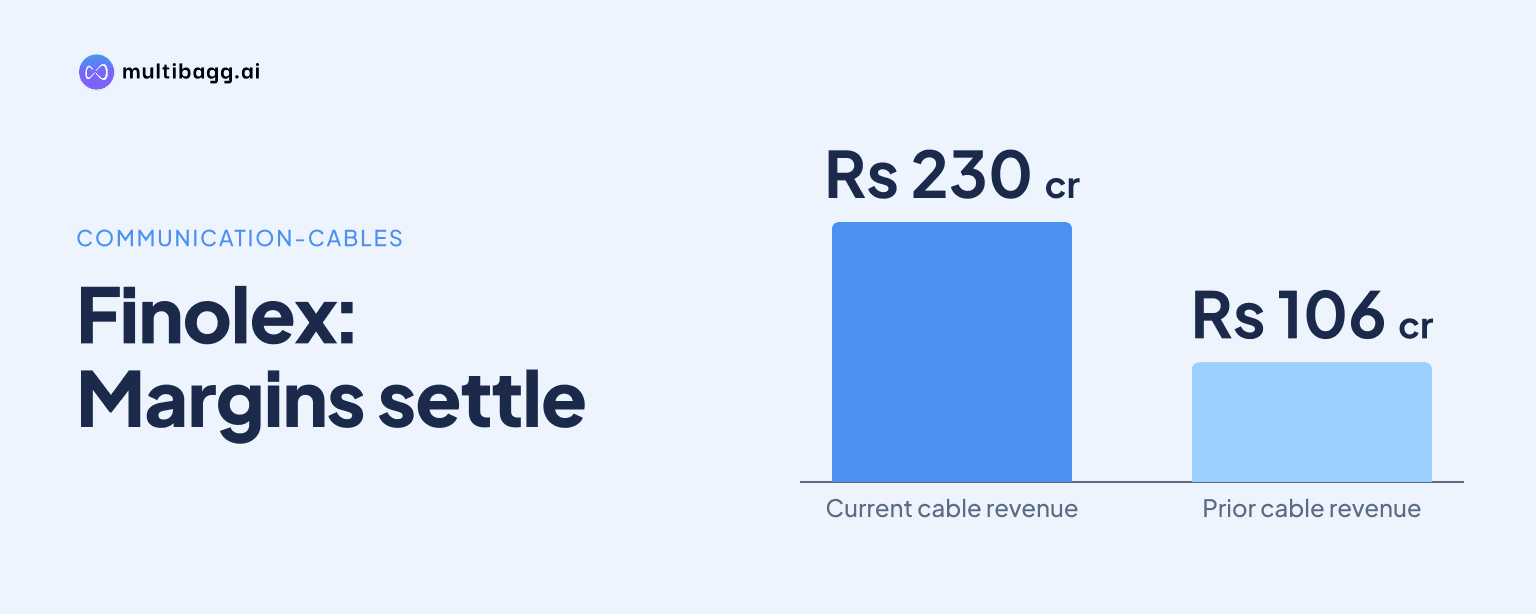
Finolex Cables Limited said in the reported quarter that communication-cable earnings before interest and tax, or EBIT, margins near 30% will eventually normalise to the mid-teens, after segment revenue reached Rs 230 crore and EBIT about Rs 69 crore. Management attributed the current level to higher fibre prices and constrained overseas supply.
Know Finolex Cables inside out
Results, valuation, peers and who's buying, in one view.
What margin does Finolex Cables expect for communication cables?
Finolex Cables expects communication-cable EBIT margin to settle in the mid-teens over time rather than remain near 30%. Management said the sharp increase in fibre prices during the previous six to eight months was the key reason for current profitability and that this pricing environment was not likely to persist for a long period.
Management did not set a deadline for the decline. It said margin normalisation might take a couple of quarters, but could also start tomorrow, after three months or after six months, depending on individual opportunities and the global demand-supply balance for fibre and preform. In a later clarification, management confirmed that its mid-teens view applied to the segment as a whole, including product mix and planned preform integration.
When an analyst asked whether preform and data-centre cable opportunities could instead support a sustained margin in the early 20s, management declined to endorse that range. It said segment margin could be above or below 15%, depending on product design, the availability of global capacity and the timing of hyperscaler expansion in India. Its stated outlook therefore remained the mid-teens.
Why did Finolex Cables’ communication-cable margin approach 30%?
Finolex Cables’ communication-cable revenue rose 116% year on year to Rs 230 crore from Rs 106 crore, while segment EBIT increased to about Rs 69 crore from Rs 1.2 crore. Management also said revenue grew about 30% over the preceding quarter, showing that the reported-quarter profit increase accompanied a substantial increase in sales.
The relationship between reported EBIT of about Rs 69 crore and revenue of Rs 230 crore equates to roughly 30%, consistent with the margin cited by the analyst on the call. Management’s explanation was that a sudden fibre-price increase, rather than a permanent change in segment economics, drove the result.
Volume also contributed to the expansion. Management said optical-fibre volume increased about 25% year on year and 30% quarter on quarter, with the quarter-on-quarter gain largely arising from volume. It separately said standard preform prices had stabilised somewhat compared with the first quarter and the fourth quarter of the prior year, while exotic preform grades remained expensive.
How long could overseas shortages support Finolex Cables’ margins?
Finolex Cables said restricted overseas supply of both fibre and preform could support elevated prices for some time, but it could not forecast when the market would rebalance. Management said some global majors had indicated their production lines were booked until the end of 2027, potentially requiring buyers without secured allocations to pay higher prices for available material.
Management described the route to normalisation as a supply-chain adjustment rather than a company-set quarterly target. Global suppliers are working to reorganise internal supply chains to serve demand more consistently, it said, and prices could return towards normal levels once supply becomes sufficiently resilient. The timing remains uncertain because demand, available capacity and supplier responses can change rapidly.
Exports formed part of the reported-quarter communication-cable mix. Management estimated export revenue at about Rs 25 crore to Rs 28 crore out of total segment revenue of Rs 230 crore, and said Finolex Cables supplied Malaysia, Europe and the United States during the quarter. It also confirmed that overseas inquiries were increasing, without disclosing an export order-book value.
Management said it was booked for another quarter and a half when asked about order visibility. That visibility sits alongside the wider overseas supply constraint, but management did not connect the order-book period to a specific EBIT-margin outcome. Its margin guidance remained conditional on whether global fibre and preform supply catches up with demand.
Got a follow-up? Ask IRIS
Can preform expansion lift Finolex Cables’ long-term margin?
Finolex Cables said backward integration into preform should be margin accretive in principle, but it did not quantify the benefit or raise its mid-teens segment-margin outlook. Management said in-house preform would reduce dependence on third-party suppliers and improve supply-chain management for optical-fibre production.
The other stated benefit is greater flexibility in tender quotations. Management noted that engineering, procurement and construction, or EPC, companies have increasingly participated in BharatNet tender cycles, and said the most recent round had aggressive pricing. Access to preform could give Finolex Cables more flexibility in such projects while retaining a portion of the value created by backward integration.
The company’s stated expansion plan is fibre capacity of about 8 million kilometres, preform capacity equivalent to 4 million kilometres of fibre, and cabling capacity between 12 million and 15 million kilometres. Management said most of the programme’s funds had already been spent and that the overall capacity outcome was expected in about seven to eight months.
Management also said 4 million kilometres of fibre capacity was under testing, with machines installed but formal handover pending certification. It said fibre capacity would be 8 million kilometres by the end of the year. No decision had been made on a further increase from 8 million kilometres to 12 million kilometres or 16 million kilometres.
What working-capital factors could affect Finolex Cables’ profitability?
Finolex Cables said inventory at the September closing date was temporarily elevated and should normalise by the end of the current quarter. Management said material that otherwise would have been bought in October was purchased in late September to complete casting within October, leaving additional inventory on the books at period end.
Inventory value also increased when commodity prices touched Rs 14,500, although management did not specify the commodity’s unit in the call. Total inventory days were slightly above 70 at quarter-end, compared with the company’s usual range of about 60 to 65 days. The measure covers raw material, semi-finished goods, finished goods and branch inventory.
Receivable days increased to 18 from 15, against a historical range of roughly 16 to 17 days. Management said sales completed in the final days of a month can remain outstanding at period end. It also said its channel model generally operates without credit and that it aims to purchase material for monthly consumption rather than take long positions in volatile commodity markets.
A significant fall in commodity prices could create an inventory-related margin effect. Management said a 10% price change would trigger a selling-price correction, and that a substantial commodity-price reduction would result in margin loss to the extent of inventory held. It did not expect a substantial short-term change in consumption solely because prices fall.
Conclusion
Finolex Cables’ reported-quarter communication-cable EBIT of about Rs 69 crore on Rs 230 crore of revenue reflects higher fibre prices, supply constraints, volume growth and export sales of about Rs 25 crore to Rs 28 crore. Management’s central message is that the near-30% segment EBIT margin is temporary, with the mid-teens its stated normalised range.
The next developments to watch are whether global fibre and preform supply remains restricted, the conversion of rising overseas inquiries, and the completion of capacity projects. Management said fibre capacity should reach 8 million kilometres by the end of the year, while the broader fibre, preform and cabling expansion was expected to reach its planned scale in about seven to eight months.