










Finolex Cables to double solar cable capacity from April
Key highlights
- Finolex Cables plans to raise solar cable capacity from 5,000 km to 10,000 km per month from April.
- The solar cable expansion equipment is on order and is expected around early January.
- Management said installation of the solar cable equipment will take a couple of months.
- Finolex Cables did not disclose solar cable revenue, utilisation, order book, pricing or margins on the call.
powered by IRIS
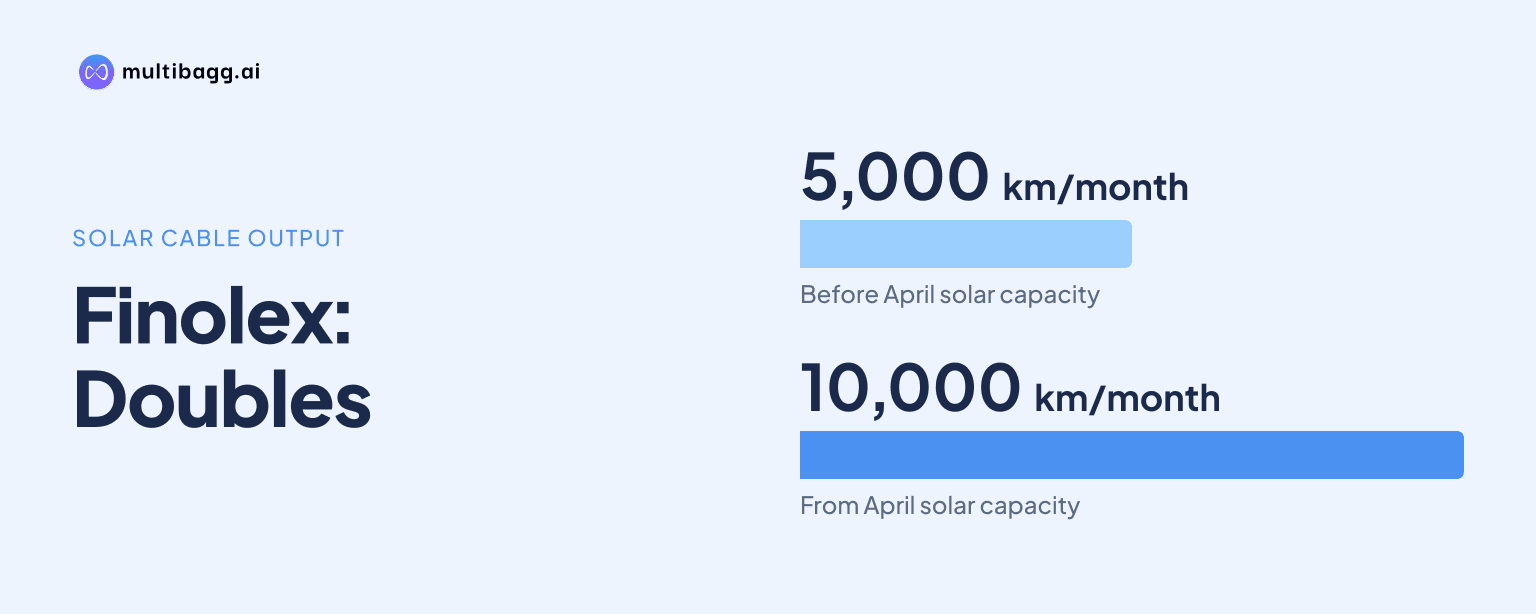
Finolex Cables plans to double solar cable capacity to 10,000 km a month from April, from about 5,000 km a month currently. Management said the required equipment is already on order, expects delivery around early January, and estimates installation will take a couple of months.
Know Finolex Cables inside out
Results, valuation, peers and who's buying, in one view.
When will Finolex Cables reach 10,000 km of monthly solar cable capacity?
Finolex Cables expects its solar cable capacity to reach 10,000 km a month from April. Management said the equipment is expected around early January and that installation will take a couple of months, establishing the delivery and installation sequence behind the April target.
The call did not give a separate commissioning date, testing timetable or production ramp-up schedule between early January and April. It also did not state whether the additional 5,000 km a month will be available all at once at the start of April or built up during that month.
Management’s stated milestone is therefore capacity availability from April, rather than a forecast for output or sales in that month. The company did not disclose solar cable utilisation at the existing 5,000-km monthly capacity, which means the call does not show the volume increase that may follow the expansion.
How much solar cable capacity is Finolex Cables adding?
Finolex Cables is adding 5,000 km a month of solar cable capacity, equal to its existing capacity of about 5,000 km a month. The planned 10,000-km monthly level is therefore double the present capacity identified by management.
These figures refer to manufacturing capacity, not reported sales, dispatches or booked orders. Finolex Cables did not disclose solar cable revenue, average selling prices, segment margin, customer count or order-book coverage in the call.
The expansion differs from a demand estimate because it is tied to equipment that management said was already on order. The company did not disclose the cost of that equipment, the amount paid so far, or whether the solar cable investment forms part of the funds previously discussed for fibre and communication cable expansion.
What solar cable demand information did Finolex Cables disclose?
Finolex Cables did not provide a solar cable demand forecast, order book or customer commitment when it disclosed the April capacity plan. Management responded to an analyst’s question on potential solar-project development by setting out the capacity increase from 5,000 km to 10,000 km a month.
The analyst referred to possible captive solar installations of 50 gigawatts to 100 gigawatts by large corporates and cited hydrogen and data centres as possible demand drivers. Those figures were part of the analyst’s question, not management guidance, a Finolex Cables target or a contracted opportunity.
Management also did not identify the intended end market for the additional 5,000 km a month. The call does not say whether the solar cable capacity will primarily serve utility-scale solar projects, captive plants, data-centre projects, hydrogen-linked facilities or another customer segment.
That distinction limits the financial conclusions that can be drawn from the April target. Capacity is scheduled to double, but the source does not provide a solar cable volume outlook, pricing assumption or margin expectation that would translate 10,000 km a month into revenue or profit.
Got a follow-up? Ask IRIS
How does the solar cable expansion compare with Finolex Cables’ fibre plans?
Finolex Cables’ solar cable plan is separate from its disclosed expansion in fibre, preform and communication cable operations. Management said fibre capacity would reach about 8 million km a year, preform capacity would reach the equivalent of 4 million km of fibre, and cabling capacity would rise to between 12 million km and 15 million km in about seven to eight months.
The 12 million km to 15 million km cabling range was discussed in the context of fibre and related products and should not be added to the solar cable target. Solar cable is measured at 5,000 km and 10,000 km per month, while the other disclosed capacities use annual measures and cover different products.
Management said most funds for the fibre-related expansion had already been spent, with some amount still pending. It gave no comparable funding status for the solar cable equipment, beyond saying that the equipment was on order and should arrive around early January.
What must happen before Finolex Cables can operate the expanded line?
Finolex Cables must receive, install and commission the ordered equipment before its April capacity target can be achieved. The company expects delivery around early January and allowed a couple of months for installation, making execution of those two steps the disclosed condition for reaching 10,000 km a month.
The call did not identify any further solar cable capacity expansion beyond the April plan. In a separate discussion about increasing fibre capacity beyond 8 million km a year, management said viability would need to be studied and that no decision had been made, but that statement concerned fibre rather than solar cable.
Solar cable order visibility was also not provided. Management said it was booked for another quarter and a half during the communication cable discussion, but it did not say that this booking position applied to solar cable, so it cannot be treated as solar cable demand coverage.
The relevant near-term milestones are thus equipment delivery around early January, installation over the following couple of months and capacity availability from April. The source provides clearer evidence on the physical expansion timetable than on utilisation, customer demand or the financial contribution of the added 5,000 km a month.
Conclusion
Finolex Cables has set a defined solar cable expansion plan: capacity would rise by 5,000 km a month to 10,000 km a month from April. This is a separate initiative from the company’s fibre plan for 8 million km a year and its communication cabling target of 12 million km to 15 million km.
The next item to watch is delivery of the ordered equipment around early January, followed by installation over a couple of months. Finolex Cables has not disclosed solar cable utilisation, orders, revenue, pricing or margins, so an update on commissioning and line use after the April target would clarify the commercial outcome.