










FirstCry India revenue growth hits 18.6%, eight-quarter high
Key highlights
- FirstCry India multichannel revenue rose 18.6% year on year to Rs 163.79 crore in Q2 FY27.
- FirstCry RocketBees expanded to 102 cities and handled more than 60% of online shipments in Q2 FY27.
- FirstCry Qwik processed about 250,000 shipments in September across 16 cities, approximately twice its June volume.
- FirstCry offline GMV grew 14.0% in H1 FY27, compared with 4.8% in H1 FY26.
powered by IRIS
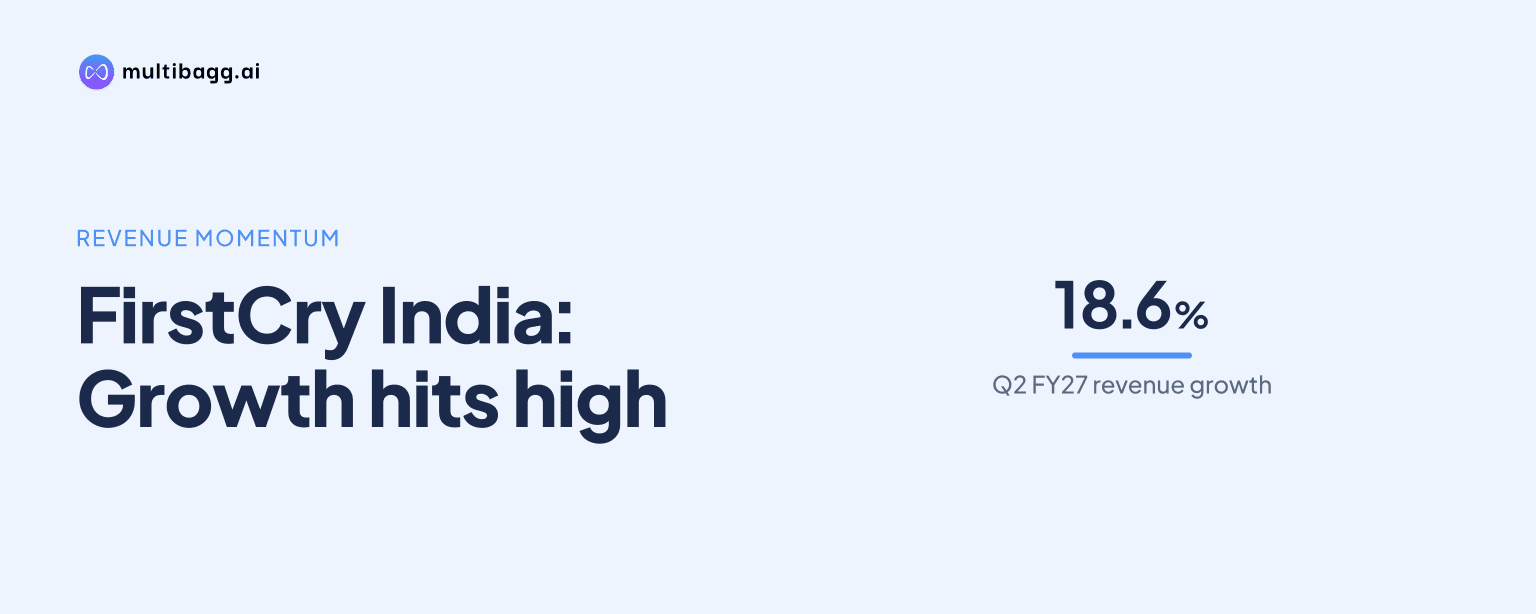
FirstCry reported India multichannel revenue growth of 18.6% year on year in Q2 FY27, its highest rate in eight quarters, with revenue reaching Rs 163.79 crore. Orders rose 13% to 11.5 million, while RocketBees expanded to 102 cities and FirstCry Qwik processed about 250,000 shipments in September.
Know Brainbees Solutions inside out
Results, valuation, peers and who's buying, in one view.
How quickly did FirstCry India multichannel revenue grow?
FirstCry India multichannel revenue grew 18.6% year on year to Rs 163.79 crore in Q2 FY27 from Rs 138.11 crore in Q2 FY26. The rate increased from 7.5% in Q1 FY26 and 11.4% in Q4 FY26 to 17.7% in Q1 FY27, before reaching 18.6% in Q2 FY27. FirstCry described the Q2 rate as its strongest India multichannel revenue growth in the last eight quarters.
Growth in gross merchandise value, or GMV, was slower at 9% year on year, with India multichannel GMV reaching Rs 257.54 crore from Rs 236.30 crore. GMV is the monetary value of orders, including taxes and gross of discounts, before product returns. FirstCry separately said online revenue, net of discounts, returns and taxes, grew by more than 10% year on year, the strongest rate in six quarters.
FirstCry recorded 11.6 million annual unique transacting customers, or AUTC, in Q2 FY27, compared with 10.5 million a year earlier. Orders increased 13% to 11.5 million, which FirstCry said was the strongest order-growth rate in six quarters. Average order value was Rs 2,231, compared with Rs 2,309 in Q2 FY26. The non-diapering portfolio accounted for about 85% of GMV, while the company said diapering competition had started to soften.
Why did FirstCry GMV growth trail revenue growth?
FirstCry’s 9% GMV growth trailed its 18.6% revenue growth because the measures use different definitions, and the presentation does not give a single quantified explanation for the difference. GMV is inclusive of taxes and gross of discounts, while FirstCry describes online revenue as net of discounts, returns and taxes. The two growth rates therefore cannot be read as directly comparable measures of the same sales base.
Online GMV rose 8.0% to Rs 199.85 crore in Q2 FY27 from Rs 185.18 crore in Q2 FY26. Offline GMV increased 12.9% to Rs 57.69 crore from Rs 51.11 crore, making offline growth faster than online growth during the quarter. FirstCry said Q2 growth would have been stronger if Dussehra had not fallen three weeks later in the year, shifting some festive sales from September 2026 to October 2026.
Offline GMV growth accelerated to 14.0% in H1 FY27 from 4.8% in H1 FY26 after changes to product assortment. FirstCry cited greater depth in frequently chosen products and accessible entry prices, which it said supported footfall and conversion. The modern-store network nevertheless declined by 10 locations year on year to 1,188 stores in September 2026, including 659 FirstCry franchise-owned and franchise-operated stores and 529 company-owned and company-operated stores.
Got a follow-up? Ask IRIS
How is FirstCry using RocketBees and Qwik to improve delivery?
FirstCry expanded RocketBees, its dedicated delivery network, to 102 cities in Q2 FY27 from 13 cities in Q2 FY26. RocketBees handled more than 60% of online shipments and reduced turnaround time by about 20%, according to FirstCry. The company also reported more than 90% on-time delivery, 50% fewer return-to-origin shipments and 60% fewer delivery-related complaints.
FirstCry said online transaction-frequency cohorts in RocketBees-served cities improved by more than 10%, contributing to an overall improvement of more than 5% year on year. Coverage grew from 22 cities in Q3 FY26 and 62 in Q4 FY26 to 72 in Q1 FY27 and 102 in Q2 FY27. The presentation does not quantify the portion of revenue growth directly attributable to RocketBees.
FirstCry Qwik expanded from a three-city pilot in Q3 FY26 to 16 cities in Q2 FY27. The rapid-delivery service processed about 250,000 shipments in September, approximately twice the roughly 125,000 shipments in June and more than four times the roughly 60,000 shipments in March. Qwik offers delivery in one to three hours for a mother, baby and kids assortment in selected locations.
What happened to FirstCry India multichannel margins and costs?
FirstCry India multichannel adjusted earnings before interest, tax, depreciation and amortisation, or adjusted EBITDA, declined to Rs 11.22 crore in Q2 FY27 from Rs 12.54 crore in Q2 FY26. The adjusted EBITDA margin decreased to 6.9% from 9.1% despite the 18.6% revenue increase. In H1 FY27, adjusted EBITDA was Rs 19.57 crore, compared with Rs 23.21 crore in H1 FY26, and the margin was 6.3% versus 8.9%.
Gross margin was 33.9% in Q2 FY27, down from 37.0% in Q2 FY26, although FirstCry said online and offline gross margin improved by about 100 basis points from Q3 FY26. A basis point is one-hundredth of a percentage point. Management attributed manufacturing-margin pressure to higher crude-linked raw-material costs, citing crude oil at US$108.5 per barrel in October 2026 against US$63 in October 2025.
Direct cost represented 8.7% of revenue in Q2 FY27, compared with 8.5% a year earlier. Marketing cost fell to 4.7% from 5.5%, while indirect cost, which includes salary and other selling, general and administrative costs but excludes employee stock option plan cost, declined to 13.6% from 13.9%. Management said stabilisation in crude prices would allow customer pricing to catch up and support margin recovery, without providing a timetable or target.
Conclusion
FirstCry’s Q2 FY27 disclosures show India multichannel revenue accelerating faster than GMV, alongside a 13% increase in orders and faster offline GMV growth than online GMV. RocketBees’ 102-city network and Qwik’s 250,000 September shipments form part of the company’s delivery and convenience initiatives, while assortment changes coincided with 14.0% offline GMV growth in H1 FY27.
The next results will indicate whether management’s expectation of continued online and offline growth momentum is met after festive demand shifted into October 2026. Investors can watch GMV growth relative to revenue growth, Qwik’s rollout beyond 16 cities, RocketBees’ share of online shipments above 60%, and management’s disclosed condition for margin recovery: crude-cost stabilisation and customer-price catch-up.