










FirstCry International Business cuts Q2 EBITDA loss margin
Key highlights
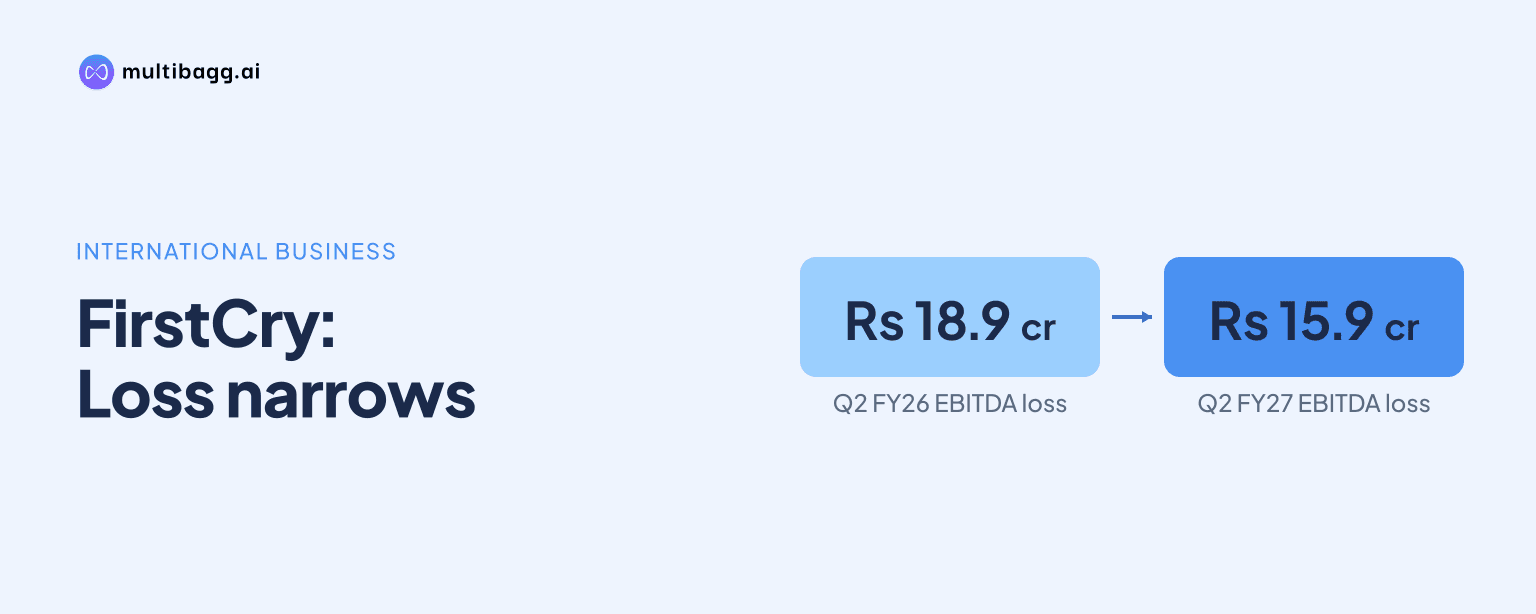
- International Business reduced its Q2 FY27 Adjusted EBITDA loss to Rs 15.9 crore from Rs 18.9 crore a year earlier.
- Q2 FY27 gross margin increased to 28.5% from 26.3% in Q2 FY26.
- H1 FY27 revenue rose to Rs 481.4 crore from Rs 443 crore, while the Adjusted EBITDA loss narrowed to Rs 32.6 crore.
- Q2 FY27 GMV increased 10% year on year to Rs 502.1 crore.
powered by IRIS
FirstCry International Business cut its adjusted earnings before interest, tax, depreciation and amortisation (Adjusted EBITDA) loss margin to 6.4% of revenue in Q2 FY27 from 8.0% in Q2 FY26, as gross margin increased to 28.5% from 26.3%. Revenue rose 5.8% year on year to Rs 249.3 crore despite reported geopolitical disruptions in the Middle East business.
Know Brainbees Solutions inside out
Results, valuation, peers and who's buying, in one view.
Why did International Business reduce its Q2 FY27 loss margin?
International Business reduced its Q2 FY27 Adjusted EBITDA loss to Rs 15.9 crore from Rs 18.9 crore in Q2 FY26, reducing the loss margin by 1.6 percentage points to 6.4% of revenue. The presentation said the absolute loss declined 15.9% year on year, while the business remained loss-making during the quarter.
Revenue reached Rs 249.3 crore in Q2 FY27, compared with Rs 235.7 crore a year earlier. That represented 5.8% growth, slower than the 13.3% year-on-year growth reported in Q2 FY26. Management said the Middle East business delivered 6% revenue growth despite geopolitical disruptions and has higher potential in a stable environment.
How did International Business improve gross margin?
International Business increased Q2 FY27 gross margin by 2.2 percentage points to 28.5%, from 26.3% in Q2 FY26. Gross profit rose to Rs 70.9 crore from Rs 62 crore, while revenue increased by Rs 13.6 crore over the same comparison, contributing to the smaller Adjusted EBITDA loss.
Management said the improving gross margin demonstrates the use of its India playbook in the international operation. Its disclosed margin levers are a higher home-brand mix, higher-margin category and brand selection, customer-acquisition quality and retention, and operating leverage as revenue grows. These are operating mechanisms, not numerical targets or a stated break-even date.
The quarterly gross-margin trend also improved sequentially, rising from 27.7% in Q1 FY27 to 28.5% in Q2 FY27. Revenue increased from Rs 232.1 crore in Q1 FY27 to Rs 249.3 crore in Q2 FY27, while the Adjusted EBITDA loss narrowed from Rs 16.7 crore to Rs 15.9 crore.
What changed in International Business costs during H1 FY27?
International Business reduced its H1 FY27 Adjusted EBITDA loss margin to 6.8% from 9.1% in H1 FY26, while revenue increased to Rs 481.4 crore from Rs 443 crore. The six-month Adjusted EBITDA loss narrowed to Rs 32.6 crore from Rs 40.4 crore, and gross margin improved to 28.1% from 25.7%.
Marketing cost was the only disclosed cost category that declined as a share of revenue, falling to 9.4% in H1 FY27 from 9.8% in H1 FY26. Its rupee cost still increased to Rs 45.2 crore from Rs 43.4 crore. Direct cost rose to 8.8% of revenue from 8.5%, and indirect cost increased to 16.7% from 16.5%.
Indirect cost was Rs 80.2 crore in H1 FY27, against Rs 73 crore in H1 FY26. The presentation defines indirect cost as salary and other selling, general and administrative costs, excluding employee stock option plan cost. Gross profit grew to Rs 135.2 crore from Rs 113.6 crore across the two half-year periods.
Got a follow-up? Ask IRIS
What do International Business customer and GMV trends show?
International Business reported gross merchandise value (GMV) of Rs 502.1 crore in Q2 FY27, up 10% year on year from Rs 456.3 crore. The company defines GMV as the monetary value of orders, including taxes and before product returns, gross of discounts where applicable, across its FirstCry websites and mobile application.
The 10% GMV growth rate was higher than the 5.8% reported revenue growth rate in Q2 FY27. Q1 FY27 GMV was Rs 426.3 crore, so GMV increased by Rs 75.8 crore sequentially in Q2 FY27. The presentation does not separately explain the difference between the GMV and revenue growth rates.
AUTC, as reported by the company, was 0.55 million in Q2 FY27, compared with 0.52 million in Q2 FY26. Its year-on-year growth rate was 5.5%, below the 11.9% growth rate reported for AUTC in Q2 FY26. The displayed orders metric was 0.52 million in both Q2 FY26 and Q2 FY27.
How far has International Business progressed toward profitability?
International Business improved its Adjusted EBITDA margin from a 25% loss in FY23 to a 10% loss in FY26, followed by a 7% loss in H1 FY27. The reported annual Adjusted EBITDA loss was Rs 120.1 crore in FY23, Rs 139.6 crore in FY24, Rs 140.1 crore in FY25 and Rs 90.7 crore in FY26.
The loss amount increased between FY23 and FY25 before falling in FY26. In the more directly comparable half-year periods, the Adjusted EBITDA loss reduced by Rs 7.8 crore to Rs 32.6 crore in H1 FY27 from Rs 40.4 crore in H1 FY26. The corresponding margin improved by about two percentage points, from 9% to 7%.
International Business did not disclose a target date for Adjusted EBITDA break-even. Management instead linked further progress to home-brand mix, category and brand selection, customer-acquisition quality, customer retention and operating leverage as revenue grows.
Conclusion
International Business reported a smaller Q2 FY27 Adjusted EBITDA loss while revenue rose to Rs 249.3 crore and gross margin reached 28.5%. Compared with Q2 FY26, revenue increased by Rs 13.6 crore, gross profit increased by Rs 8.9 crore and the Adjusted EBITDA loss declined by Rs 3 crore, despite the geopolitical disruption management identified.
The next reported periods will show whether the 28.5% Q2 FY27 gross margin and 6.4% loss margin can be sustained. The disclosed matters to watch are the effect of geopolitical conditions on the UAE and KSA operation, and management’s stated levers of home-brand mix, category selection, retention and operating leverage; the presentation gives no profitability target date.