










Five-Star Business Finance Limited expects margin compression
Key highlights
- Five-Star Business Finance raised fresh-loan rates by about 1%, moving them to roughly 22.5%-23.9%.
- Five-Star expects book funding cost to rise 12-15 basis points by the end of FY27, reaching about 8.90%.
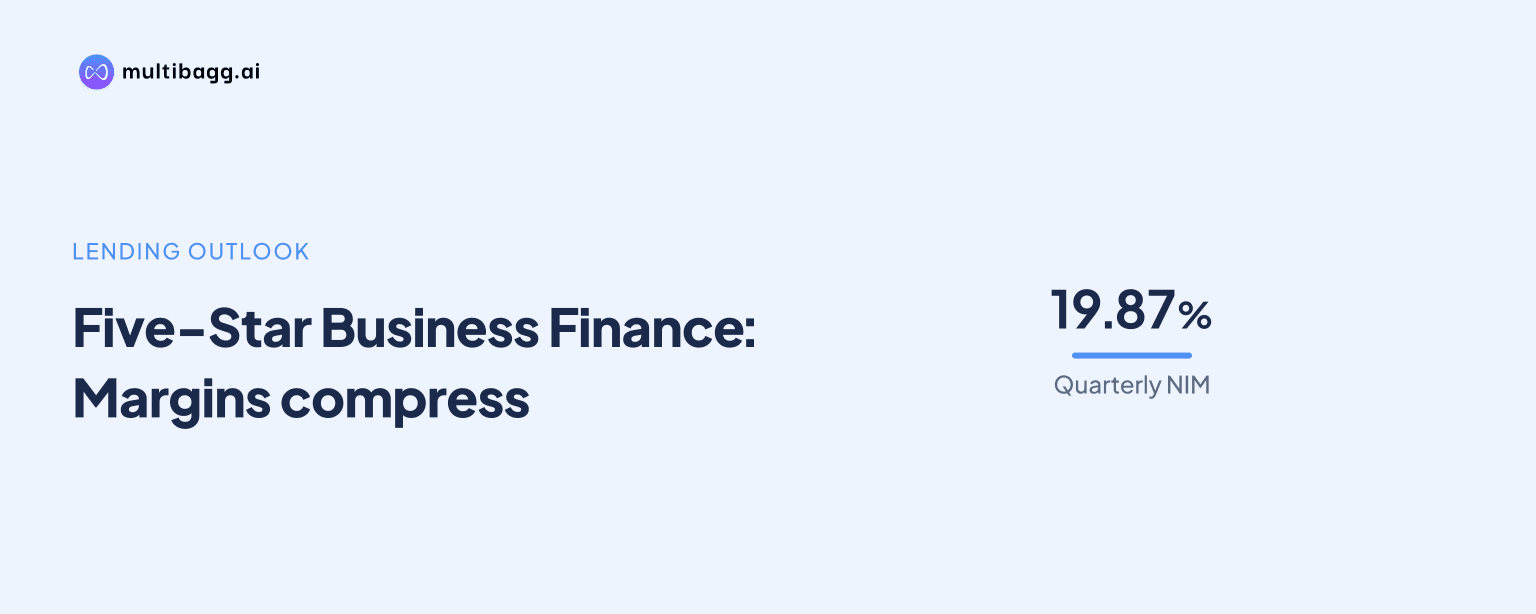
- Five-Star reported a quarterly NIM of 19.87% and a yield of 22.26%.
- Five-Star expects its operating-expense ratio to decline by 50-75 basis points to 6.75%-7% over the next couple of years.
powered by IRIS
Five-Star Business Finance Limited has increased rates on fresh loans by about 1%, but management expects margins to compress as borrowing costs reprice faster than the higher yields reach the fixed-rate loan book. Management expects book funding cost to rise by 12-15 basis points by the end of FY27, while the pricing benefit builds over 24-36 months.
Know Five-Star Business Finance inside out
Results, valuation, peers and who's buying, in one view.
Why will Five-Star's margins compress despite higher new-loan rates?
Five-Star expects margin compression because its existing borrowings are exposed to higher benchmark rates while its outstanding loan book cannot be repriced. Management said liabilities linked to the repo rate, external benchmarks and the marginal cost of funds-based lending rate, or MCLR, are already reflecting the tighter rate cycle, whereas the 1% lending-rate increase applies only to fresh disbursements.
Management estimated that a 25-basis-point repo-rate increase could otherwise have raised overall funding cost by at least 20 basis points. The new pricing is expected to reduce that impact to about 10-15 basis points, but not eliminate it. In response to an analyst's estimate of 8-10 basis points of net spread moderation in the half year, management said the framing was broadly right, with funding-cost pressure of about 10-12 basis points.
How much has Five-Star raised rates on fresh loans?
Five-Star has raised incremental lending rates by about 1% across customer risk categories. Management said rates that had broadly ranged from 21% to 23% would now be around 22.5% to 23.9%, with pricing varying by ticket size, borrower credit score, priority-sector lending eligibility and other risk parameters.
The increase does not apply to loans already outstanding. Five-Star reported a yield of 22.26% for the quarter and agreed with an analyst that the yield had likely bottomed out. Portfolio yield can rise only as new, higher-yielding disbursements replace repayments from the older fixed-rate portfolio.
When will Five-Star's higher loan yields affect the portfolio?
Five-Star expects a large part of the 1% yield increase to reach the portfolio over 24-36 months, rather than in FY27. Management said the existing book is fixed-rate and that the higher pricing on fresh loans would take roughly eight quarters to be absorbed meaningfully at the overall-book level.
The transmission speed will depend on new disbursements relative to the existing portfolio. Management referred to a loan book of about Rs 15,000 crore when explaining the yield transition, while reported assets under management, or AUM, were Rs 14,640 crore on September 30. It expects disbursements during the next two years to exceed the current book, which would increase the share of loans written at the revised pricing.
Got a follow-up? Ask IRIS
What is driving Five-Star's funding-cost increase?
Five-Star expects its incremental borrowing cost to rise by another 20-25 basis points to 8.70%-8.75% in the second half. Management cited planned sizeable borrowings and the second tranche of Asian Development Bank funding, for which hedging costs remained higher, as reasons for the expected increase.
About 70% of Five-Star's borrowings are variable-rate, according to management. Roughly 25% is MCLR-linked, 30%-35% is linked to the repo rate and Treasury bills, and 15%-18% is tied to the Secured Overnight Financing Rate, or SOFR, and other external benchmarks. MCLR-linked loans reset with a lag, based on their repricing windows, extending the effect of prior rate changes.
Five-Star raised Rs 825 crore of incremental debt during the quarter at an all-inclusive cost of 8.43%, including interest and processing fees amortised over the life of the liability. Management said the 12-15-basis-point increase in book cost assumed the 25-basis-point repo-rate rise already seen; another 25 or 50 basis points of policy tightening would add further pressure.
What does the outlook mean for Five-Star's profitability?
Five-Star reported a net interest margin, or NIM, of 19.87% for the quarter, alongside a yield of 22.26%. Management did not set a revised NIM target, but said the expected rise in funding cost would compress margins because the new-lending yield increase cannot immediately change returns on the outstanding fixed-rate book.
Profit after tax was Rs 299 crore in the quarter, including a one-time item. Management put profit excluding that item at about Rs 281 crore, 3% higher sequentially. Return on average assets was 8.39%, up 28 basis points sequentially, and return on equity was 15.25%, showing the reported profitability level before the full funding-cost increase expected by the FY27 exit.
Can operating leverage reduce Five-Star's cost burden?
Five-Star expects operating leverage to lower its operating-expense ratio over the next couple of years, although management did not say it would offset the near-term margin pressure. The operating-expense ratio was about 7.5% in the quarter and 7.35%-7.40% for the year to date; management expects it to decline by 50-75 basis points to 6.75%-7% over the next couple of years.
Collection and legal-infrastructure costs have been fully absorbed, management said, so it does not expect further increases from those specific investments. Cost-to-income, including credit costs, was a little above 47% in the quarter. Five-Star added 19 branches in the quarter and 75 over the preceding year, while disbursements rose 74% year on year and AUM increased 14%.
Conclusion
Five-Star's revised pricing provides a partial buffer against rising liabilities, but the timing mismatch remains decisive: fresh loans earn about 1% more immediately, while book funding cost is projected to rise 12-15 basis points by the FY27 exit. The reported 19.87% NIM will therefore face pressure until new disbursements form a larger share of the portfolio.
The next variables to watch are the Central Bank's policy action in December or thereafter and the pace of fresh disbursements. Management said an additional 25 or 50 basis points of repo-rate increases would further affect funding cost, and it may provide revised AUM guidance after Q3 if needed.