










Five-Star expects to beat guidance after record disbursals
Key highlights
- Five-Star reported record Q2 FY27 disbursals of Rs 2,078 crore, up 74% year on year and 39% sequentially.
- Assets under management reached Rs 14,640 crore at September 30, 2026, up 14% year on year and 6.7% sequentially.
- Unique customer collection efficiency improved to 98.2%, while 30-plus days past due declined to 11.5% from 12.38% in Q1 FY27.
- Q2 FY27 profit after tax rose 5% year on year to Rs 299 crore, including a one-time tax benefit of Rs 19 crore.
powered by IRIS
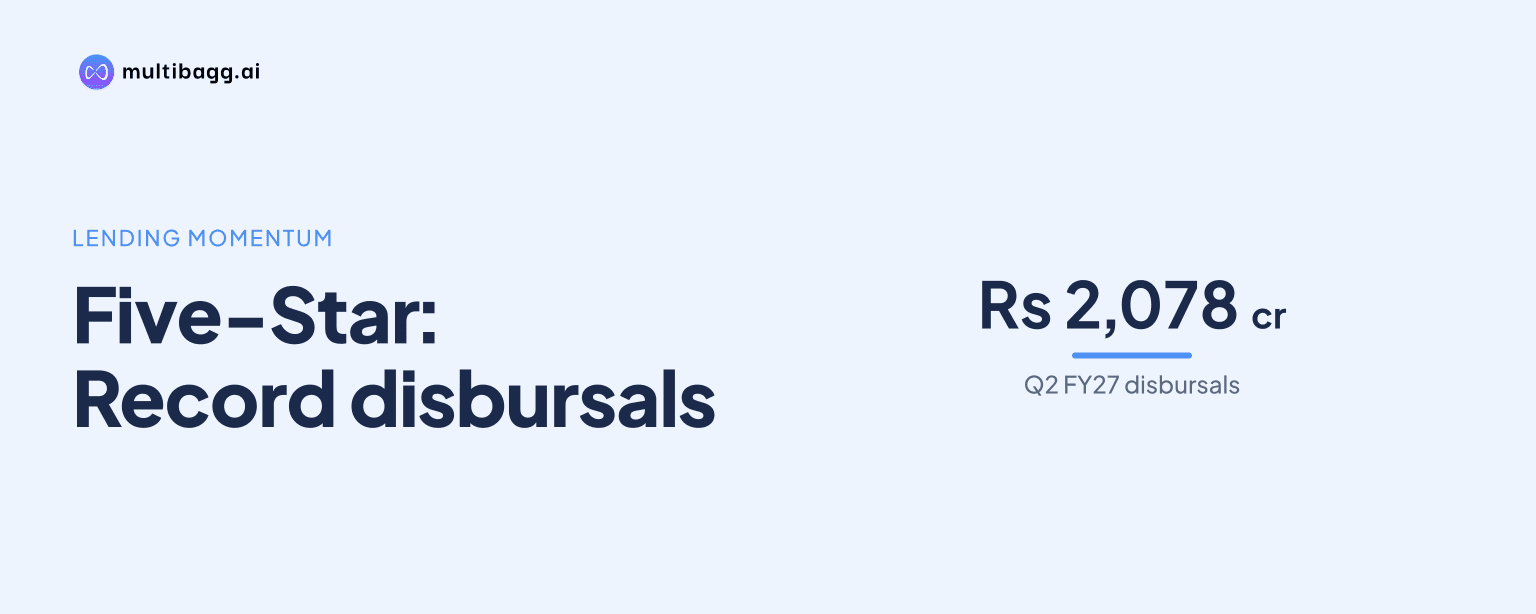
Five-Star Business Finance Limited recorded its highest quarterly disbursals of Rs 2,078 crore in the quarter ended September 30, 2026, rising 74% year on year and 39% sequentially. With collection efficiency improving to 98.2% and assets under management reaching Rs 14,640 crore, management said it expects to exceed FY27 growth guidance.
Know Five-Star Business Finance inside out
Results, valuation, peers and who's buying, in one view.
Why did Five-Star's disbursals rise to a record?
Five-Star’s record disbursals reflected a return in lending momentum alongside improving collections. The Rs 2,078 crore disbursed in Q2 FY27 was its historical best, according to management, and represented a 39% increase from Q1 and a 74% increase from the comparable quarter a year earlier. Management linked the acceleration to its focus on restoring growth after challenges affecting both Five-Star and the wider industry.
The increased lending also lifted Five-Star’s assets under management, or AUM, to Rs 14,640 crore at September 30, 2026. That was 6.7% above the preceding quarter and 14% above a year earlier. The difference between the 74% rise in quarterly disbursals and the 14% annual AUM increase indicates that new lending accelerated faster than the outstanding loan book, which is also affected by repayments.
Five-Star had about 5.1 lakh active loans at the end of the quarter, 5% more than a year earlier. Its expansion was concentrated on deeper coverage in existing operating markets: it added 19 branches during Q2 FY27 and 75 branches over the prior 12 months. Management said the additions targeted core geographies and states where Five-Star had already built operating familiarity.
What changed in Five-Star's collections and asset quality?
Five-Star reported better collections and lower early-stage delinquency in Q2 FY27. Its unique customer collection efficiency rose to 98.2% from 97.7% in Q1, while X-bucket collections improved to 99.4% from 99.2%. Management said these collection trends helped contain forward flows, or movement of borrowers from early delinquency buckets into more severe overdue categories.
The share of AUM in the current bucket increased by 1.48 percentage points to 84.78%, while loans overdue by more than 30 days, or 30-plus days past due, declined by 0.88 percentage points to 11.5%. Slippages eased to 0.68% from 0.70%, and gross Stage-3 assets were broadly stable at 3.48%. Five-Star’s credit cost, the charge associated with expected loan losses, fell to 1.80% of average AUM from 1.85% in Q1.
The improvement was also visible in the absolute stock of Stage-2 assets. These assets stood at Rs 1,173 crore at September 30, 2026, down from about Rs 1,225 crore a year earlier, despite the larger AUM base. Five-Star said its provision coverage ratio, or PCR, was about 40% for Stage-3 assets and 1.73% of overall AUM. Management expects slippages and credit cost to remain broadly flat through the rest of FY27.
Got a follow-up? Ask IRIS
Will Five-Star exceed its annual growth guidance?
Management said Five-Star is poised to exceed its FY27 growth guidance, but it did not disclose a revised numerical target on the call. The basis for that view was the Rs 2,078 crore Q2 FY27 disbursal run rate, collections that management described as holding up well, and AUM growth of 14% year on year at September 30, 2026. The statement is management’s outlook rather than a confirmed full-year result.
Five-Star said the recovery in collections had enabled it to focus again on growth while retaining its emphasis on controlling flows from early delinquency buckets. Management described stronger collections, contained slippages and lower credit cost as supporting continued disbursal traction in coming quarters. Five-Star ended the first half of FY27 with profit after tax, or PAT, of Rs 571 crore, up 3% year on year.
Repayment trends also affect the speed at which higher disbursals convert into AUM. Management said its adjustment of outstanding balances on selected top-up loans, subject to what it described as strong filters, had raised reported repayment rates by about 1% to 2% compared with earlier periods. It expects behavioural loan tenure to settle closer to four years, rather than exceed four years, as the top-up experience becomes more stable over the next few quarters.
How did Five-Star's profit and funding change in Q2 FY27?
Five-Star reported Q2 FY27 PAT of Rs 299 crore, up 10% sequentially and 5% year on year. The figure included a one-time tax benefit of Rs 19 crore related to previous years. Excluding that item, management said PAT was about Rs 281 crore, which was still 3% higher sequentially. Return on average assets increased by 28 basis points, or bps, to 8.39%, while return on equity rose by 79 bps to 15.25%.
Net interest margin, or NIM, was 19.87% in Q2 FY27, compared with 19.97% in Q1, but was 16 bps higher year on year. Yield was 22.26%, while the cost-to-income ratio inclusive of credit costs remained a little above 47%. Management said higher future productivity, growth and control over operating and credit costs should provide operating leverage, although it did not give a date or level for the intended reduction in that ratio.
During the quarter, Five-Star raised incremental debt of Rs 825 crore at an all-inclusive cost of 8.43%, and its cost of funds on book declined marginally to 8.78% from 8.80% in Q1. Bank borrowing represented about 69% of funding, up from 67% in the prior quarter. Liquidity was close to Rs 1,300 crore at September 30, alongside about Rs 1,100 crore of unavailed sanctions, which management said was sufficient for the next quarter’s requirements.
Management expects a tightening interest-rate cycle to raise the cost of both incremental and existing funding, creating pressure on spreads. Five-Star increased pricing on incremental lending by about 1% from October 2026, taking rates across risk categories from about 21%-23% to roughly 22.5%-23.9%. Management does not expect margin expansion in the second half; it said the repricing should instead cushion the anticipated compression in NIM.
Conclusion
Five-Star’s Q2 FY27 results show that lending growth, collections and reported profitability improved together. Record disbursals of Rs 2,078 crore were accompanied by a 14% year-on-year rise in AUM, a 98.2% collection-efficiency rate, and a decline in 30-plus days past due to 11.5%. Management therefore expects to exceed its annual growth guidance while maintaining broadly flat slippages and credit cost.
The next indicators are whether the October 2026 lending-rate increase offsets higher borrowing costs and whether collection improvement continues as disbursals remain elevated. Management also said it is progressing towards a new product and may provide more details in the next quarter, while its stated plan remains to expand through deeper presence in core geographies.