










Five-Star says top-ups make up 10%-15% of disbursals
Key highlights
- Internal top-up loans accounted for 10%-15% of Five-Star’s disbursements in the quarter ended September 30, 2026.
- Five-Star recorded September-quarter disbursements of Rs 2,078 crore, up 39% sequentially and 74% year on year.
- Assets under management reached Rs 14,640 crore on September 30, 2026, up 6.7% sequentially and 14% year on year.
- Five-Star raised pricing on new loans by about 1 percentage point from October 2026, with indicative rates moving to roughly 22.5%-23.9%.
powered by IRIS
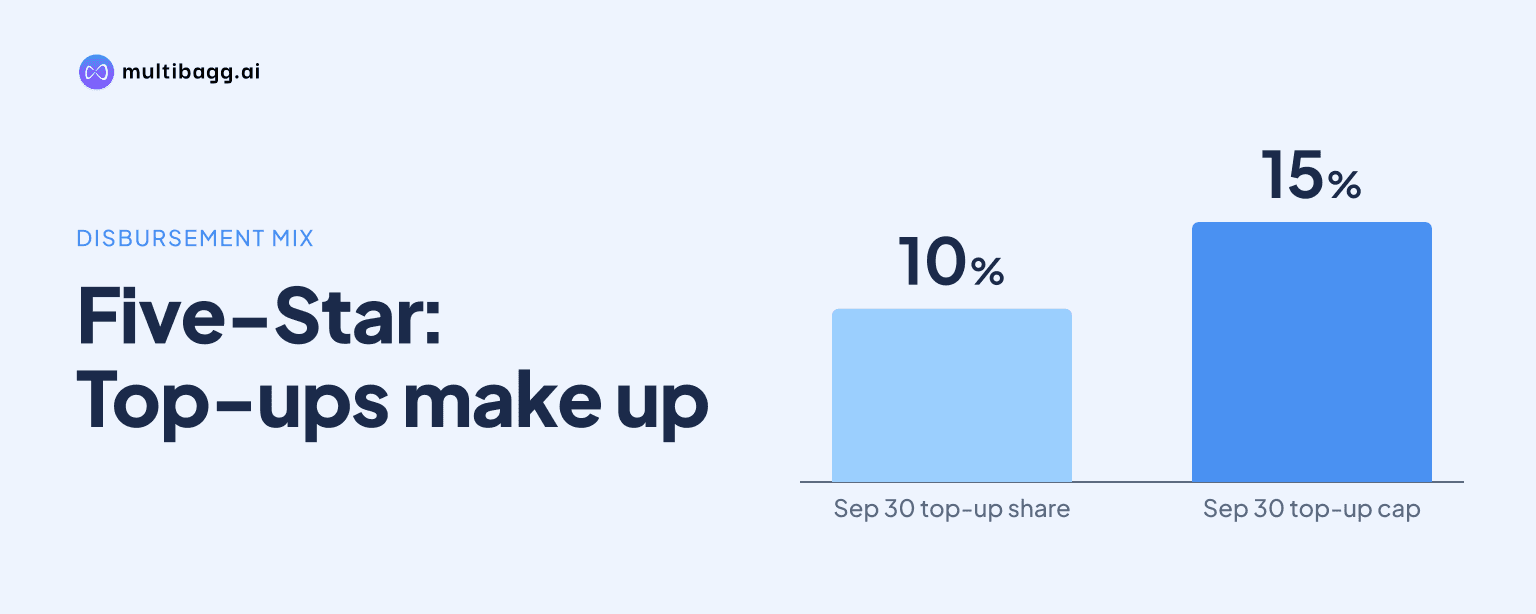
Five-Star Business Finance Limited said internal top-up loans accounted for about 10%-15% of disbursements in the quarter ended September 30, 2026. Management said top-ups are limited to current borrowers with 12-18 months of vintage, satisfactory repayment conduct and no credit-score deterioration, controls it said distinguish the product from evergreening.
Know Five-Star Business Finance inside out
Results, valuation, peers and who's buying, in one view.
What share of Five-Star disbursements comes from top-up loans?
Five-Star said top-up loans currently account for about 10%-15% of overall disbursements. The company recorded Rs 2,078 crore of disbursements in the September 2026 quarter, its historical best, up 39% from the preceding quarter and 74% from a year earlier. In an illustration based on about Rs 2,000 crore of quarterly disbursements, management placed top-up lending at roughly Rs 200 crore to Rs 300 crore.
Five-Star expects top-ups to decline as a proportion of disbursements as new-loan volumes grow, although their absolute value may continue to rise. That distinction reflects the faster growth in total originations: assets under management, or AUM, reached Rs 14,640 crore on September 30, 2026, up 6.7% sequentially and 14% year on year. Management did not provide a target top-up share for the full year.
The product is an internal top-up rather than a balance transfer from another lender, according to management. Five-Star said debt aggregation is extremely limited in its existing product because typical ticket sizes are around Rs 4 lakh to Rs 5 lakh. It described its primary activity as secured lending, including takeovers from unorganised institutions, rather than consolidation of multiple customer debts.
How does a Five-Star top-up loan work?
Five-Star said a qualifying top-up adjusts the outstanding balance of an existing Five-Star loan and gives the borrower additional funds through a new loan. In management's example, a borrower with Rs 3 lakh outstanding could receive a Rs 6 lakh loan, of which Rs 3 lakh repays the earlier balance and Rs 3 lakh is incremental cash flow to the borrower.
This internal adjustment has lifted reported repayment rates, management said. Previously, borrowers had to close their existing Five-Star loan before taking a fresh loan, and some arranged funds from another institution to do so. Management said the revised process should add about 1%-2% to repayments compared with the level a couple of quarters earlier, rather than reflecting increased balance transfers out.
Management said the 36%-37% repayment rate is elevated and should moderate as the top-up portfolio develops over the next few quarters. Five-Star had previously indicated behavioural tenure of around four years or more; under the revised approach, management expects behavioural tenure to be closer to four years and not above it. It said a more stable assessment would be possible after another couple of quarters of top-up data.
Who qualifies for a Five-Star top-up loan?
Five-Star said top-up loans are available only to current borrowers with a minimum vintage of 12-18 months. Management said it does not offer top-ups to Stage-2 borrowers, which are accounts that have moved beyond the earliest delinquency category. The borrower must also have demonstrated satisfactory repayment behaviour during the relationship.
A qualifying borrower must not have exceeded an undisclosed days past due, or DPD, threshold, including in the repayment history, management said. The customer's credit score also must not have deteriorated from the score at the original loan sanction. Five-Star did not disclose either the numerical DPD threshold or the minimum credit-score requirement.
Five-Star said it does not apply additional loan-to-value, or LTV, and debt-burden-ratio, or DBR, guardrails solely because the facility is a top-up. Management said it had resisted relaxing those existing underwriting measures, while considering a borrower’s repayment record over about 18 months. It characterised the key safeguard as proof that the customer remains current and has demonstrated repayment capacity.
Got a follow-up? Ask IRIS
Why does Five-Star say top-ups are not evergreening?
Five-Star said its eligibility filters are intended to ensure that top-ups do not raise questions of restructuring or evergreening. Management said the controls would pass scrutiny from third parties, including the regulator, because top-ups are made to current, seasoned customers rather than borrowers in arrears seeking funds to cure overdue instalments.
The September-quarter collection data provides the context for that stance. Unique-customer collection efficiency improved to 98.2% from 97.7% in the first quarter of fiscal 2027, while current-bucket collections rose to 99.4% from 99.2%. The proportion of AUM in the current bucket increased to 84.78% from 83.3%, and the share overdue by 30 days or more fell to 11.5% from 12.38%.
Later-stage stress nevertheless remained a consideration in management's outlook. Quarterly slippages eased to 0.68% from 0.70% in the first quarter, Gross Stage-3 assets were 3.48%, and credit cost declined to 1.80% of average AUM from 1.85%. Management expects slippages and credit cost to be broadly flat for the rest of fiscal 2027, saying later-stage delinquent accounts could take a couple of quarters to improve.
How do top-ups fit Five-Star's lending and growth plans?
Five-Star is seeking a portfolio mix of about 25% below Rs 3 lakh, 50% in the Rs 3 lakh to Rs 5 lakh range, and 25% above Rs 5 lakh. In the September 2026 quarter, management said the respective mix was about 26%-27%, 51%-52%, and the balance above Rs 5 lakh. It described this as greater focus on larger ticket sizes, not a withdrawal from smaller loans.
From October 2026, Five-Star raised pricing on incremental lending by about 1 percentage point across risk categories. Management said indicative lending rates that had been about 21%-23% moved to roughly 22.5%-23.9%. The change applies only to new disbursements and, according to management, may take about 24-36 months to be substantially reflected in book yields.
Management said the new-loan rate increase is intended to cushion pressure from funding costs, not to alter the top-up eligibility framework. It expects the cost of funds on the book to exit fiscal 2027 near 8.90%, versus 8.78% in the September quarter, based on the 25-basis-point repo-rate increase already seen. A basis point is one-hundredth of a percentage point.
Conclusion
Five-Star’s disclosure places top-ups as a material but minority component of originations, accounting for 10%-15% of September-quarter disbursements. The lender attributes part of the higher repayment rate to internal adjustment of old loan balances and relies on current status, a 12-18 month vintage, repayment-history tests and credit-score checks to support its position that the product is not evergreening.
The next point to watch is whether the top-up proportion falls as new lending expands, as management expects, while absolute top-up volumes rise. Five-Star expects October 2026 disbursements of about Rs 550 crore before a pickup in November and December, and management said another couple of quarters of data should provide a clearer view of repayment rates and behavioural tenure.