










Sadhav Shipping offshore logistics reaches 80% of H1 revenue
Key highlights
- Offshore supply vessel operations accounted for almost 80% of Sadhav Shipping’s H1 FY27 top line, versus about 40% in H1 FY26.
- Management expects offshore logistics to remain about 70% to 80% of revenue in the coming quarter.
- Sadhav Shipping retained revenue guidance of Rs 120 crore and expects a little more than Rs 60 crore in the next half year.
- EBITDA margin was 26%, compared with 36% last year, as charter arrangements increasingly include fuel costs.
powered by IRIS
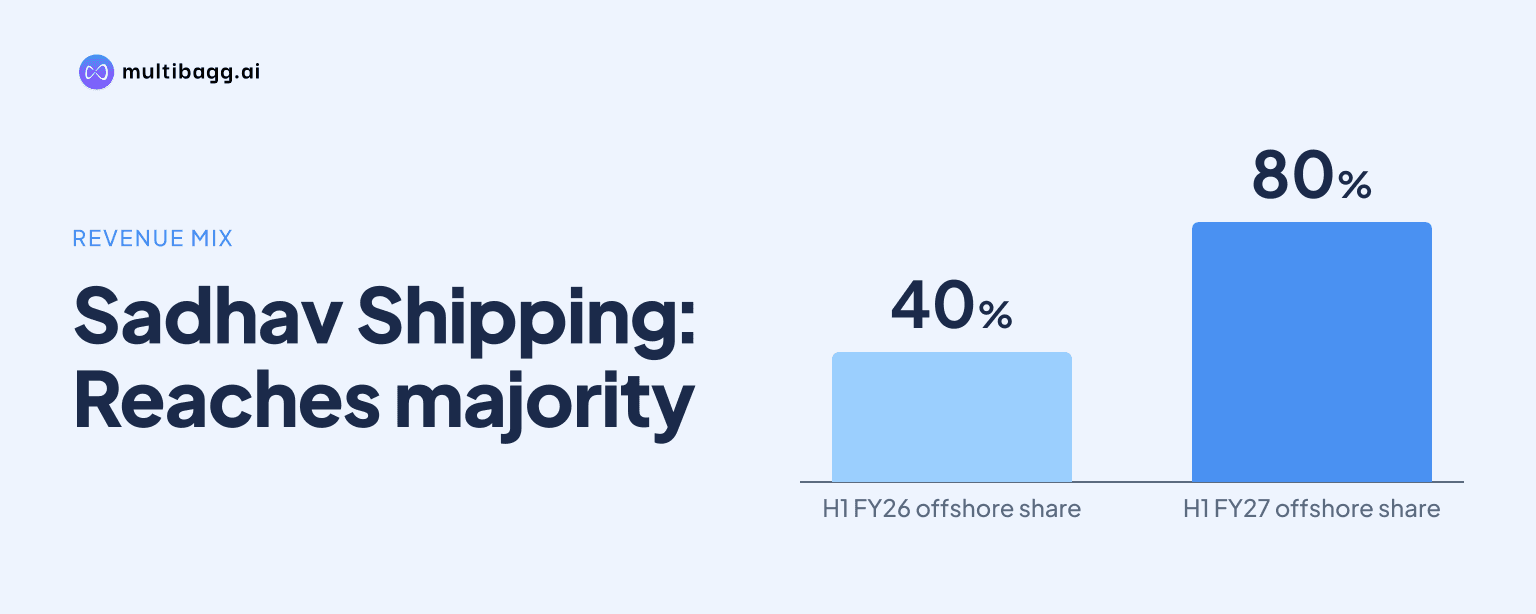
Sadhav Shipping Limited said offshore supply vessel operations accounted for almost 80% of H1 FY27 revenue, compared with about 40% in H1 FY26, after Saroja Blessing entered international service. Management expects offshore logistics to represent about 70% to 80% of revenue in the coming quarter, supported by baseline and vessel-specific contracts.
Know Sadhav Shipping inside out
Results, valuation, peers and who's buying, in one view.
What changed in Sadhav Shipping’s H1 FY27 revenue mix?
Sadhav Shipping’s offshore supply vessel, or OSV, business contributed almost 80% of total revenue in H1 FY27, up from about 40% in H1 FY26. Management disclosed the comparison in response to a question on revenue distribution across key business segments, identifying OSV operations as the principal contributor to the first-half top line.
The OSV share was therefore roughly twice its level a year earlier. This is a change in revenue composition rather than a disclosure of separate segment revenue in rupees, because management provided percentage contributions but did not state OSV revenue amounts for either H1 FY26 or H1 FY27.
The higher offshore weighting came as the company retained overall revenue guidance of Rs 120 crore and said offshore logistics had provided good revenue streams in the first half. Management also said it expected a little more than Rs 60 crore in the next half year, while noting that revenue growth can be lumpy and that Q2 is usually a softer period.
Why did offshore supply vessels become Sadhav Shipping’s largest revenue contributor?
Sadhav Shipping attributed the move to almost 80% OSV revenue contribution to Saroja Blessing’s deployment in international waters. Management separately identified the vessel’s employability in international markets as one of the drivers of second-half performance, alongside the company’s long-term order book and possible deployment of four ordered pilot boats.
Management said it was proceeding with the purchase of Saroja Blessing and expected contracts obtained for the vessel to be the driving force behind offshore logistics. It also cited long-term contracts that occur during Q3 and Q4 as a baseline for revenue, suggesting that the reported H1 FY27 mix reflects both existing offshore work and the international deployment of Saroja Blessing.
The source does not disclose the value, customer, duration or geography of Saroja Blessing’s contracts. It also does not quantify the vessel’s individual revenue contribution, so the connection between international employment and the shift from about 40% to almost 80% is management’s explanation rather than a separately reported vessel-level revenue calculation.
Can Sadhav Shipping maintain a 70% to 80% offshore revenue mix?
Management said Sadhav Shipping expects offshore logistics to remain at about 70% to 80% of revenue in the coming quarter, supported by baseline contracts and contracts for Saroja Blessing. The range is slightly below the almost 80% H1 FY27 share at its lower end, but it indicates that management expects OSV work to remain the largest disclosed source of revenue.
The outlook is dependent on contract activity rather than a fixed disclosed revenue amount. Management said long-term contracts are expected in Q3 and Q4 and that Saroja Blessing contracts would be the main driver, but it did not disclose the number, value or commencement dates of these contracts.
Sadhav Shipping also expects its four ordered pilot boats to contribute if they can enter service quickly enough during the year. Management did not provide a delivery schedule, operating contracts or revenue forecast for the four boats, meaning their potential effect on the 70% to 80% offshore mix is not quantified in the call.
Got a follow-up? Ask IRIS
What could affect Sadhav Shipping’s second-half revenue performance?
Management retained revenue guidance of Rs 120 crore and said it expected a little more than Rs 60 crore in the next half year. It named three drivers for the period: the long-term order book, Saroja Blessing’s international-market employment and the possible contribution from four pilot boats if they are engaged soon enough.
Sadhav Shipping also identified a contract loss that could affect the revenue pattern. Management said the Mumbai Port oil-spill response, or OSR, contract ended during the year and that the company was trying to make up for that lost contract in the coming financial year, rather than saying it had already secured replacement revenue.
Management described Q2 as a period of seasonal slump, while agreeing that H2 is expected to be stronger than H1. That assessment sits alongside the expectation for more than Rs 60 crore in the next half year, but management cautioned that growth may be lumpy rather than evenly distributed across quarters.
How do offshore operations affect Sadhav Shipping’s margins and vessel needs?
Sadhav Shipping said its earnings before interest, tax, depreciation and amortisation, or EBITDA, margin was 26%, compared with 36% last year. Management attributed the 10-percentage-point change to charter arrangements that increasingly include fuel costs, after fuel-price volatility led charterers to prefer all-inclusive vessel quotations.
Management said that under earlier pure-charter arrangements, charterers bore fuel costs directly, whereas the shipowner now includes fuel in quoted charter prices. It described an EBITDA margin range of 25% to 30% as sustainable, indicating that the 26% reported margin falls within management’s stated forward range.
Vessel needs differ by offshore location, according to management. It said deeper east-coast waters may require anchor-handling tugs with 120-ton or 150-ton capability, while west-coast work may require 80-ton-capability tugs, with client requirements and the distance from the base port affecting vessel specifications.
Management linked prospective offshore requirements to development in the KG Basin, Mahanadi Basin and Andaman area, as well as efficiency work at ageing western offshore fields including Mumbai High, Bassein and Neelam Heera. These locations describe possible demand conditions, but management did not state that Sadhav Shipping had won contracts in any of these areas.
Conclusion
Sadhav Shipping’s H1 FY27 disclosure shows its revenue mix has become much more concentrated in offshore operations, with OSV work contributing almost 80% of the top line against about 40% a year earlier. Management linked the shift to Saroja Blessing’s international service, while the move toward fuel-inclusive charter terms helps explain why EBITDA margin was 26%, compared with 36% last year.
The next indicators are Q3 and Q4 long-term contracts, further Saroja Blessing assignments and whether the four ordered pilot boats can enter service during the year. Management’s expectation for a 70% to 80% offshore share, its Rs 120 crore revenue guidance and its plan to replace the Mumbai Port OSR contract will determine whether the H1 FY27 mix persists.