










Sadhav Shipping H1 revenue up 73%, EBITDA margin at 27%
Key highlights
- Sadhav reported H1 FY27 revenue from operations of Rs 60.4 crore, up 73% from Rs 35.0 crore.
- H1 FY27 EBITDA margin fell to 27% from 36%, while EBITDA increased 31% to Rs 16.4 crore.
- Q2 FY27 EBITDA margin rose to 29% from 25% in Q1 FY27 despite a 6% sequential revenue decline.
- Management disclosed an approximately Rs 365 crore order book and a 120-day Lamprell Energy charter.
powered by IRIS
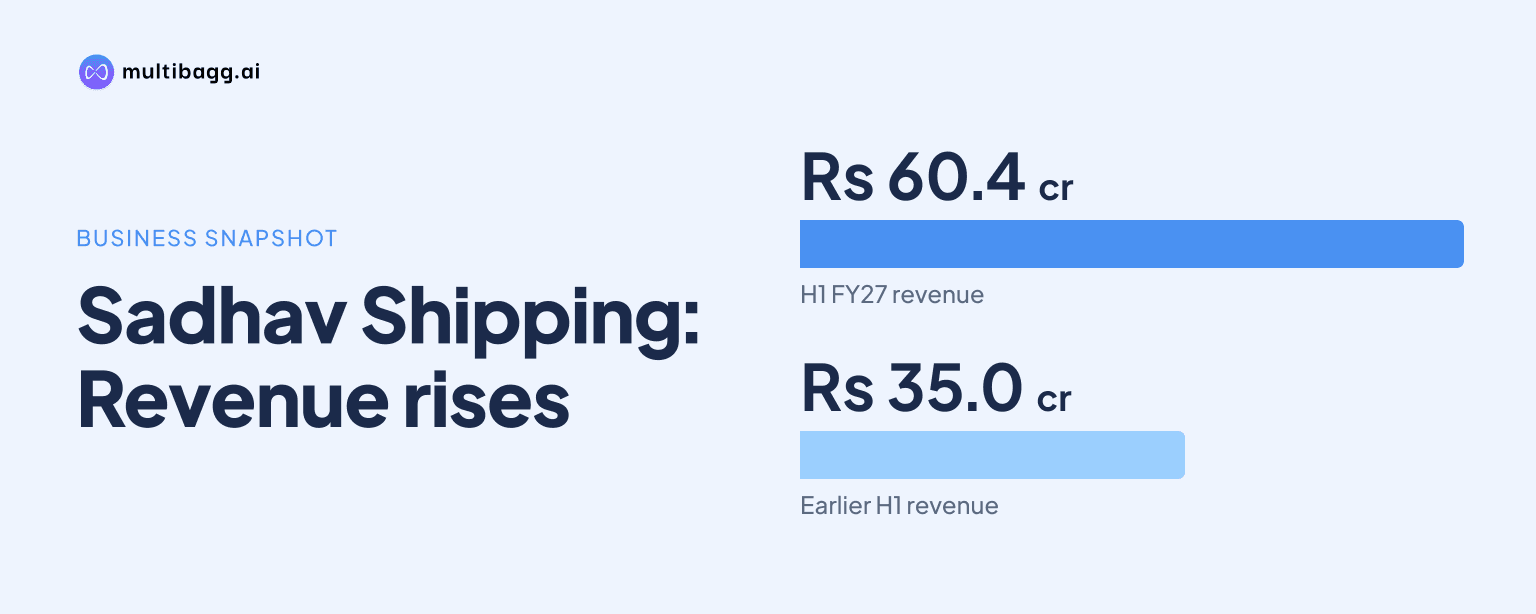
Sadhav Shipping reported H1 FY27 revenue from operations of Rs 60.4 crore, up 73% from H1 FY26, while earnings before interest, tax, depreciation and amortisation (EBITDA) margin declined to 27% from 36%. Sadhav’s Q2 FY27 EBITDA margin, however, improved sequentially to 29% from 25% in Q1 FY27.
Know Sadhav Shipping inside out
Results, valuation, peers and who's buying, in one view.
Why did Sadhav’s H1 EBITDA margin decline?
Sadhav’s H1 FY27 EBITDA margin declined by nine percentage points as reported operating costs rose faster than EBITDA. Revenue from operations increased to Rs 60.4 crore from Rs 35.0 crore in H1 FY26, while EBITDA rose 31% to Rs 16.4 crore from Rs 12.6 crore. This difference in growth rates coincided with the margin falling to 27% from 36%.
Cost of materials consumed increased to Rs 32.7 crore in H1 FY27 from Rs 13.2 crore a year earlier. Employee benefits expense rose to Rs 7.4 crore from Rs 6.2 crore, while other expenses increased to Rs 4.5 crore from Rs 3.3 crore. Together, these three cost lines were Rs 44.6 crore, compared with Rs 22.7 crore in H1 FY26.
Sadhav reported total income of Rs 61.1 crore in H1 FY27, including Rs 0.7 crore of other income, compared with Rs 35.3 crore and Rs 0.3 crore, respectively, in H1 FY26. EBITDA margin is measured before depreciation, amortisation, finance costs and tax, so the reported cost movements above EBITDA are relevant to the nine-percentage-point change.
Did Sadhav’s Q2 FY27 profitability improve from Q1?
Sadhav’s Q2 FY27 profitability improved from Q1 despite a 6% sequential decline in revenue from operations. Q2 revenue was Rs 29.21 crore, compared with Rs 31.2 crore in Q1, but EBITDA increased 6% to Rs 8.46 crore from Rs 8.0 crore. EBITDA margin therefore rose to 29% from 25%.
The quarterly cost mix changed as materials consumed declined to Rs 14.8 crore in Q2 from Rs 17.9 crore in Q1. Employee benefits expense increased to Rs 3.8 crore from Rs 3.6 crore, and other expenses rose to Rs 2.4 crore from Rs 2.1 crore. Total income was Rs 29.5 crore in Q2, against Rs 31.6 crore in Q1, with other income of Rs 0.3 crore in both quarters.
Profit before tax increased 11% to Rs 4.7 crore in Q2 FY27 from Rs 4.2 crore in Q1. Deferred tax was Rs 0.9 crore, compared with Rs 0.8 crore, leaving profit after tax (PAT) of Rs 3.8 crore, up 13% from Rs 3.4 crore. PAT margin increased to 13% from 11%, while basic earnings per share rose to Rs 2.37 from Rs 2.11.
What does H1 FY27 show about Sadhav’s profit growth?
Sadhav’s H1 FY27 PAT grew at the same reported 73% rate as revenue even though EBITDA margin was lower than a year earlier. PAT reached Rs 7.2 crore from Rs 4.2 crore, while PAT margin was 12% in both first-half periods. Basic earnings per share increased to Rs 4.48 from Rs 2.91.
Below EBITDA, depreciation and amortisation expense rose to Rs 4.4 crore in H1 FY27 from Rs 4.2 crore in H1 FY26. Finance costs increased to Rs 3.1 crore from Rs 2.9 crore, while profit before tax rose 62% to Rs 8.9 crore from Rs 5.5 crore. Deferred tax was Rs 1.7 crore, compared with Rs 1.3 crore in the prior first half.
The H1 outcome follows FY26, when annual revenue from operations rose 1% to Rs 97.6 crore from Rs 96.9 crore in FY25, but EBITDA fell 17% to Rs 25.8 crore from Rs 31.3 crore. FY26 EBITDA margin was 26%, compared with 32% in FY25, while PAT increased 25% to Rs 14.7 crore from Rs 11.7 crore.
Got a follow-up? Ask IRIS
How has Sadhav’s financial position changed since March 2026?
Sadhav’s total assets increased to Rs 231.6 crore in September 2026 from Rs 211.8 crore in March 2026, while total equity rose to Rs 108.6 crore from Rs 101.3 crore. Property, plant and equipment increased to Rs 147.1 crore from Rs 144.7 crore, and capital work-in-progress rose to Rs 7.7 crore from Rs 6.9 crore.
Total current assets were Rs 76.5 crore in September 2026, compared with Rs 59.7 crore in March 2026. Financial assets increased to Rs 44.7 crore from Rs 42.7 crore, and other current assets rose to Rs 26.1 crore from Rs 17.0 crore. The presentation separately lists Rs 5.7 crore of current assets in September 2026, without a March 2026 amount in that line.
Total liabilities increased to Rs 123.1 crore from Rs 110.5 crore during the same period. Non-current borrowings declined to Rs 69.1 crore from Rs 72.7 crore, while short-term borrowings increased to Rs 11.6 crore from Rs 8.5 crore and other current liabilities rose to Rs 15.6 crore from Rs 5.8 crore. Sadhav notes that consolidated FY26 results largely reflected standalone operations because certain subsidiaries and associates were at an early business stage.
What is Sadhav planning after H1 FY27?
Management said Sadhav’s order book of approximately Rs 365 crore provides a foundation for business visibility and future growth. Its stated plan is to increase participation at major Indian ports, strengthen mooring and harbour operations, and expand long-term port-service engagements. The company also plans to increase offshore vessel deployment, coastal logistics and marine-support operations.
Management said Sadhav secured a 120-day offshore pipeline-support charter from Lamprell Energy Ltd. for pipeline replacement support services in Mumbai. It also disclosed a proposed joint venture to explore shipbuilding and ship repair, and a proposed acquisition of a 26% stake in AOSL Energy Services Limited to expand its offshore oil and gas-services presence. These are disclosed plans or contracts, not reported H1 FY27 revenue contributions.
Sadhav also plans to explore electric marine mobility through the upcoming Candela P-12 launch, described by management as India’s first fully electric hydrofoiling boat, in connection with the Mumbai Water Metro Project. Other stated priorities include specialised offshore contracts, oil-spill response, marine safety services and a higher share of long-term annuity-style contracts.
Conclusion
Sadhav’s H1 FY27 results show revenue and PAT growing 73% to Rs 60.4 crore and Rs 7.2 crore, respectively, while EBITDA grew 31% to Rs 16.4 crore and margin declined to 27% from 36%. The Q2 FY27 comparison showed a different sequential pattern: revenue declined to Rs 29.21 crore, but EBITDA margin rose to 29% from 25% in Q1.
The next disclosures to watch are execution against the approximately Rs 365 crore order book and the 120-day Lamprell Energy charter. Management’s proposed joint venture, proposed 26% AOSL Energy Services Limited acquisition, and upcoming Candela P-12 launch remain future developments whose progress has not been quantified in the H1 FY27 results.