










Sadhav Shipping Limited H1 FY27 Revenue Rises 73% to ₹60.43 Crore
Key highlights
- Sadhav Shipping Limited reported H1 FY27 revenue of ₹60.43 crore, up 73% year on year.
- H1 FY27 EBITDA rose 31% year on year to ₹16.44 crore.
- H1 FY27 net profit increased 73% year on year to ₹7.2 crore.
- Q2 FY27 revenue was ₹29 crore, down 6.5% sequentially from ₹31 crore in Q1 FY27.
powered by IRIS
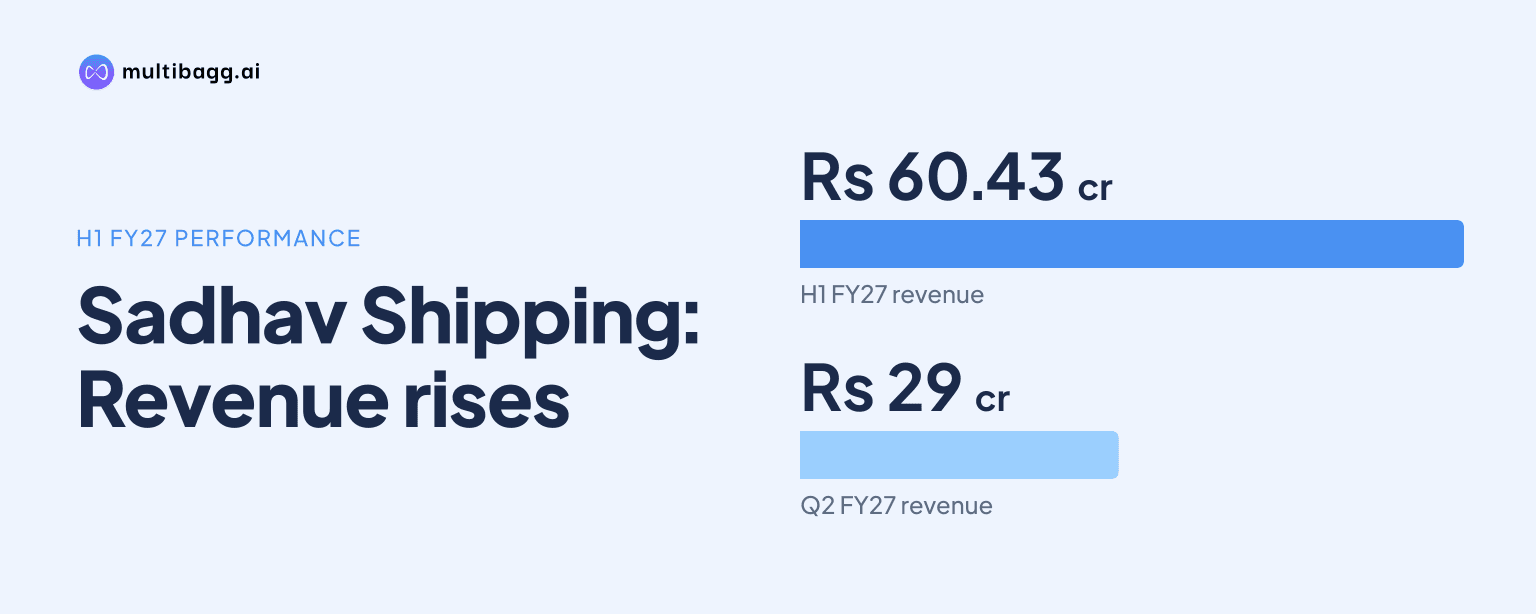
Sadhav Shipping Limited reported H1 FY27 revenue of approximately ₹60.43 crore, up 73% year on year, with EBITDA rising 31% to ₹16.44 crore and net profit increasing 73% to ₹7.2 crore. The performance places the company ahead of the period with a stronger earnings base despite monsoon-related operational seasonality in offshore logistics.
Know Sadhav Shipping inside out
Results, valuation, peers and who's buying, in one view.
What did Sadhav Shipping report for H1 FY27?
Sadhav Shipping reported revenue of ₹60.43 crore for the first half of FY27, representing year-on-year growth of 73%. EBITDA for the six-month period increased 31% to ₹16.44 crore, while net profit rose 73% to ₹7.2 crore, according to the company’s H1 FY27 earnings-call information.
The reported numbers show that profit growth matched revenue growth during the period, while EBITDA growth was lower than revenue growth. This indicates that operating profitability expanded in absolute terms, although the available H1 data does not provide a comparable half-year margin figure.
The company operates barges, tugs and vessels, and also undertakes ship-management work for other owners. Its business includes offshore logistics and port-linked marine operations, which can be affected by vessel deployment schedules, charter rates and monsoon conditions.
How did the second quarter compare with recent periods?
Sadhav Shipping disclosed Q2 FY27 revenue of ₹29 crore, up 63.5% year on year and down 6.5% sequentially from ₹31 crore in Q1 FY27. The quarter followed Q1 FY27 revenue of ₹31.2 crore, as stated in the August 2026 earnings-call summary.
The sequential moderation is relevant because the company has previously pointed to monsoon-related disruption in offshore operations. Management had stated that offshore revenue can decline by about ₹4 crore a month during the monsoon, reflecting lower vessel utilisation or delayed mobilisation in this part of the business.
For comparison, the Q1 FY27 call said EBITDA margin was 25.3% and profit after tax was ₹3.4 crore. The available Q2 data in the supplied material is limited to revenue, so a quarter-on-quarter comparison of profitability cannot be made from the disclosed figures.
What is driving Sadhav Shipping’s operating pipeline?
Sadhav Shipping’s operating pipeline includes port-service contracts, offshore work and an order book that management cited at ₹350 crore in the August 2026 earnings call. The work in hand was described as spread over periods of up to seven years, providing visibility beyond individual quarterly vessel deployments.
Management had said it won a ₹18 crore, seven-year Mumbai Port contract. It also ordered new boats expected to add about ₹4 crore in annual revenue. The company has indicated that the Mumbai Port and JNPA contracts were expected to begin around January or February 2027, alongside delivery of new pilot boats.
The status of the JNPA contract has drawn attention because a termination filed on 18 August 2026 was subsequently withdrawn through a filing dated 3 October 2026. The supplied disclosures do not provide further financial details on the revised contract position, but the withdrawal remains material to the planned expansion of port operations.
Sadhav Shipping was founded in 1996 and has developed operations across coal lighterage, inland-waterway diesel exports and port-based oil spill response. The company is also building an offshore supply-base initiative with a Singaporean partner, although the supplied material does not provide a confirmed financial contribution from that arrangement.
Got a follow-up? Ask IRIS
What are management’s FY27 targets and the key risks?
Sadhav Shipping has maintained FY27 revenue-growth guidance of 20% and guided for an EBITDA margin of 30%. Management confirmed the revenue target at the higher end of an earlier 15% to 20% range during the Q1 FY27 call.
The H1 revenue growth of 73% is substantially above the full-year guidance rate, but half-year growth alone does not establish the full-year outcome. Marine logistics revenue depends on vessel availability, mobilisation timing, contract commencements and weather conditions, all of which may affect the second half.
Charter-rate conditions are another key variable. Management said in August 2026 that charter rates in India were softening, while a geopolitical premium associated with vessels deployed in Iran-US conflict waters could normalise. In Q1, Saroj Blessing was deployed in those waters at premium charter rates, while Anusha was affected by monsoon conditions.
The company’s margin record also provides important context. EBITDA margin declined to 26% in FY26 from 32% in FY25, following delayed vessel mobilisation. Profit before tax fell to ₹10.7 crore in FY26 from ₹17.4 crore in FY25. This makes execution on new contracts and fleet deployment important for the company’s stated 30% margin objective.
Why do the H1 FY27 figures matter to investors?
The H1 FY27 figures matter because they combine strong reported growth with a pipeline of port-related contracts and a disclosed ₹350 crore order book. Revenue of ₹60.43 crore and net profit of ₹7.2 crore show a marked improvement over the comparable prior-year period, while the next phase of growth depends on converting contracts into operating revenue.
For investors, the key distinction is between confirmed current-period earnings and planned additions from contracts, pilot boats and new operational assets. The Mumbai Port contract, prospective JNPA activity and new boats could support operations once deployed, but the disclosed timeline places the expected contract starts around January or February 2027.
The wider marine-services industry remains fragmented and competitive, according to the CARE rating material cited in the supplied information. Charter rates and project timing can therefore influence earnings even when order-book visibility is relatively long. Sadhav Shipping’s H1 performance should be assessed alongside its ability to maintain vessel utilisation and meet its margin guidance.
Conclusion
Sadhav Shipping Limited delivered strong H1 FY27 growth, reporting revenue of ₹60.43 crore, EBITDA of ₹16.44 crore and net profit of ₹7.2 crore. The reported 73% revenue and profit growth reflects a materially improved first-half performance, while the lower rate of EBITDA growth highlights the importance of operating costs and margins.
Investors will next watch the planned January or February 2027 commencement of Mumbai Port and JNPA contracts, delivery of new pilot boats, and progress toward management’s FY27 guidance of 20% revenue growth and a 30% EBITDA margin. Charter-rate trends, monsoon effects and renewal of major ONGC charters will also remain relevant to operating visibility.