










Sadhav plans $6m-$7m fleet capex over six months
Key highlights
- Sadhav plans approximately $6 million to $7 million of capex over the next six months.
- Four H Wadia boats for Mumbai Port and JNPT are backed by orders and are expected to enter service by Q4 or Q1 of the following year.
- Sadhav said it normally funds new assets with 75% debt and 25% internal margin.
- Sadhav had about Rs 60 crore of term loans with public-sector banks, according to its chief financial officer.
powered by IRIS
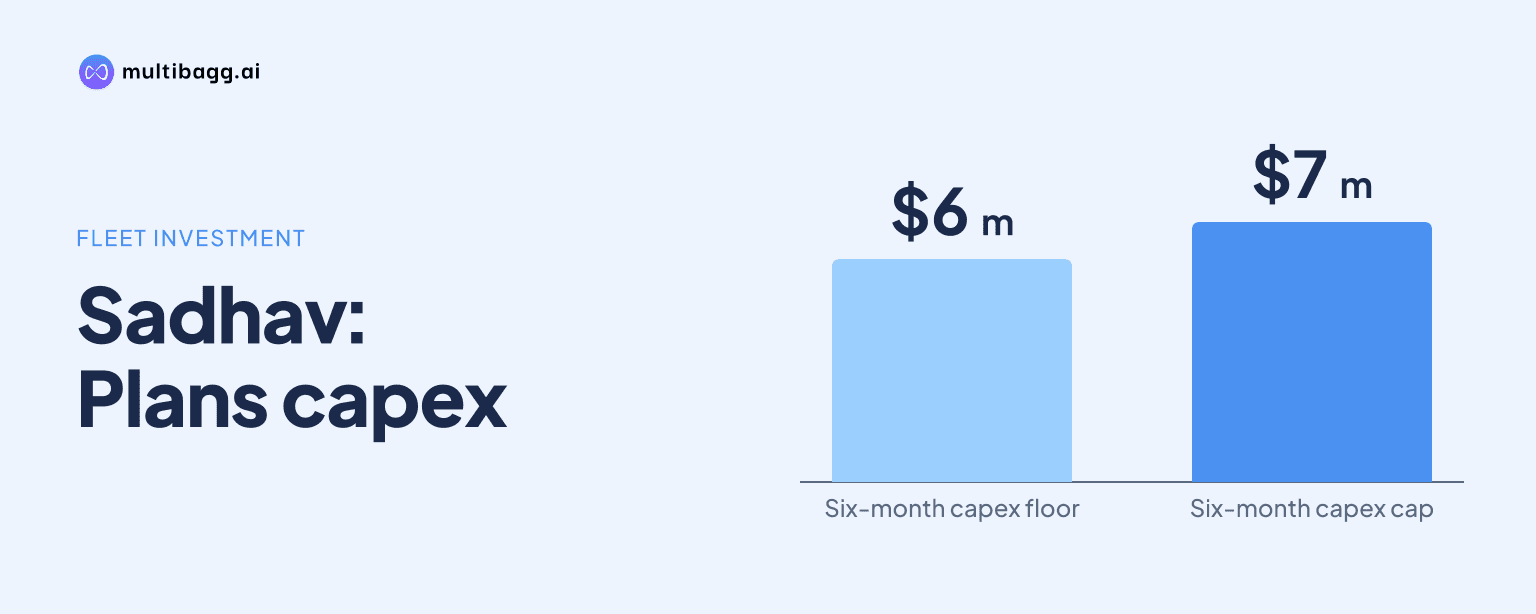
Sadhav Shipping plans approximately $6 million to $7 million of capital expenditure during the next six months for four H Wadia boats, Saroja Blessing and a Candela electric vessel, with management saying substantial expenditure has already been incurred and financing progress differs across the three projects.
Know Sadhav Shipping inside out
Results, valuation, peers and who's buying, in one view.
What will Sadhav spend $6m-$7m on over six months?
Sadhav said its approximately $6 million to $7 million six-month capex programme comprises three fleet-expansion drives: the purchase of Saroja Blessing, a Candela electric boat and four boats ordered from H Wadia Boat Builders. Management said a substantial amount of the total outlay had already been spent, but did not provide a project-by-project capex allocation.
The four H Wadia boats are intended for Mumbai Port and Jawaharlal Nehru Port Trust, or JNPT, and management said the order is backed by orders. In a separate response, management said the boats were under construction and should enter service by Q4 or Q1 of the following year. The planned deployment therefore differs from an uncontracted fleet purchase because management identified the ports and order backing.
Saroja Blessing has been operated by Sadhav under a bareboat contract for the past 10 years and is now being transferred into the company’s name. Under a bareboat contract, the charterer takes operational control of the vessel. The acquisition changes Sadhav’s position from operating the vessel under charter to owning it, while management described the vessel as its one international-market asset.
How is Sadhav funding its new fleet assets?
Sadhav said it evaluates funding on a project-by-project basis and does not complete financial closure for an asset before the relevant project is known. For the four H Wadia boats, management said it had already obtained term loans from Bank of Baroda. For Saroja Blessing, management said financial closure had already been completed.
The Candela vessel is at a different funding stage. Management said it was speaking with various parties about the investment side of that project, rather than disclosing a completed loan or financial closure. It also said financial closures for schemes already undertaken were under way, leaving the final funding arrangement for the Candela project undisclosed.
Sadhav’s chief financial officer said the company had about Rs 60 crore of term loans with public-sector banks. He described the usual structure for a new asset as 75% debt and 25% internal margin, with banks generally lending for five years and, in some cases, six years. Management also said such facilities may include a six-month moratorium.
What is the purpose of the Candela vessel?
Sadhav described the Candela vessel as an electric boat and a technology demonstrator for a water metro system. In an earlier response, management put the Candela P-12 asset cost at about $2 million and said it planned to demonstrate the vessel soon. This makes it the technology-focused element within the three-part six-month expansion programme.
The Candela initiative is separate from Sadhav’s view on the National Green Tug Transition Programme. Management said it was not aggressively pursuing that programme because the technology was not yet proven, in its view, and capital-asset costs needed to fall for charter rates to make sense. Management acknowledged that the programme offers 15-year contracts but did not disclose any Sadhav contract or participation.
The distinction is material because the Candela vessel is a disclosed near-term purchase and planned demonstration, whereas the green-tug programme remains under evaluation. Management said fleet additions would be selective and based on contract visibility, commercial viability and expected returns. The four H Wadia boats have stated order backing, while Candela’s investment funding was still being discussed.
Got a follow-up? Ask IRIS
What comes after the six-month capex programme?
Sadhav said it may consider buying an offshore support vessel over the next one year to one-and-a-half years. Management said current prices for offshore logistics assets were too high and that it was waiting for prices to decline. It did not disclose a capex budget, identified vessel, contract or financing plan for this possible acquisition.
That potential offshore purchase is therefore at an earlier stage than the approximately $6 million to $7 million programme. Management said financing for a vessel without a capex plan could be arranged later, while the H Wadia boats already have Bank of Baroda term loans and Saroja Blessing has completed financial closure. The timing depends on asset-price movements rather than a fixed purchase commitment.
Beyond asset additions, Sadhav said it is pursuing long-term contracts in port services, offshore logistics and specialised marine operations. Management said it had most major ports covered through its service portfolio and was discussing opportunities with private players. Within existing government-port relationships, it also aims to offer up to three additional services where tendering rules permit, rather than relying on a single service.
How does Saroja Blessing support Sadhav’s international activity?
Saroja Blessing is Sadhav’s one vessel in the international market, and management said its engagement had been good so far. Its transfer after 10 years on bareboat charter gives the six-month capex programme an international component alongside the four boats assigned to Mumbai Port and JNPT. The transcript did not disclose the vessel’s acquisition price or its future charter terms.
Management separately discussed a 120-day charter awarded by Lamprell Energy at approximately $7,900 a day. It estimated fixed-period revenue contribution of about $1.3 million, including taxes, with any extension dependent on the additional number of days Lamprell seeks. The call did not state that the Lamprell charter is operated by Saroja Blessing, so the revenue estimate cannot be assigned to that vessel.
Management identified regulatory and staffing factors that could affect operations. It cited changing Directorate General of Shipping vessel-age norms and said qualified personnel can earn at least 30% more on foreign-flag ships, making retention challenging. These were industry challenges identified by management, not quantified impacts on the $6 million to $7 million capex programme.
Conclusion
Sadhav’s disclosed expansion plan combines contracted port-oriented assets, the ownership transfer of an international vessel and an electric-water-metro demonstration. The approximately $6 million to $7 million outlay is more advanced for the four H Wadia boats and Saroja Blessing than for Candela, because management disclosed Bank of Baroda term loans for the boats and completed financial closure for the vessel purchase.
The next milestones are the expected Q4 or Q1 entry into service for the four H Wadia boats, the planned Candela demonstration and progress in its investment discussions. Over the following one year to one-and-a-half years, management’s possible offshore support-vessel purchase remains contingent on asset prices declining from levels it currently considers too high.