










Fortis aspires to 12,000 beds through three expansion routes
Key highlights
- Fortis aspires to increase bed capacity from about 6,300 to about 12,000 over three to five years.
- The roadmap includes about 1,900 brownfield beds, about 1,600 O&M beds and about 2,200 inorganic-opportunity beds.
- Fortis acquired the 110-bed Suguna Hospital in Bengaluru for about Rs 277 crore in October 2026.
- Hospital operating revenue rose 18.6% year on year to Rs 2,340 crore in Q2FY27.
powered by IRIS
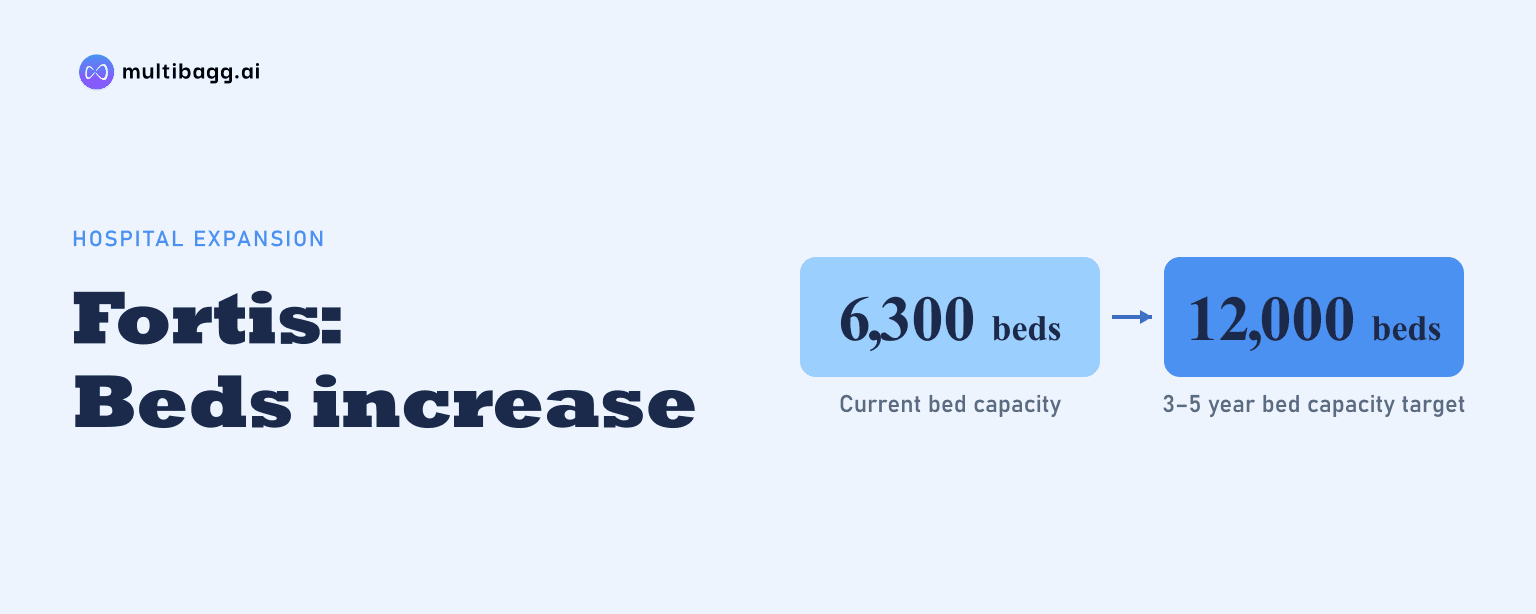
Fortis Healthcare aspires to increase bed capacity from about 6,300 to about 12,000 over the next three to five years, implying about 5,700 additional beds. The roadmap identifies about 1,900 beds from brownfield expansion, about 1,600 from operating-and-management expansion and about 2,200 from inorganic opportunities.
Know Fortis Healthcare inside out
Results, valuation, peers and who's buying, in one view.
What is Fortis's 12,000-bed expansion plan?
Fortis plans to take total bed capacity to about 12,000 from about 6,300 in three to five years through three stated routes. Its current capacity includes about 5,100 operational beds, about 500 operating-and-management, or O&M, beds at Gleneagles, and about 700 O&M beds at other facilities.
The plan remains an aspiration, while the capacity categories have different execution paths. Brownfield expansion is expected to add about 1,900 beds, O&M expansion about 1,600 beds, and inorganic opportunities about 2,200 beds, bringing the indicated total to about 12,000 beds.
Fortis excludes about 230 potential beds from the 12,000-bed roadmap because they are to be planned beyond FY32. Those excluded additions comprise about 180 beds at Jalandhar and about 50 beds at Manesar.
How will Fortis add beds through brownfield and O&M projects?
Fortis identifies brownfield expansion as a source of about 1,900 beds, but the presentation does not provide a hospital-by-hospital split for that capacity. The company separately identifies the Jalandhar and Manesar potential additions, totalling about 230 beds, as capacity to be planned beyond FY32 rather than within this roadmap.
Fortis expects its O&M route to contribute about 1,600 beds, comprising about 400 Gleneagles beds and about 1,200 beds from other arrangements. This expansion includes the healthcare services agreement with SLJ Society, additional capacity at Gleneagles units, and greenfield facilities at Lucknow and Cuttack.
The stated Gleneagles O&M-bed count excludes its Mumbai facility. This distinction matters because the current capacity base of about 6,300 beds already includes about 500 Gleneagles O&M beds and about 700 O&M beds at other facilities.
Which disclosed transactions support Fortis's capacity plan?
Fortis entered definitive agreements in September 2026 to provide healthcare services at a 400-plus-bed super-specialty hospital in Ashok Vihar, New Delhi. Under the 29-year Healthcare Services Agreement with Seth Sunder Lal Jain Charitable Eye Hospital, or SLJ Society, Fortis will provide specified inpatient services, specialised medical equipment and clinical manpower.
The Ashok Vihar facility covers about 3.1 acres and is expected to commence operations in three to four years, subject to necessary approvals. SLJ Society will own and develop the hospital infrastructure, with development planned in phases, placing the project within Fortis's stated O&M expansion route.
In October 2026, Fortis acquired the 110-bed Suguna Hospital in Rajajinagar, north-west Bengaluru, for about Rs 277 crore in an all-cash transaction. The deal includes the hospital business through a slump sale, land and building; Fortis says the facility has potential to expand to about 150 beds.
Got a follow-up? Ask IRIS
What does Fortis's hospital performance show before expansion?
Fortis's hospital business recorded operating revenue of Rs 2,340 crore in Q2FY27, up 18.6% from Rs 1,974 crore in Q2FY26. Operating earnings before interest, tax, depreciation and amortisation, or EBITDA, increased to Rs 545 crore from Rs 452 crore, while the operating EBITDA margin rose to 23.3% from 22.9%.
Hospital occupancy was 72% in Q2FY27, compared with 71% in Q2FY26 and 69% in Q1FY27. Occupied beds rose 9% year on year to 3,616 from 3,318, while average revenue per inpatient, or ARPP, increased 6.8% to Rs 2.10 lakh from Rs 1.96 lakh in Q2FY26.
Focus specialties comprising oncology, neuro sciences, cardiac sciences, gastroenterology, orthopedics and renal sciences contributed 60% of hospital revenue after growing 16.7% in Q2FY27. Renal sciences, neuro sciences and orthopedics posted year-on-year revenue growth of 27%, 28% and 30%, respectively.
Which operating and financial measures should readers track?
Fortis reported that 15 facilities with operating EBITDA margins above 20% contributed 84.3% of Q2FY27 revenue and operated 3,876 beds. These facilities reported 76% occupancy and ARPP of Rs 2.22 lakh, compared with 54% occupancy and ARPP of Rs 1.36 lakh at two facilities with margins below 10%.
Delhi NCR, including Jaipur, generated the highest Q2FY27 cluster net revenue at Rs 1,199 crore, ahead of Punjab at Rs 431 crore and Bengaluru at Rs 309 crore. Delhi NCR had 2,300 average operational beds and 72% occupancy, while Bengaluru had 722 operational beds and 63% occupancy, excluding Suguna's 110 beds acquired in October 2026.
At September 30, 2026, Fortis reported consolidated net debt of Rs 2,188 crore, down from Rs 2,334 crore on March 31, 2026. Net debt to equity was 0.20 times, compared with 0.23 times at both March 31, 2026 and September 30, 2025, while net debt to EBITDA was 0.87 times in Q2FY27 versus 0.96 times in Q2FY26.
Consolidated revenue rose 17.3% year on year to Rs 2,735 crore in Q2FY27, while profit after tax excluding exceptional items increased 4.0% to Rs 317 crore. In H1FY27, revenue increased 17.4% to Rs 5,280 crore, but the comparable profit-after-tax margin declined to 11.0% from 12.4% in H1FY26.
Conclusion
Fortis has set out an aspiration to add about 5,700 beds to its current capacity of about 6,300 beds over three to five years. The plan combines about 1,900 brownfield beds, about 1,600 O&M beds and about 2,200 beds from inorganic opportunities, while the Ashok Vihar agreement and Suguna acquisition provide disclosed examples of its O&M and acquisition activity.
The next developments to watch are the approvals and phased build-out of the 400-plus-bed Ashok Vihar hospital, which Fortis expects to begin operating in three to four years, and progress on the Lucknow, Cuttack and Gleneagles O&M additions. Fortis also identifies about 2,200 beds as inorganic opportunities, while about 230 potential beds at Jalandhar and Manesar remain planned beyond FY32.