










Fortis moves 84.3% of revenue above 20% EBITDA in Q2FY27
Key highlights
- Fortis reported 84.3% of Q2FY27 hospital revenue from facilities above 20% operating EBITDA margin, versus 76.2% in FY26.
- Fortis's above-20% margin group increased to 15 facilities with 3,876 operational beds and 76% occupancy in Q2FY27.
- Fortis had two facilities below 10% operating EBITDA margin in Q2FY27, accounting for 2.7% of hospital revenue.
- Fortis's Delhi NCR cluster generated Rs 1,199 crore of Q2FY27 net revenue and had 72% occupancy.
powered by IRIS
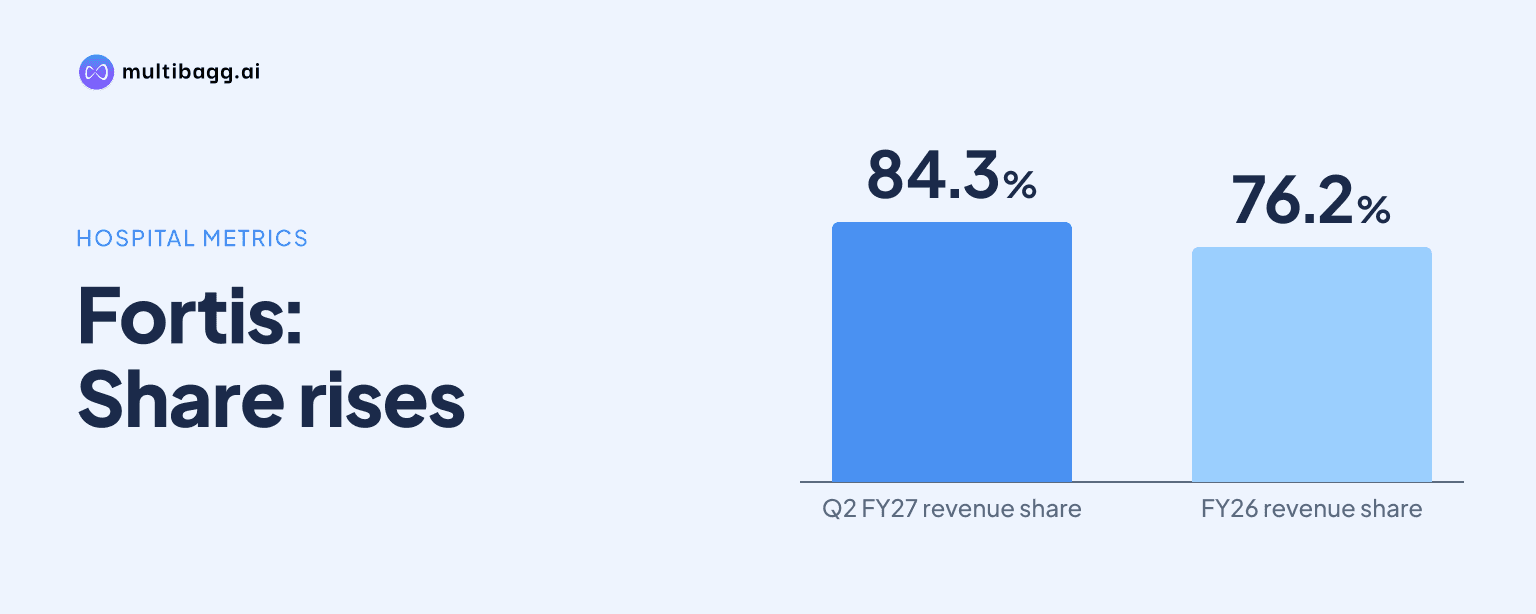
Fortis reported that 84.3% of Q2FY27 hospital revenue came from facilities with operating EBITDA margins above 20%, compared with 76.2% in FY26. The 15 facilities in this band had 3,876 operational beds, 76% occupancy and average revenue per inpatient of Rs 2.22 lakh in Q2FY27.
Know Fortis Healthcare inside out
Results, valuation, peers and who's buying, in one view.
How did Fortis move revenue into facilities above 20% EBITDA margin?
Fortis increased the revenue contribution from facilities above a 20% operating EBITDA margin to 84.3% in Q2FY27 from 76.2% in FY26. Operating EBITDA means earnings before interest, tax, depreciation and amortisation, and Fortis defines this hospital margin measure as being before employee stock-option plan expenses. The number of facilities in the highest margin band rose to 15 from 13.
The top-margin group expanded by 638 operational beds, to 3,876 in Q2FY27 from 3,238 in FY26. Its occupancy increased to 76% from 72%, while average revenue per inpatient, or ARPP, increased to Rs 2.22 lakh from Rs 2.07 lakh. Fortis calculates ARPP using gross inpatient revenue and excludes daycare procedures including chemotherapy, radiotherapy and dialysis.
The 15% to 20% margin band reduced to 2.1% of hospital revenue in Q2FY27 from 11.6% in FY26, even as its facility count declined to three from four. In contrast, the 10% to 15% band expanded to four facilities and 9.6% of revenue from one facility and 2.2% of revenue. That group had 707 beds, 64% occupancy and Rs 1.72 lakh ARPP in Q2FY27.
Which Fortis facilities were below 10% EBITDA margin?
Fortis identified Yeshwanthpur and Greater Noida as the two facilities below a 10% operating EBITDA margin in Q2FY27. Yeshwanthpur was acquired in January 2026, while Greater Noida was converted to a lease arrangement from September 2025. Together, they represented 2.7% of hospital revenue, 276 operational beds and 54% occupancy.
The below-10% group was larger in FY26, when six facilities accounted for 8.8% of revenue and 875 operational beds. Its occupancy was 52% and ARPP was Rs 1.52 lakh in FY26, compared with 54% occupancy and Rs 1.36 lakh ARPP for the two-facility Q2FY27 group. Fortis also identified Manesar, commissioned in September 2024, within the FY26 below-10% cohort.
The difference in ARPP between margin bands was marked in Q2FY27. Facilities above 20% operating EBITDA margin reported Rs 2.22 lakh ARPP and 76% occupancy, compared with Rs 1.36 lakh ARPP and 54% occupancy for facilities below 10%. The presentation does not provide facility-level revenue or margins for Yeshwanthpur and Greater Noida separately.
What did Fortis report across its hospital revenue clusters?
Fortis reported year-on-year and quarter-on-quarter net revenue growth across all five geographical clusters in Q2FY27. Delhi NCR, which includes the Jaipur hospital, was the largest cluster with Rs 1,199 crore of net revenue, compared with Rs 1,132 crore in Q1FY27 and Rs 995 crore in Q2FY26. It had 2,300 average operational beds and 72% occupancy during Q2FY27.
Punjab generated Rs 431 crore in Q2FY27, up from Rs 406 crore in Q1FY27 and Rs 384 crore in Q2FY26. The cluster had 1,017 operational beds and 76% occupancy, matching the occupancy reported for Fortis's above-20% margin facility group. Bengaluru reported Rs 309 crore of revenue, with 722 beds and 63% occupancy.
Mumbai recorded Rs 233 crore of Q2FY27 revenue, compared with Rs 216 crore in Q1FY27 and Rs 204 crore in Q2FY26. Kolkata generated Rs 141 crore, versus Rs 127 crore and Rs 121 crore in those respective periods. Mumbai had 600 beds at 75% occupancy, while Kolkata had 391 beds at 75% occupancy; the cluster bed figures exclude operations-and-maintenance beds.
Got a follow-up? Ask IRIS
How did Fortis's specialty and payor mixes change?
Fortis reported year-on-year revenue growth of 27% in renal sciences, 28% in neurosciences and 30% in orthopaedics during Q2FY27. Orthopaedics increased to 9.1% of specialty mix from 8.3% in Q2FY26, renal rose to 7.5% from 7.1%, and neuro reached 8.8% from 8.2%. Cardiac declined to 16.1% from 16.8%, while oncology declined to 13.9% from 16.2%.
Outpatient department revenue represented 14.4% of the Q2FY27 specialty mix, up from 13.8% a year earlier. Other inpatient revenue rose to 17.2% from 16.9%, while pulmonary care increased to 3.4% from 2.8%. Gastroenterology remained at 4.9%, and gynaecology declined to 3.1% from 3.3%.
Third-party administrators accounted for 37.1% of Fortis's Q2FY27 payor mix, up from 36.3% in Q2FY26, while domestic cash remained at 34.2%. International cash declined to 7.7% from 8.1%, and the Ex-Servicemen Contributory Health Scheme share declined to 6.7% from 7.5%. The Central Government Health Scheme share rose to 5.1% from 4.3%.
What capacity plan could affect Fortis's margin mix?
Fortis has stated an aspiration to reach about 12,000 beds over the next three to five years, compared with current capacity of about 6,300 beds. Its disclosed path includes about 1,900 brownfield expansion beds, about 1,600 operations-and-maintenance expansion beds and about 2,200 beds through inorganic opportunities. Fortis says inorganic opportunities include potential acquisitions and greenfield expansion.
The operations-and-maintenance expansion plan includes a hospital services agreement with SLJ Society, additional capacity at Gleneagles units, and greenfield facilities at Lucknow and Cuttack. Fortis excludes the Gleneagles Mumbai facility from Gleneagles operations-and-maintenance beds. The plan also excludes a further potential 230 beds, including about 180 in Jalandhar and about 50 in Manesar, which Fortis says will be planned beyond FY32.
Fortis reported debt of Rs 2,525 crore at September 30, 2026, down from Rs 2,872 crore at March 31, 2026. Net debt, which excludes lease liabilities, was Rs 2,188 crore, and net debt to equity was 0.20 times, compared with 0.23 times at both September 30, 2025 and March 31, 2026. Lease liabilities were Rs 640 crore at September 30, 2026.
Conclusion
Fortis's Q2FY27 margin matrix shows a greater concentration of hospital revenue in facilities above a 20% operating EBITDA margin, with the share rising to 84.3% from 76.2% in FY26. The highest-margin group also increased from 13 to 15 facilities, while its beds, occupancy and ARPP reached 3,876, 76% and Rs 2.22 lakh, respectively.
The next point to watch is Fortis's execution of its aspiration to expand from about 6,300 beds to about 12,000 beds over three to five years. The disclosed additions include about 1,900 brownfield beds, about 1,600 operations-and-maintenance beds and about 2,200 beds from inorganic opportunities, while Yeshwanthpur and Greater Noida remained below the 10% margin band in Q2FY27.