










Frontier Springs debottlenecking adds at least 20% capacity
Key highlights
- Frontier Springs expects coil-spring debottlenecking to add at least 20% capacity.
- Coil-spring process utilisation ranges from 60% in some operations to 100% in others.
- Management expects around 20% year-on-year growth in coil springs, air springs and forging.
- Frontier Springs remains committed to FY27 gross revenue of at least Rs 450 crore while working towards Rs 500 crore.
powered by IRIS
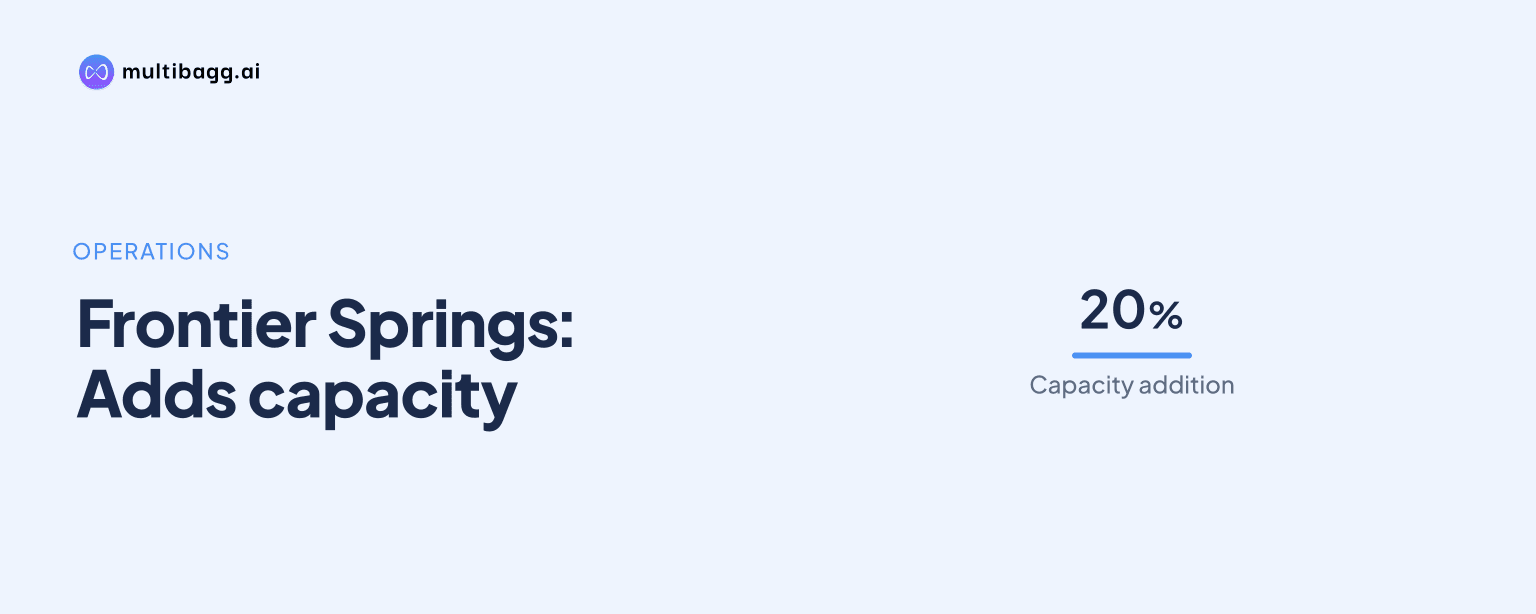
Frontier Springs Limited said its coil-spring debottlenecking programme will add at least 20% capacity by upgrading constrained manufacturing processes, some of which operate at 100% utilisation while others run at 60%. Management said the work supports its expectation of around 20% year-on-year growth in coil springs, air springs and forging.
Know Frontier Springs inside out
Results, valuation, peers and who's buying, in one view.
How much coil-spring capacity will Frontier Springs add?
Frontier Springs expects the coil-spring debottlenecking programme to add a minimum 20% capacity. Management provided that estimate after an investor referred to about 80% utilisation in the springs division and asked how the company would expand if facilities became fully utilised by next year.
The proposed addition is based on improving the existing coil-spring manufacturing facility rather than building a separate greenfield coil-spring plant. Management said utilisation differs across individual processes, with some operations at 60% and others at 100%, meaning overall plant capacity is constrained by the steps already at full use.
Frontier Springs did not disclose installed coil-spring capacity in units, a capital outlay for this debottlenecking work, or a commissioning date for the minimum 20% increase. The capacity figure is therefore management's stated minimum addition, not a production-volume forecast for a specified financial year.
How will Frontier Springs remove coil-spring bottlenecks?
Frontier Springs plans to raise coil-spring output by balancing utilisation across individual manufacturing processes. Management said it is working to address the gap between operations at 60% utilisation and those at 100%, with the aim of preventing fully loaded stages from limiting finished output.
Automation and modernisation are the mechanisms management identified for removing these constraints. Frontier Springs said it intends to use more automation, reduce manpower use and install newer machines in relevant processes, but it did not provide machine numbers, an automation ratio or a quantified labour-cost saving.
The practical objective is to increase throughput by easing the production stages at 100% utilisation. Management described the work as covering bottlenecks in different plant processes, so capacity at a 60% utilised operation can contribute more effectively once the constrained stages are upgraded.
What demand will support Frontier Springs' higher spring output?
Frontier Springs said demand for Linke Hofmann Busch, or LHB, coaches should not be a problem for the next three years. Management said the conversion of 48,000 coaches to LHB is progressing, and cited that programme as a source of demand visibility for its railway products.
Vande Bharat production forms the second part of management's demand case. Frontier Springs said its products are approved across the Vande Bharat types discussed on the call, including chair-car and sleeper-car trains. Management expects LHB demand to reduce after three years, but said a larger Vande Bharat opportunity would then cover its supply position.
Management said growth through FY28 would come from all three divisions, rather than forging alone. Forging has additional capacity and is being supported by automotive job work, while coil-spring and air-spring divisions are also expected to receive orders. Its stated expectation is around 20% year-on-year growth in all segments, without separate volume targets.
The call contained differing descriptions of spring-product margins. Management initially said coil and air-spring margins remained the same and forging margins were lower; it later said air-spring margins were higher than coil-spring and forging margins. Management nevertheless said it expected air-spring margins to remain at the indicated level for at least two years and said new products would have similar margins.
Got a follow-up? Ask IRIS
What other capacity and product projects is Frontier Springs pursuing?
Frontier Springs has separately bought land costing about Rs 10 crore to Rs 12 crore for future products and estimated the associated project cost at Rs 15 crore to Rs 20 crore. Management put total capital outlay, including land, at about Rs 30 crore, and did not say that this future-product project was the same as coil-spring debottlenecking.
Management said facility setup for the future plant would begin in the last quarter of the current financial year and be completed in the first quarter of the following financial year. Frontier Springs said it would fund the land, plant and machinery from internal resources, stating that it has no debt and is not taking a loan for the project.
The future product will require railway approval because Frontier Springs is targeting high-margin, high-safety import-substitution components, according to management. Management said the initial phase would be slow because approvals precede regular orders, but expected the product to add a good chunk of revenue in FY28 and FY29.
In forging, Frontier Springs is seeking business beyond railway applications. Management named JCB and Caterpillar as road-construction equipment companies providing ACE machine-related orders, while its marketing team is pursuing the mining sector. A sample for a defence product has been sent to BEML, although management said no major breakthrough had occurred and approval was taking time.
How does supplier availability affect Frontier Springs' air-spring operations?
Frontier Springs said ContiTech had cleared the rubber-bellows backlog that arose in the first quarter. Management said regular shipping took about 45 days, but war-related disruption extended transit beyond 90 days before ContiTech used air freight to cover the supply shortfall.
Management said Frontier Springs now has no problem with rubber-bellows availability from ContiTech. That resolution matters for air-spring production because rubber bellows are a required input, while the company is expecting around 20% year-on-year growth across the air-spring segment as well as coil springs and forging.
Conclusion
Frontier Springs' immediate capacity response is a minimum 20% coil-spring addition through debottlenecking, using automation and equipment upgrades to address processes operating between 60% and 100% utilisation. Management's broader growth plan combines LHB coach demand visibility for three years, Vande Bharat product approvals, air-spring order expectations and available forging capacity.
The next disclosed milestones are the start of future-facility setup in the last quarter of the current financial year and completion in the first quarter of the following year, followed by railway product approvals before regular orders can be executed. Management also remained committed to FY27 gross revenue of at least Rs 450 crore while working towards Rs 500 crore, making order conversion and execution across all three segments central matters to watch.