










Frontier Springs targets at least ₹450 crore FY27 gross revenue
Key highlights
- Frontier Springs reported Q2FY27 revenue from operations of ₹99.73 crore, up 20.54% year on year.
- Frontier Springs expects FY27 gross revenue of at least ₹450 crore and continues to work towards ₹500 crore guidance.
- Q2FY27 EBITDA was ₹29.73 crore, while the EBITDA margin reached 29.81% from 26.68% a year earlier.
- Frontier Springs said air-spring production is running at around 250 coach sets each month.
powered by IRIS
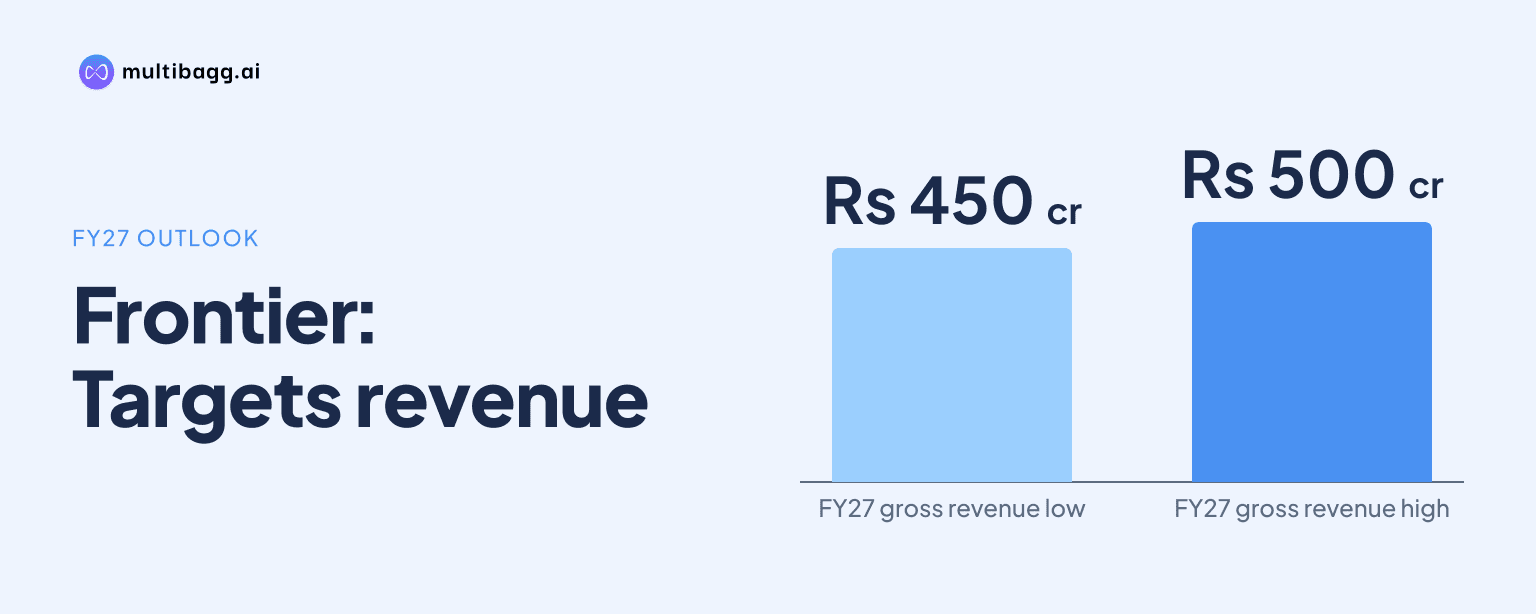
Frontier Springs Limited expects financial year 2027 (FY27) gross revenue of at least ₹450 crore after first-quarter supply constraints, while continuing to work towards ₹500 crore guidance. Second-quarter FY27 (Q2FY27) revenue from operations rose 20.54% year on year to ₹99.73 crore as the company executed some orders deferred from Q1.
Know Frontier Springs inside out
Results, valuation, peers and who's buying, in one view.
How did Frontier Springs perform in Q2FY27?
Frontier Springs reported Q2FY27 revenue from operations of ₹99.73 crore, compared with ₹82.74 crore in Q2FY26 and ₹78.46 crore in Q1FY27. Revenue increased 27.11% quarter on quarter and 20.54% year on year. Management said part of the increase came from orders that could not be completed in Q1 because raw-material availability was constrained by the geopolitical situation.
Profitability rose faster than revenue in Q2FY27. Earnings before interest, tax, depreciation and amortisation (EBITDA) were ₹29.73 crore, 34.69% above ₹22.07 crore a year earlier and 54.55% above ₹19.24 crore in Q1FY27. The EBITDA margin rose to 29.81% from 26.68% in Q2FY26 and 24.52% in Q1FY27, while profit after tax (PAT) increased 35.79% year on year to ₹21.33 crore.
The first-half comparison shows the contribution of the Q2 recovery. H1FY27 revenue from operations reached ₹178.19 crore, against ₹158.08 crore in H1FY26, while EBITDA increased to ₹48.97 crore from ₹42.50 crore. H1FY27 PAT was ₹33.34 crore versus ₹30.45 crore, and the EBITDA margin moved to 27.48% from 26.88%.
Why does Frontier Springs expect at least ₹450 crore in FY27 gross revenue?
Frontier Springs expects FY27 gross revenue of at least ₹450 crore because Q1 supply constraints delayed its execution schedule. Management said it continues to work towards its stated ₹500 crore guidance, but identified raw-material availability constraints during Q1FY27 as the reason it was set back from its earlier pace.
The ₹450 crore minimum is above FY26 revenue from operations of ₹322.06 crore, which was 39.22% higher than ₹231.34 crore in FY25. However, management describes the FY27 goal as gross revenue, whereas the historical tables report revenue from operations. The presentation does not establish that the two measures are identical, so they should not be treated as directly comparable.
Management said it expects to maintain the Q2FY27 run-rate, when revenue from operations was ₹99.73 crore. Its outlook rests on converting deferred orders and its current order position into deliveries, since the Q2 increase was partly linked to clearing orders postponed from Q1 rather than only to new demand.
Got a follow-up? Ask IRIS
What will drive Frontier Springs' FY27 execution?
Frontier Springs identifies deferred-order execution, wagon tenders, air-spring output and forging utilisation as the operational levers for FY27. In coil springs, tenders for 4,000 wagons have been finalised, which management said will drive the next leg of growth for that segment.
The air-springs business is operating at around 250 coach sets each month and has a strong order book, according to management. The presentation says air springs are used in passenger coaches, while hot coil springs are widely used in freight, coaching and locomotive stock, giving the two product lines exposure to different railway applications.
Forging growth in Q2FY27 was driven entirely by railways, management said, while orders continued to come in. Frontier Springs has also taken up automotive job work to raise forging-capacity utilisation. Management said automotive work carries slightly lower margins, but expects the extra volume to lower the operating cost of the forging capacity.
The FIBA system is another potential contributor, although the presentation does not quantify its revenue opportunity. Management said the system has received approval and that it expects a trial order shortly. The trial is expected to run for six to eight months, after which management expects commercial production to begin.
What could affect Frontier Springs' margins and delivery plan?
Frontier Springs said higher steel, oil and gas prices could put pressure on margins in coming quarters. Management said it is incorporating current input costs into tender bids to protect profitability, making bid outcomes and the subsequent movement in those input costs relevant to the FY27 margin outcome.
The Q2FY27 EBITDA margin of 29.81% was 313 basis points above Q2FY26's 26.68% and 529 basis points above Q1FY27's 24.52%. Total operating expenses increased 15.38% year on year to ₹70.00 crore in Q2FY27, below the 20.54% increase in revenue from operations, alongside the reported margin expansion.
Forging utilisation is also an execution variable because automotive job work is intended to add volume despite its slightly lower margins. Management's stated mechanism is that greater utilisation should bring down the operating cost of the forging capacity; the presentation gives no figure for expected utilisation, cost savings or automotive revenue in FY27.
Conclusion
Frontier Springs' FY27 outlook combines a minimum gross-revenue expectation of ₹450 crore with continued work towards ₹500 crore, following a Q1 disruption and a Q2 recovery. The 4,000-wagon tenders, air-spring production of around 250 coach sets a month and rail-led forging demand are the operating actions management has identified to support execution.
The next disclosures should show whether deferred orders continue to convert into deliveries and whether input-cost pressure affects tender economics after Q2FY27's 29.81% EBITDA margin. Management also expects a FIBA trial order shortly, and the disclosed six-to-eight-month trial is the scheduled step before expected commercial production.