










Frontier Springs links primary customer to Rs 2.93 lakh crore capex
Key highlights
- The Union Budget 2026-27 allocates Rs 2.93 lakh crore of capital expenditure to Indian Railways.
- Indian Railways has a FY2026-27 freight-loading target of 1,765 million tonnes.
- The National Rail Plan identifies 126 projects with combined stated costs of Rs 1.15399 lakh crore.
- Frontier Springs does not disclose a 90,000-wagon procurement or replacement forecast in the supplied material.
powered by IRIS
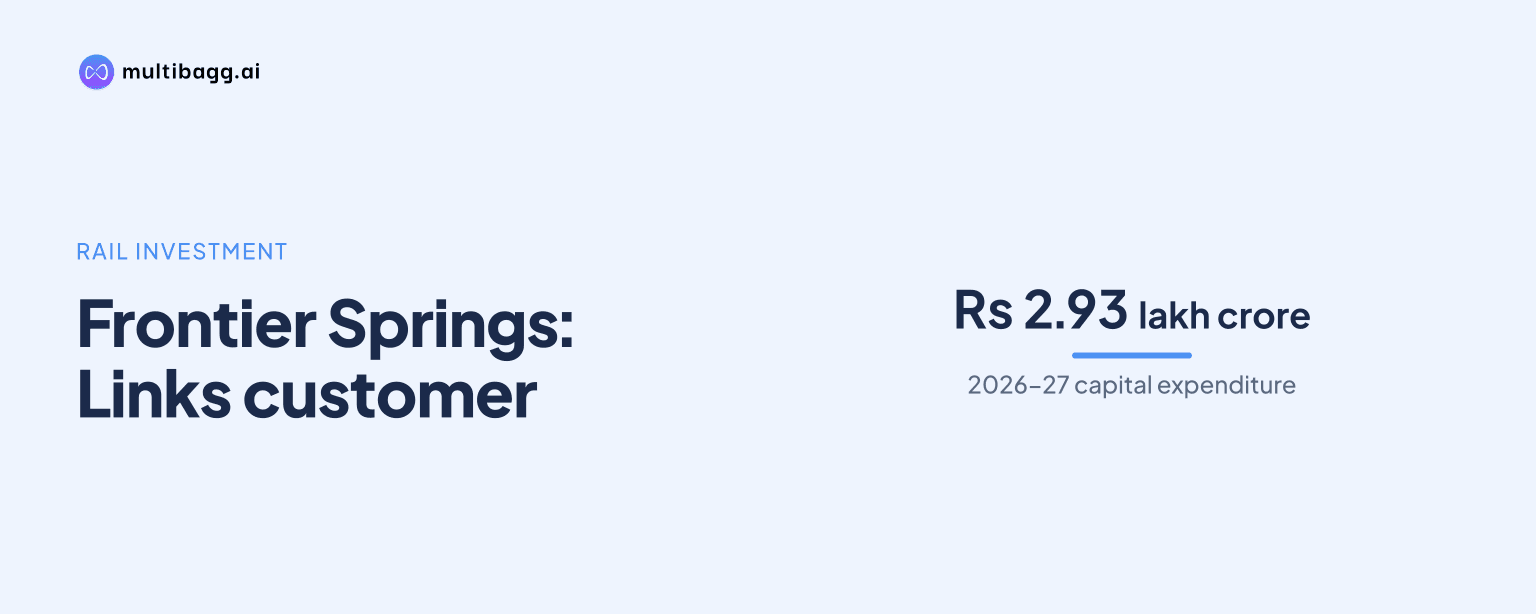
Frontier Springs Limited identifies Indian Railways as its primary customer as the Union Budget 2026-27 allocates Rs 2.93 lakh crore in rail capital expenditure, while the presentation sets a FY2026-27 freight-loading target of 1,765 million tonnes. The supplied material does not disclose a procurement or replacement cycle of up to 90,000 wagons.
Know Frontier Springs inside out
Results, valuation, peers and who's buying, in one view.
What rail-investment backdrop does Frontier Springs cite?
Frontier Springs cites Rs 2.93 lakh crore of capital expenditure allocated to Indian Railways in the Union Budget 2026-27. The presentation places this allocation alongside its description of Indian Railways as the company’s primary customer and of the network as the world’s fourth largest railway network. The figure is a railway-system allocation, not a Frontier Springs order, sales forecast or production commitment.
Frontier Springs also reports budget-estimate revenue from operations of Rs 3.02 lakh crore for FY2026-27 for Indian Railways. This measure differs from the Rs 2.93 lakh crore capital allocation: revenue from operations is an operating-income estimate, while capital expenditure funds investment. The presentation does not state what portion of either amount relates to rolling stock, springs or Frontier Springs.
Does Frontier Springs disclose a 90,000-wagon replacement cycle?
No, Frontier Springs does not disclose a wagon-procurement, fleet-replacement or fleet-expansion figure of up to 90,000 wagons in the supplied material. It gives a FY2026-27 freight-loading target of 1,765 million tonnes, but provides no wagon count, tender timetable, procurement value or expected component volumes for the company.
Frontier Springs says 260 Vande Bharat rakes are planned for manufacture. That is a passenger-train manufacturing plan, rather than a stated contract or demand forecast for the company. The presentation does not say whether Frontier Springs supplies these rakes, identify the spring type required, or estimate sales arising from the 260-rake plan.
Which railway expansion measures does Frontier Springs identify?
Frontier Springs reports 5,300 kilometres of new railway lines added in FY2024, compared with 2,701 route kilometres, or RKMs, electrified in FY2025. These are different infrastructure measures in different reporting periods: the new-line figure concerns network expansion, while the electrification figure concerns conversion of existing or new routes. Neither is presented as a measure of wagon replacement or spring demand.
The company also states that 582 kilometres were upgraded with automatic signalling in FY2024. Nearly 118 Gati Shakti Cargo Terminals, or GCTs, had been commissioned, while 306 locations had been approved as of January 13, 2026. The gap of 188 between approved locations and commissioned terminals shows that the disclosed terminal programme includes locations at an earlier approval stage.
What does the National Rail Plan contain?
Frontier Springs says the National Rail Plan identifies 58 super-critical projects covering 3,750 kilometres at a stated cost of Rs 39,663 crore. It also identifies 68 critical projects spanning 6,913 kilometres and costing Rs 75,736 crore. The critical category has 10 more projects, 3,163 more kilometres and Rs 36,073 crore more stated cost than the super-critical category.
Together, the two categories cover 126 projects and 10,663 kilometres, with a combined stated cost of Rs 1.15399 lakh crore. Frontier Springs does not identify any of the 126 projects as a contract, approved supplier programme or addressable-revenue opportunity for the company. The plan therefore indicates the scale of disclosed rail development, not a confirmed Frontier Springs sales pipeline.
Got a follow-up? Ask IRIS
How do freight and policy programmes fit the opportunity?
Frontier Springs cites the 1,765 million-tonne FY2026-27 freight-loading target as part of its Indian Railways backdrop. It also describes Mission Raftaar as aiming to double average freight-train speed and increase the average speed of superfast, mail and express trains by 25 kilometres per hour. These are railway operating objectives, rather than targets assigned to Frontier Springs.
The presentation says the government has cleared 100% foreign direct investment, or FDI, in the railway sector other than operations through the automatic route. It further describes the Indian Railway Innovation Policy as intending to work with start-ups, entrepreneurs, technology developers and innovators on affordable, user-friendly and reliable solutions. Frontier Springs does not disclose investment received, a policy partnership or work awarded under either initiative.
Which spring applications does Frontier Springs describe?
Frontier Springs describes hot coil springs as steel products heated and shaped into coils, with use across freight, coaching and locomotive stock. It describes air springs as rubber products filled with compressed air and used in Linke Hofmann Busch, or LHB, passenger coaches. The product descriptions therefore cover freight, locomotive, conventional coaching and LHB passenger-coach applications.
The company says both hot coil and air springs absorb shock and provide a smoother ride. It describes hot coil springs as more expensive to manufacture and air springs as cost-efficient to manufacture, while listing better handling, greater resilience and less maintenance among the stated advantages. Frontier Springs does not provide capacity, realised price, margin, delivery volume or revenue split for either spring category.
Conclusion
Frontier Springs presents its exposure to Indian Railways against a disclosed Rs 2.93 lakh crore FY2026-27 capital-expenditure allocation, a 1,765 million-tonne freight target and National Rail Plan projects worth Rs 1.15399 lakh crore. Its hot coil spring and air spring descriptions show applications across freight, locomotive, coaching and LHB passenger stock, but the presentation does not convert railway programmes into company-specific demand.
What to watch next is whether Frontier Springs links its own orders, capacity, product mix or customer contracts to the 260 planned Vande Bharat rakes, 306 approved GCT locations or the 126 National Rail Plan projects. The supplied material leaves unresolved the volume of springs needed, the timing of any wagon procurement and Frontier Springs’ expected participation in these programmes.