










GACL targets 75% chlorine integration within three years
Key highlights
- GACL aims to increase chlorine integration from 45% to almost 75% in two to three years.
- GACL currently sells about 150 tonnes per day of chlorine through pipelines and 700 to 750 tonnes per day externally.
- GACL plans to commission one HCl synthesis unit in the current year and another in the next year or two.
- GACL plans to raise renewable energy’s power-mix share from 49% to 60% by March 2027.
powered by IRIS
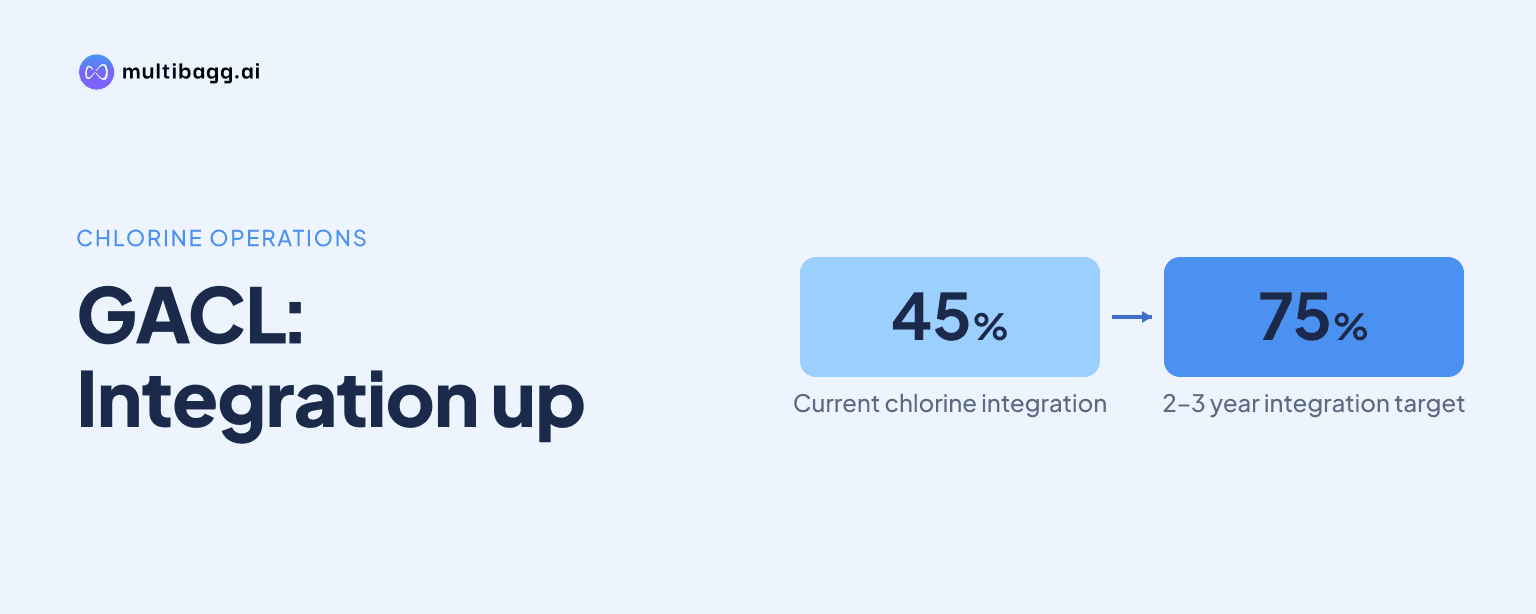
Gujarat Alkalies (GACL) aims to raise chlorine integration from about 45% to almost 75% in the next two to three years through hydrochloric acid, or HCl, synthesis and phosphoric-acid projects. Management said GACL currently sells about 150 tonnes per day through pipelines and 700 to 750 tonnes per day to external customers.
Know Gujarat Alkalies & Chemicals inside out
Results, valuation, peers and who's buying, in one view.
How will GACL raise chlorine integration to 75%?
GACL plans to raise chlorine integration by commissioning chlorine-consuming downstream projects, including an HCl synthesis unit in the current year, another HCl synthesis unit in the next year or two, and a phosphoric-acid plant. Management said the integration ratio is likely to approach 75% after the chlorine-integration capital-expenditure pipeline is commissioned.
The proposed move would add about 30 percentage points to GACL’s current integration level of 45%. Management set a two-to-three-year target rather than giving a project-by-project chlorine-consumption breakdown, so the contribution of each HCl unit and the phosphoric-acid plant has not been disclosed.
GACL currently has pipeline chlorine sales of about 150 tonnes per day, while sales to external customers in tonners amount to about 700 to 750 tonnes per day. These merchant sales remain relevant at the current 45% integration level, although management did not disclose total chlorine production or quantify the volume expected to move into internal consumption.
The second HCl synthesis unit has received in-principle Board approval, according to management. GACL did not state the capital cost, design capacity, commissioning month or expected revenue contribution for either HCl project in the discussion on its 75% integration goal.
Why does GACL’s chlorine integration affect caustic soda operations?
GACL said the ability to sell or consume chlorine affects caustic soda plant utilisation because chlorine and caustic soda are co-produced in chlor-alkali operations. Higher internal use of chlorine would leave a larger share of output linked to GACL’s downstream products rather than to pipeline and tonner sales channels.
Management said chlorine prices had been substantially negative before improving significantly during the quarter, helping to maintain electrochemical-unit, or ECU, levels. It did not disclose the chlorine-price movement in rupees, the ECU level, or the profit impact of that improvement.
In response to an analyst’s question on positive chlorine realisations, management said increasing downstream chlorine capacity across the industry was affecting merchant sales and improving chlorine pricing. That was a management view of market conditions, not a forecast of future prices or a disclosed industry supply-demand estimate.
GACL also linked its chlor-alkali strategy to power costs. Management said average power cost was close to Rs 6.95 per kilowatt-hour, or kWh, and renewable energy, or RE, represented 49% of the power mix; it plans to increase RE to 60% by March 2027 and expects power cost of Rs 6.18 per kWh under that plan.
Which projects and dates support GACL’s integration plan?
GACL identified the HCl synthesis unit due in the current year as the nearest commissioning relevant to chlorine integration. The second HCl unit is expected in the next year or two, while the phosphoric-acid plant was also named as part of the project pipeline supporting the almost 75% integration level.
Management’s broader current-year schedule includes a 200-tonnes-per-day caustic flaking unit, the HCl synthesis unit, cell-element replacement work and phase one of chlorotoluene downstream units by March 2027. Of these projects, management directly identified the HCl unit, rather than the caustic flaking or cell-replacement projects, in its discussion of chlorine integration.
For FY28, GACL plans to commission an electronic-grade hydrogen peroxide plant around January. Management’s FY29 schedule includes boilers, a potassium hydroxide, or KOH, expansion at Vadodara, and a second food-grade phosphoric-acid plant at Dahej.
The call did not clarify whether the second food-grade phosphoric-acid plant planned for FY29 is the same project referred to in the two-to-three-year chlorine-integration plan. It also did not specify whether the HCl units or phosphoric-acid facilities will be commissioned before, or after, GACL reaches the almost 75% target.
Got a follow-up? Ask IRIS
Which products and operating measures did GACL highlight?
GACL said chlorotoluene and the chlorotoluene group recorded pricing uplift of almost 100% from the same quarter a year earlier. Management also cited a 44% improvement for phosphoric acid, a 31% improvement for hydrogen peroxide from the previous quarter, and an additional 10% for the overall caustic soda group.
An analyst said value-added products other than caustic soda accounted for close to 61% of second-quarter sales. GACL did not provide an exact product-wise share of earnings before interest, tax, depreciation and amortisation, or EBITDA, within reported H1 FY27 EBITDA of Rs 450 crore, saying such a breakdown would be difficult.
Management said Project Ahvaan, its strategic transformation exercise, focuses on energy efficiency, procurement, production and plant operations, with power as the primary focus. Beyond the March 2027 target of 60% RE and Rs 6.18 per kWh, management’s longer-term FY30 plan is to reach 80% RE and reduce power cost to less than Rs 6 per kWh.
GACL also said GNAL’s second-quarter sales grew about 23% and EBITDA rose about 19%. Management attributed its outlook for GNAL to plant stabilisation at optimal utilisation, higher caustic soda and hydrogen sales, and improved caustic realisation, while describing these as expectations rather than guidance.
What does GACL’s chlorine plan leave undisclosed?
GACL has disclosed the target, timeframe and named projects, but not the project-level chlorine volumes needed to move integration from 45% to almost 75%. It also did not disclose total chlorine output, merchant-sales revenue, chlorine realisation, or the capital expenditure assigned specifically to the integration programme.
Management declined to quantify value-added-products EBITDA within H1 FY27 EBITDA of Rs 450 crore. As a result, the call does not establish how much of the reported profitability came from chlorotoluene, phosphoric acid, hydrogen peroxide, caustic soda or the chlorine-related downstream portfolio.
Hydrazine hydrate was described as a business still being developed and ramped up, despite GACL being India’s sole producer and using indigenous technology. Management said it would assess hydrazine hydrate over a longer operating horizon instead of one or two quarters, and gave no utilisation, yield, revenue or profit target.
Conclusion
GACL’s disclosed plan is to shift chlorine integration from 45% to almost 75% over two to three years through HCl synthesis and phosphoric-acid projects. The plan is significant for its chlor-alkali operations because chlorine consumption and sales affect caustic soda utilisation, while chlorine realisations influence ECU economics; current merchant volumes include 150 tonnes per day of pipeline sales and 700 to 750 tonnes per day of external sales.
The next disclosed milestones are commissioning of an HCl synthesis unit in the current year, chlorotoluene downstream phase one by March 2027, and progress towards a 60% RE power mix by March 2027. Management also expects another HCl unit in the next year or two, but project-level chlorine consumption and capital spending remain undisclosed.