










Gujarat Alkalies and Chemicals Q2 profit rises to ₹79 crore
Key highlights
- Gujarat Alkalies and Chemicals reported Q2 FY27 revenue of ₹1,358 crore, up 25.3% year on year.
- Q2 FY27 EBITDA rose 66.9% year on year to ₹222 crore, with margin at 15.74%.
- Q2 FY27 net profit increased to ₹79 crore from ₹16 crore a year earlier.
- GACL targets chlorine integration of about 75% in two to three years, up from about 45%.
powered by IRIS
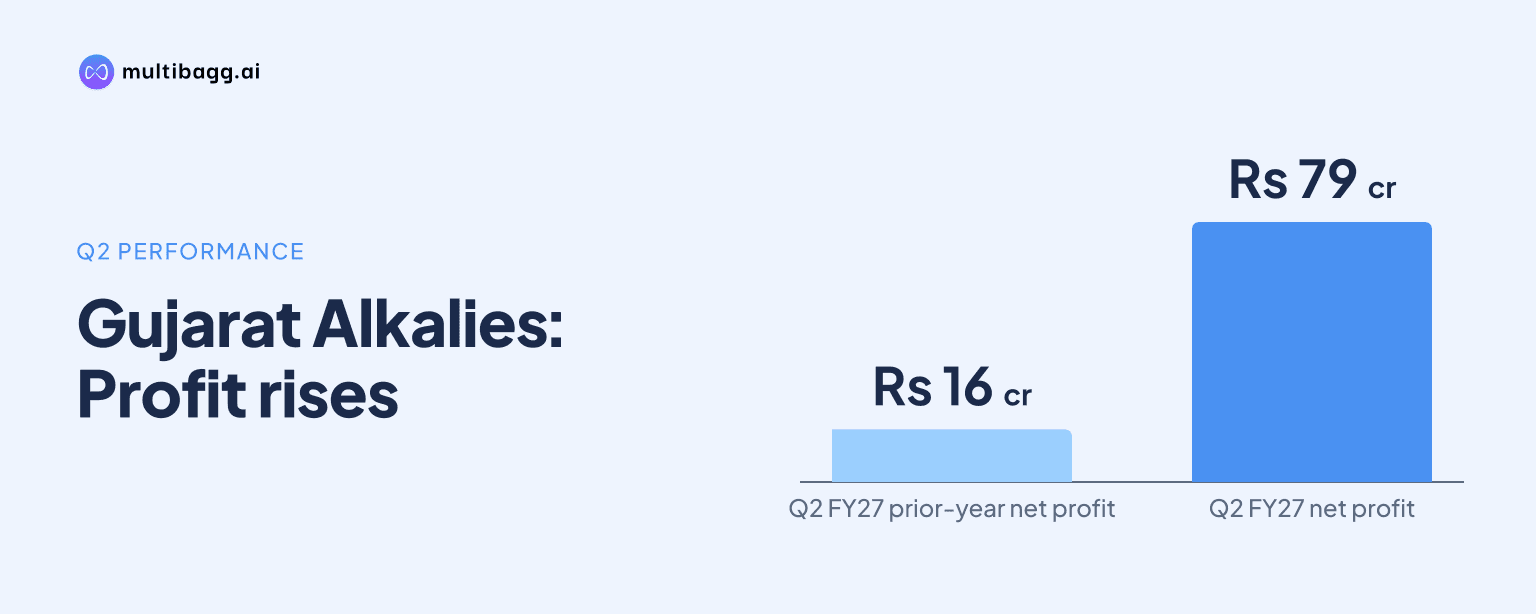
Gujarat Alkalies and Chemicals Limited reported standalone Q2 FY27 net profit of ₹79 crore, compared with ₹16 crore a year earlier, while revenue from operations rose 25.3% year on year to ₹1,358 crore and EBITDA increased 66.9% to ₹222 crore.
Know Gujarat Alkalies & Chemicals inside out
Results, valuation, peers and who's buying, in one view.
What did Gujarat Alkalies and Chemicals report in Q2 FY27?
Gujarat Alkalies and Chemicals Limited, referred to as GACL, reported a substantial year-on-year improvement in its September 2026 quarter earnings. Standalone revenue from operations reached ₹1,358 crore, against ₹1,083 crore in the corresponding quarter of the previous year. The company described external sales revenue of ₹1,334.79 crore as its highest quarterly external sales in the past two decades.
EBITDA rose to ₹222 crore from ₹133 crore a year earlier, while profit before tax increased to ₹102 crore from ₹13 crore. Net profit stood at ₹79 crore, compared with ₹16 crore in Q2 FY26. The reported EBITDA margin expanded to 15.74% from 11.6%, indicating that earnings grew faster than revenue during the quarter.
How did GACL's earnings improve during the quarter?
GACL attributed the quarterly performance to better realisations and product mix, according to the earnings-call material. The company also reported that demand in domestic and export markets was strong for chlorotoluene and acid products. These factors supported the increase in revenue and operating profit.
The company recorded sequential revenue growth as well. Revenue was ₹1,245 crore in the June 2026 quarter and increased 9% to ₹1,358 crore in the September quarter. Net profit rose 48.4% sequentially from ₹53 crore, while earnings per share increased to ₹10.79 from ₹7.27.
However, some operating-cost pressure remained visible. The earnings-call summary cited a ₹0.45 per unit increase in grid power cost, while another summary noted that operating margin was 16.3%, down 2.1 percentage points sequentially from 18.4%. The reported year-on-year EBITDA-margin improvement and the sequential operating-margin movement use different disclosed margin measures and should not be treated as identical.
What are GACL's chlorine integration and renewable-energy plans?
GACL plans to raise chlorine integration from about 45% to roughly 75% over the next two to three years through hydrochloric acid synthesis and phosphoric-acid projects. Chlorine is a co-product of the chlor-alkali process, and greater internal consumption can reduce dependence on external chlorine sales.
Management said external chlorine sales were around 700 to 750, although the unit was not clearly specified in the available call summary. The proposed integration projects are therefore relevant to the company’s product mix and operating configuration rather than being only an expansion in sales volume.
The company also targets renewable energy to account for 60% of its power mix by the end of March 2027, with a longer-term aim of 80%. Power is an important input cost for chlor-alkali producers, so the renewable-energy programme is central to GACL's response to higher grid-power costs cited in the quarter.
Got a follow-up? Ask IRIS
What is Project AMA and what targets has GACL set?
GACL has outlined a revenue target of more than ₹10,000 crore and an EBITDA margin above 20% by FY31 under Project AMA. The plan links the company’s growth objectives with higher chlorine utilisation, new projects and a greater share of renewable electricity.
The target is substantially above the company’s reported FY25-26 revenue of ₹4,358 crore. It also exceeds the Q2 FY27 reported EBITDA margin of 15.74%. The disclosed figures establish the scale of management’s stated ambition, but the company did not provide a detailed quarterly pathway to these targets in the material provided.
Hydrazine hydrate remains another strategically important product for GACL. Management said the company is India’s sole producer and that the technology was developed indigenously. The company also discussed prospects for liquid and solid caustic soda and noted India’s position as the world’s third-largest producer in the call summary.
How do the results affect GACL investors and operations?
For investors, the quarter shows higher revenue, EBITDA and net profit compared with both the previous quarter and the year-earlier period. First-half FY27 revenue was reported at ₹2,662 crore, up 18% year on year, while EBITDA was ₹451 crore, up 75%, and net profit was ₹133 crore, up 454%.
The operational focus remains on sustaining profitability amid energy and commodity-price volatility. Management’s plans for chlorine integration and renewable power address two identified operating issues: monetising chlorine more effectively and limiting exposure to grid electricity costs. Their financial effect will depend on the commissioning and performance of the stated projects.
The company’s Q2 performance also reflects conditions in chemical markets where product realisations and demand can move materially across cycles. GACL management expressed confidence in demand but also remained cautious on commodity cycles and energy-cost volatility. The available information does not establish a forecast for future margins or earnings.
Conclusion
GACL delivered a stronger Q2 FY27, with ₹1,358 crore of standalone revenue, ₹222 crore of EBITDA and ₹79 crore of net profit. The results were supported by better realisations and product mix, while the sharp rise in profit underscores the operating leverage from the improvement in EBITDA over the year-earlier quarter.
The next developments to watch are the progress of hydrochloric acid and phosphoric-acid projects intended to lift chlorine integration to about 75% over two to three years, and the renewable-power target of 60% by the end of March 2027. Investors will also monitor power costs, commodity conditions and progress toward the FY31 Project AMA targets.