










ACME Solar Holdings Orders 3.1 GWh BESS for Indian Projects
Key highlights
- ACME Solar has ordered more than 3.1 GWh of BESS from Zhejiang Narada and Trina Energy.
- The ordered systems are scheduled for delivery in phases over the next four to eight months of the current financial year.
- ACME Solar expects the supported renewable projects to be commissioned within 12 to 18 months.
- India is estimated to require 236 GWh of battery storage by 2031-32 under the National Electricity Plan 2023.
powered by IRIS
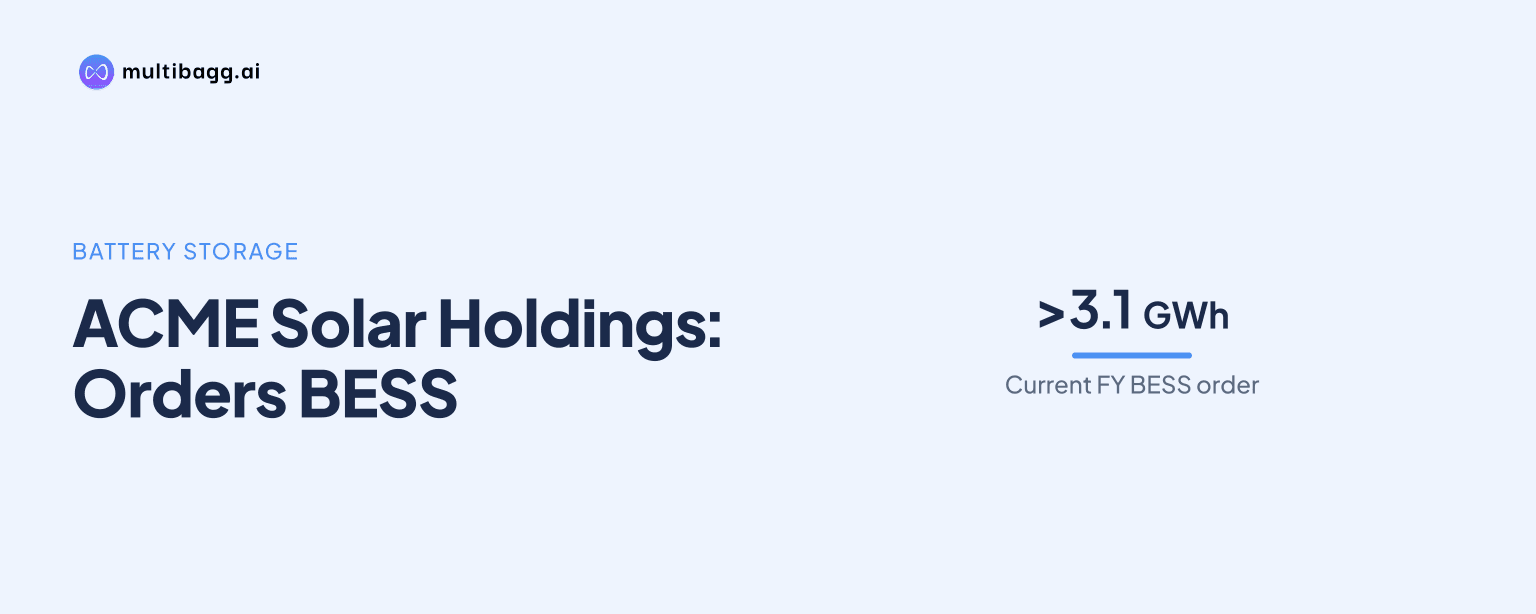
ACME Solar Holdings has ordered more than 3.1 GWh of battery energy storage systems from Zhejiang Narada and Trina Energy, with the equipment intended for renewable projects across India that are scheduled for commissioning within 12 to 18 months. The procurement is among the largest disclosed battery-storage orders in India and supports the company’s firm and dispatchable renewable energy pipeline.
Know ACME Solar Holdings inside out
Results, valuation, peers and who's buying, in one view.
What has ACME Solar ordered?
ACME Solar has placed orders for over 3.1 GWh of Battery Energy Storage Systems, or BESS, from Zhejiang Narada and Trina Energy. The company said the equipment will provide high-efficiency and scalable storage solutions for multiple renewable energy and battery-linked projects in India.
The order is intended for ACME Solar’s Firm and Dispatchable Renewable Energy, or FDRE, projects. These projects combine renewable generation with storage to supply electricity more reliably than a standalone solar or wind facility. The company has not disclosed the value of the procurement or the allocation of the ordered capacity between the two suppliers.
How will the battery systems be deployed?
The ordered systems will be delivered in phases over the next four to eight months of the current financial year, according to the company statement. ACME Solar plans to deploy them across multiple states, although it has not specified individual project locations, capacities or commissioning dates.
The planned commissioning window of 12 to 18 months indicates that procurement is being aligned with projects already under development. In an FDRE structure, battery storage can retain electricity generated during periods of strong solar or wind output and discharge it when contracted supply is required. This makes storage capacity an important part of meeting dispatch commitments under long-term power purchase agreements.
ACME Solar has been adding storage capacity in Rajasthan through its subsidiaries. Supplied reports describe several BESS commissioning milestones at FDRE and assured peak-power projects, including additions at Neemri in Chittorgarh district and Kelan in Bikaner district. These projects are connected to grid substations and have 25-year power purchase agreements with a national renewable energy implementing agency.
What is ACME Solar’s existing battery-storage position?
ACME Solar has reported rapid growth in operational battery capacity, although the supplied disclosures refer to different reporting dates and project scopes. A quarterly release dated October 28 stated that the company had around 5.2 GWh of commissioned battery capacity before a subsequent Neemri addition.
Other supplied reports recorded 4.96 GWh of total operational BESS capacity following the commissioning of 107.36 MW and 437.49 MWh across two Rajasthan projects. An earlier company update reported cumulative operational BESS capacity of about 3.62 GWh across three Rajasthan sites after 2.29 GWh was commissioned during the financial year to date.
At Neemri, ACME Solar commissioned an additional 88.02 MW and 366.969 MWh on October 30, taking that project’s stated commissioned storage capacity to 159.66 MW and 664.261 MWh against a plan of 250 MW and 1,069 MWh. Separately, a Rajasthan FDRE project was reported to have 195.35 MW and 781.40 MWh commissioned against planned capacity of 300 MW and 1,200 MWh.
Got a follow-up? Ask IRIS
What does India’s storage demand indicate?
India will require 236 GWh of battery storage by 2031-32, according to the Ministry of Power’s estimate cited from the National Electricity Plan 2023. This requirement reflects the need to integrate a larger share of variable renewable generation while maintaining reliable electricity supply during evening and peak-demand periods.
The 3.1 GWh order is modest relative to the national requirement but material at company level. It gives ACME Solar access to equipment for a sizeable part of its near-term project pipeline and reduces the risk that storage equipment availability could delay projects that are already contracted or under construction.
ACME Solar has said it is on track to have 10 GWh of BESS capacity by March 2027, with an upward bias because contracting has exceeded that target. The company also previously said it had secured battery supply for about 90% of its 20 GWh portfolio from suppliers including CATL and Lithium. The latest order adds Zhejiang Narada and Trina Energy to the suppliers named in the provided disclosures.
How does the order affect investors and renewable operations?
For investors, the order provides visibility on ACME Solar’s execution plans in the storage segment, but it does not establish the financial return on the projects because procurement costs, tariff details and project-level financing have not been disclosed. There is also no stock-price movement included in the supplied information, so no direct market reaction can be assessed.
For operations, phased delivery may allow ACME Solar to coordinate equipment arrival with construction and grid-connection schedules. The company’s ability to commission the projects within the stated 12-to-18-month period will depend on installation, transmission connectivity, testing and commercial-operation processes.
The procurement also illustrates the expanding role of battery systems in India’s renewable-energy market. Storage-backed projects are being developed to provide firm and peak-period power, rather than only electricity generated when sunlight or wind conditions are available. The disclosed order therefore supports ACME Solar’s wider move toward FDRE, hybrid and battery-linked capacity.
Conclusion
ACME Solar’s order for more than 3.1 GWh of BESS from Zhejiang Narada and Trina Energy is a significant supply commitment for its Indian renewable portfolio. It strengthens the equipment pipeline for projects that require storage to support firm and dispatchable power delivery, while adding to a series of recent battery commissioning updates in Rajasthan.
The next points to watch are phased deliveries over the next four to eight months of the current financial year and the commissioning of associated projects over the following 12 to 18 months. ACME Solar’s progress toward its stated target of more than 10 GWh of BESS capacity by March 2027 will depend on those execution milestones.