










ACME Solar says grid links support 15 GW plan by 2030
Key highlights
- ACME Solar said connectivity for its 15 GW target is scheduled for 2028 or early 2029.
- ACME Solar had signed PPAs for 8.5 GW and expects another 5 GW within 12 to 18 months.
- ACME Solar said ACME Cleantech demand is excluded from its 15 GW plan.
- ACME Solar targets 1.5 GW of commissioning in FY27 and 2.5 GW to 3 GW of GNA availability in FY28.
powered by IRIS
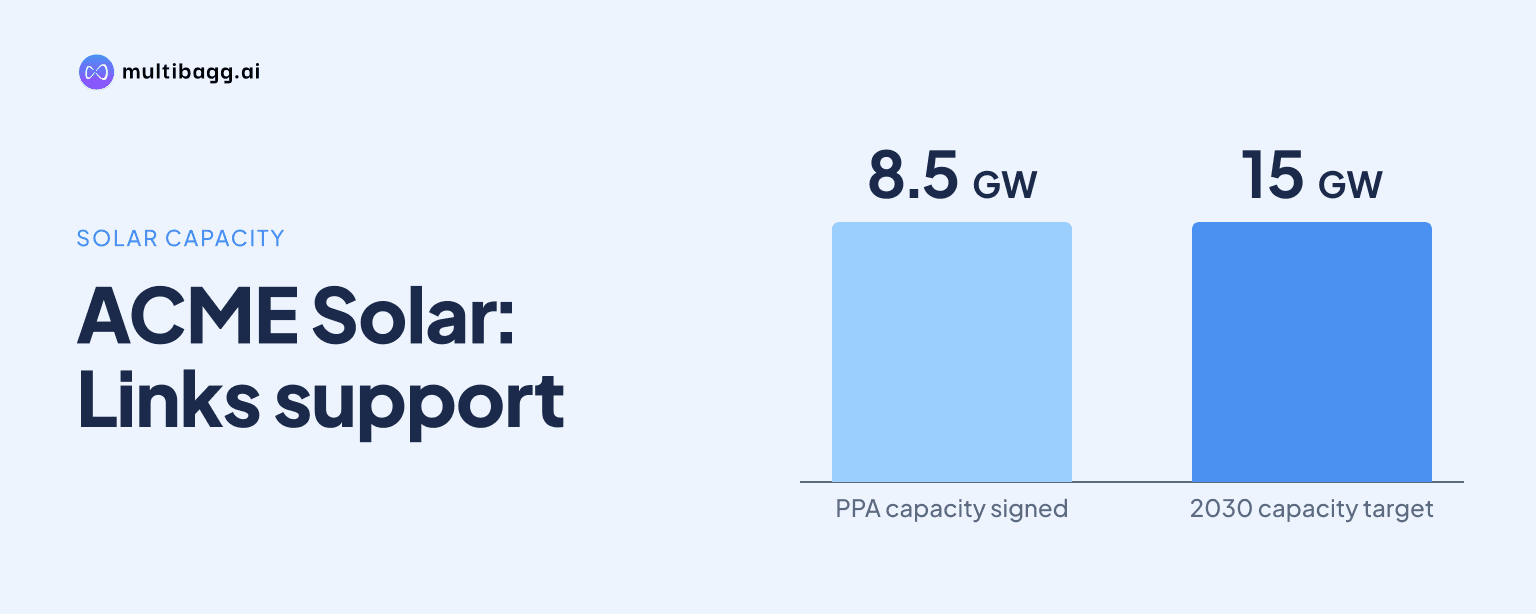
ACME Solar Holdings Limited says its 15 gigawatt (GW) capacity target for 2030 is supported by grid connectivity scheduled for 2028 or early 2029, with 8.5 GW of power purchase agreements (PPAs) already signed. Management said it expects a further 5 GW of capacity awards within the next 12 to 18 months.
Know ACME Solar Holdings inside out
Results, valuation, peers and who's buying, in one view.
Is ACME Solar’s 15 GW target at risk from grid delays?
ACME Solar said its 15 GW target is not at risk from General Network Access (GNA) connectivity because the substations targeted for the plan are expected by 2028 at the latest or in early 2029. That timetable precedes the company’s 2030 target and, according to management, provides room for project execution after transmission access becomes available.
Management said transmission-substation timelines have been extended to 30 to 36 months by the Central Transmission Utility or the Ministry of Power. It added that a further delay of six or 12 months would still fit within the 2030 objective. This is management’s assessment of the current project schedule, rather than confirmation that each substation will meet its planned date.
ACME Solar also said it has sufficient connectivity for the battery energy storage system, or BESS, projects it has discussed. Management said battery orders are made only for sites where GNA is live and the project is ready, and said it was ordering 12 gigawatt-hours of batteries. The company described battery expenditure as front-ended because debt disbursements can precede letters of credit, delivery and installation.
How much additional capacity does ACME Solar expect to contract?
ACME Solar expects to win an incremental 5 GW within 12 to 18 months, on top of the 8.5 GW of PPAs management said were already signed. It also said it planned to participate shortly in more than 3 GW to 4 GW of PPAs, framing the 15 GW roadmap around contracted capacity as well as eventual physical commissioning.
Management said that securing the planned PPAs by the end of 2027 could place ACME Solar at about 12 GW by 2029. It separately said 15 GW of contracted capacity could be tied up by the end of the next calendar year, while construction and execution would continue through 2029 and 2030. These are management targets and expectations, not confirmed project awards.
The signed 8.5 GW base represents more than half of the 15 GW target, while the expected incremental 5 GW would take contracted capacity materially closer to that goal. Management said ACME Solar had won projects at a rate of around 1.5 GW annually over the preceding three to four years. It also said peak-power and BESS projects could form a larger part of the future mix because they generate higher revenue per megawatt than conventional capacity, in management’s view.
Where does ACME Solar expect demand for the extra 5 GW?
ACME Solar said its principal route to additional demand will remain PPAs with central and state-government counterparties, particularly tenders from Solar Energy Corporation of India, or SECI. Management said it sees sufficient bidding opportunities to move from 10 GW to 15 GW, linking this view to peak-power deficits and tenders designed around identified demand.
Management said data centres, green ammonia and other demand centres could add electricity requirements, but it does not expect a fundamental change in its customer model. Rather than relying on direct sales to those end users, ACME Solar said SECI may procure power for such uses and remain a contracting conduit alongside state governments.
The company cited a recent tender cycle in which a bid became a signed PPA in about two months. Management attributed the faster process to SECI tying up demand with distribution companies before issuing the tender. It said bids for pumped storage, wind and peak power are being issued for defined requirements rather than without a customer arrangement.
Got a follow-up? Ask IRIS
Is ACME Cleantech included in ACME Solar’s 15 GW plan?
No. ACME Solar said it is not including any demand from ACME Cleantech in its 15 GW target. Management said ACME Cleantech could add capacity beyond that figure if it purchased power for green ammonia, data-related demand or other applications through SECI or other agencies, but those potential volumes are excluded from the stated plan.
The exclusion means the 15 GW calculation rests on ACME Solar’s existing PPA-led model with SECI and state-government counterparties. Management identified connectivity tie-ups, demand availability and execution capability as the three foundations of its confidence. It said the target does not require demand from the related cleantech business to be achieved.
Management also linked its demand view to increased procurement of BESS-supported peak power. It said BESS had developed trust with around 10 to 12 governments supplied by ACME Solar and its peers, and that some near-term procurement was shifting from round-the-clock power to batteries. Management said tariffs in newly won contracts for the fourth quarter or the first quarter of the following year were substantially higher than tariffs realised so far, without providing numerical comparisons.
What is ACME Solar’s delivery timetable for the plan?
ACME Solar is targeting 1.5 GW of commissioning in FY27, subject to the operationalisation of Fatehgarh 2, and expects 2.5 GW to 3 GW of GNA availability in FY28. Management said some FY27 capacity could shift by a quarter to June, while most FY28 substations are expected to become live between June and December.
The company said it had partially commissioned around 1.9 GW of its under-construction portfolio, including solar at two locations and batteries at around four locations, excluding ACME Suryodaya. It also said it had operationalised 133 megawatts of grid-facing solar during the quarter. The difference between partially commissioned capacity and grid-facing solar shows the role of transmission readiness in converting projects into fully operating assets.
For BESS operations, ACME Solar said 90 megawatts to 100 megawatts of alternating-current solar capacity from a 133-megawatt project was used to charge batteries, while 33 megawatts to 40 megawatts was supplied to the customer. Management said capitalised BESS expenditure was about Rs 90 lakh to Rs 1 crore per megawatt-hour, aided by using operational substations where transformer and alternating-current infrastructure already existed. It said this avoided about Rs 20 lakh per megawatt-hour of infrastructure expenditure compared with a greenfield installation.
Conclusion
ACME Solar’s 15 GW case combines an 8.5 GW signed PPA base, management’s expectation of another 5 GW of awards within 12 to 18 months, and substations scheduled for 2028 or early 2029. The plan excludes ACME Cleantech demand and instead depends on transmission connectivity, public-sector and state PPAs, and management’s expectation of continued peak-power procurement.
The next measures to watch are whether ACME Solar secures the more than 3 GW to 4 GW of PPAs it plans to pursue shortly, whether Fatehgarh 2 supports the FY27 commissioning target of 1.5 GW, and whether the June-to-December FY28 substation timetable delivers 2.5 GW to 3 GW of GNA availability. Management has said a six- to 12-month transmission delay would remain within its 2030 plan.