










ACME Solar Says Batteries Are Displacing Thermal RTC Procurement
Key highlights
- ACME Solar said 85% of DEEP portal short- and medium-term procurement volumes are thermal RTC tenders.
- ACME Solar said newer BESS contracts for Q4 or the following Q1 have tariffs substantially above earlier realised rates.
- ACME Solar said FY27 output is about 90% to 95% contracted, versus an estimated 50% to 65% for FY28.
- ACME Solar said it has 8.5 gigawatts of PPAs against a 15-gigawatt objective by 2030.
powered by IRIS
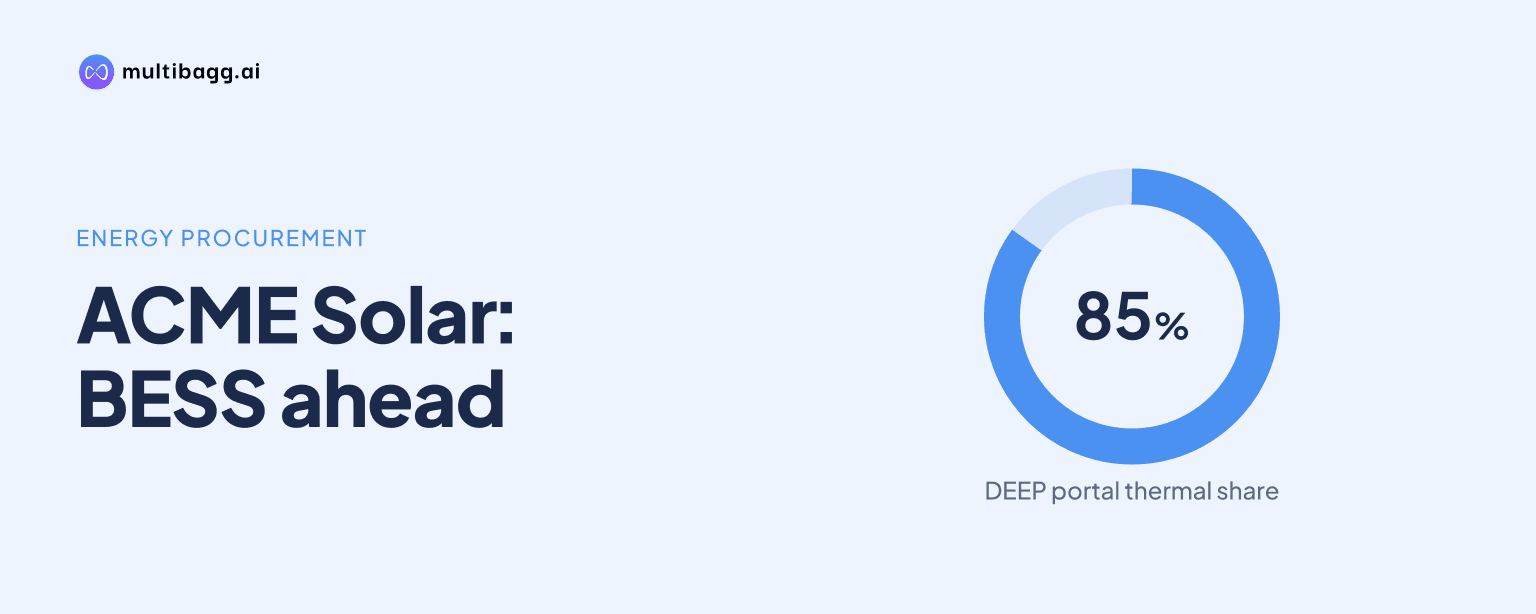
ACME Solar said battery energy storage systems, or BESS, can displace short- and medium-term round-the-clock, or RTC, thermal procurement because 85% of volumes on the DEEP portal are thermal RTC tenders. Management said newly won contracts for Q4 or the following Q1 carry tariffs substantially above rates realised so far.
Know ACME Solar Holdings inside out
Results, valuation, peers and who's buying, in one view.
Why does ACME Solar see batteries replacing RTC procurement?
ACME Solar said 85% of short- and medium-term volumes procured through the DEEP portal are thermal RTC tenders, while the remaining 15% comes from gas or other sources. Management’s argument is that states have often purchased continuous power because alternatives were unavailable, even when their practical requirement was concentrated during peak-demand hours.
Management said an RTC contract priced at Rs 6 or Rs 7 per unit can cost more in aggregate than BESS power at Rs 10 per unit if the buyer receives daytime electricity it does not need. The comparison depends on the amount of surplus energy embedded in an RTC contract, rather than a direct comparison of the stated per-unit tariffs.
ACME Solar cited Gujarat as an example during the current year, saying the state had previously bought a large amount of RTC power but had instead bought a large amount of peak power. Management said this reduced Gujarat’s short- and medium-term RTC purchase volume and reflected growing confidence in batteries after supply by ACME Solar and peers to about 10 to 12 governments.
Are ACME Solar's newer BESS contract tariffs higher?
ACME Solar said tariffs in BESS bids won for Q4 or Q1 of the following year are substantially higher than the rates it has realised so far. Management said the Q1 and Q2 delivery contracts had been signed before those quarters began, meaning the reported change in tariff realisation from Q1 to Q2 did not indicate a contemporaneous movement in market pricing.
The company said it normally signs contracts around two quarters ahead to reduce risk, and that the bids in question typically require delivery in six to 12 months rather than 15 months or more. ACME Solar said its Q3 tariff was also already contracted, making newer Q4 and following-Q1 awards its stated indicator of more recent pricing.
Management attributed the newer contract pricing to states’ assessments of near-term demand, while not presenting it as a permanent tariff trend. It said states are seeking peak power while waiting for thermal plants, pumped-storage projects or other capacity to come online, and while some projects face delays related to GNA connectivity.
How is ACME Solar managing BESS costs and charging-power exposure?
ACME Solar said its capitalised BESS cost has been between Rs 90 lakh and Rs 1 crore per megawatt-hour because it installs batteries at operational substations. Management said existing transformers and alternating-current infrastructure save about Rs 20 lakh per megawatt-hour compared with a greenfield installation.
Management expects battery prices overall to decline, but identified lithium carbonate prices, copper prices, a 6% Chinese export tax from January, supply-demand conditions and geopolitical developments as variables. This is management’s outlook rather than a cost forecast, and the company did not quantify the expected reduction in battery prices.
ACME Solar said it has no external power-purchase tie-up for charging batteries and currently depends on Indian Energy Exchange, or IEX, prices for that electricity. It expects this exposure to reduce substantially by the end of March or by June at several sites as its own solar generation becomes available to charge batteries installed at those stations.
For FY27, ACME Solar said it had contracted about 90% to 95% of the output it can produce, retaining about 5% to 10% for real-time market sales. For FY28, it estimated that 50% to 65% was contracted, subject to confirmation, leaving a larger proportion of FY28 output uncontracted than FY27 output.
Got a follow-up? Ask IRIS
What state demand supports ACME Solar's peak-power pipeline?
ACME Solar said the peak-power tender pipeline is primarily underpinned by state demand rather than demand from Solar Energy Corporation of India, or SECI, which management said has no demand of its own. Management said it had mapped states’ short-, medium- and long-term requirements and identified high demand for peak power in the near to medium term.
The company referred to a 16-gigawatt-hour tender structured as 4 gigawatts for four hours, with viability-gap funding and a 12-month commissioning requirement. Management said the tender was designed to secure supply quickly and reflected immediate power-procurement needs, rather than demand for standalone solar generation.
ACME Solar named Chhattisgarh, Odisha, Bihar, Telangana and Andhra Pradesh as states bringing forward bids, and said West Bengal and other states were buying through a SECI tender. Management’s view was that some states can be surplus in solar power while still lacking firm peak supply, which creates demand to convert solar energy into dispatchable peak power.
How do connectivity and capacity plans affect ACME Solar's execution?
ACME Solar has set a 15-gigawatt objective by 2030 and said it already held 8.5 gigawatts of power purchase agreements, or PPAs. Management said it expected to participate in more than 3 to 4 gigawatts of PPA opportunities soon and believed it could win an additional 5 gigawatts over the next 12 to 18 months.
Management said the 15-gigawatt target was not at risk from GNA connectivity because the substations relevant to that capacity are scheduled for completion by 2028 at the latest or early 2029. It said even a six- to 12-month delay would fit within the target timetable, while acknowledging that execution ultimately depends on customer demand, connectivity and project delivery.
For FY28, ACME Solar expects 2.5 to 3 gigawatts of capacity associated with GNA availability, with most substations expected to become operational from June to December. The company said it had partially commissioned about 1.9 gigawatts from its under-construction portfolio, including solar at two locations and batteries at about four locations.
ACME Solar said peak-power projects are generally installed at sites where GNA is already operational, reducing their exposure to connectivity delays. For FY27, management is targeting 1.5 gigawatts of commissioning, although it said some capacity could shift by a quarter to June depending on the operationalisation of Fatehgarh 2.
Conclusion
ACME Solar’s case is that battery-backed peak-power contracts can replace part of the RTC procurement that states have historically used for short- and medium-term needs. Its evidence is the 85% thermal RTC share it identified on the DEEP portal, Gujarat’s reported shift towards peak-power purchases, and management’s statement that newer BESS awards carry higher tariffs than earlier realised contracts.
The next measures to watch are whether IEX-based charging purchases decline by the end of March or June as solar charging capacity becomes ready, and whether FY27 output remains 90% to 95% contracted. Investors can also track the FY27 1.5-gigawatt commissioning target, the FY28 2.5-to-3-gigawatt GNA-linked capacity expectation, and the timing of Fatehgarh 2 operationalisation.