










ACME Solar Holdings Limited targets 1.5 GW amid GNA delays
Key highlights
- ACME Solar targets 1.5 GW of full FY27 commissioning, subject to GNA timing.
- ACME Solar reported 1.9 GW of partly commissioned capacity in Q2 and H1 FY27.
- ACME Solar sold 324 million units through short-term peak-power BESS contracts during the quarter.
- ACME Solar raised FY27 BESS commissioning guidance to more than 12 gigawatt-hours from 10 gigawatt-hours.
powered by IRIS
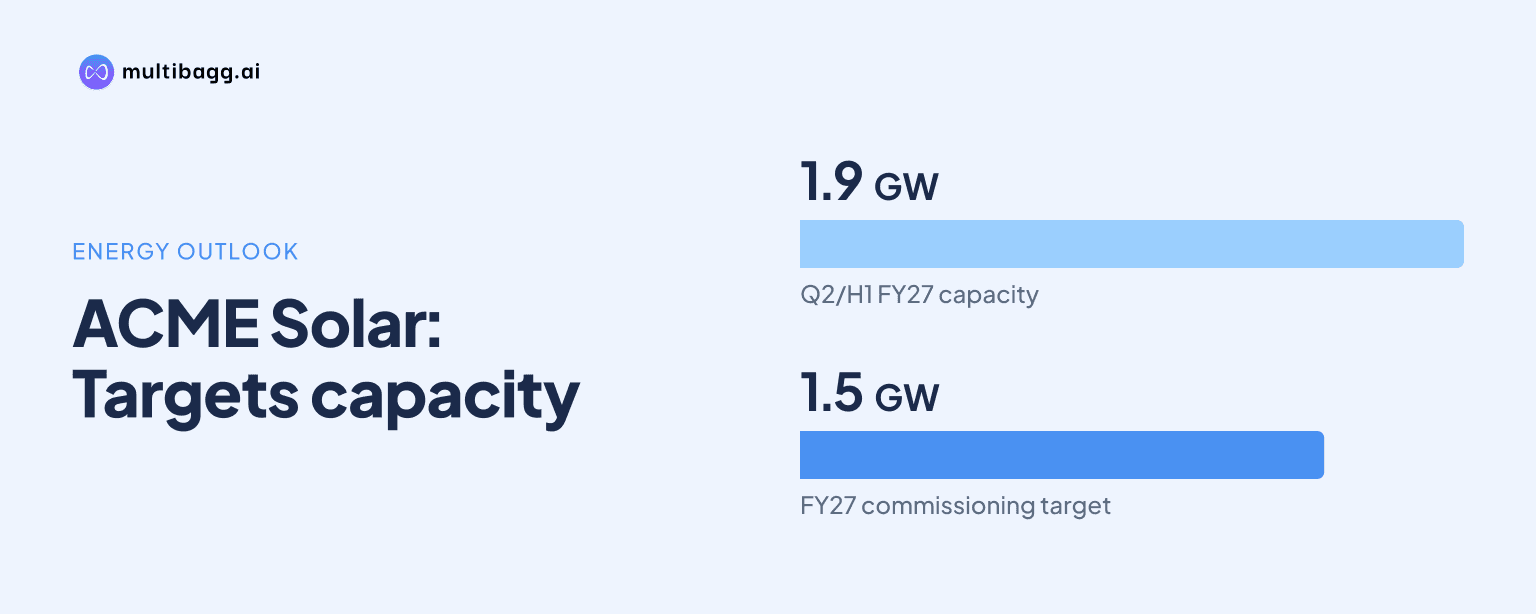
In Q2 and H1 FY27, ACME Solar targets 1.5 GW of fully commissioned firm and dispatchable renewable energy projects, subject to general network access timing. It has partly commissioned 1.9 GW and is using available grid access and batteries to earn revenue before every project reaches full commissioning.
Know ACME Solar Holdings inside out
Results, valuation, peers and who's buying, in one view.
What is ACME Solar’s FY27 full-commissioning target?
ACME Solar is targeting 1.5 GW of full commissioning in FY27, although management said the outcome could move by a quarter depending on general network access, or GNA, commissioning. Full commissioning of a firm and dispatchable renewable energy, or FDRE, plant or hybrid plant requires the relevant GNA to be live, whereas individual solar and battery elements can be commissioned earlier.
Management distinguished the 1.5 GW target from a potentially larger 2.5 GW to 3 GW of partial commissioning during FY27. ACME Solar said it had already charged 2.5 GW of alternating-current capacity, while partial commissioning was measured at 1.9 GW after a mix of solar and battery energy storage system, or BESS, assets came online. The distinction matters because a project can earn revenue before its entire contracted configuration and transmission links are complete.
How can ACME Solar earn before full grid connectivity?
ACME Solar can earn from commissioned elements before a project reaches full GNA-based commissioning because BESS capacity can be deployed early under peak-power contracts. Management said the 1.9 GW of partly commissioned capacity was already realising revenue, and it reported sales of 324 million units through short-term peak-power BESS contracts during the quarter.
At Bikaner-III, where GNA is partly available, ACME Solar said it supplies NTPC during daytime hours when transmission access is live and directs remaining solar generation to batteries. Management described the solar plant as commissioned but said incomplete GNA prevents conventional full commissioning. Charging BESS with solar power that cannot otherwise be evacuated reduces the cost of energy used for battery discharge rather than leaving that generation unused.
Which ACME Solar projects could add solar generation before March?
ACME Solar expects 1.5 GW to more than 2 GW of solar generation capacity, measured in megawatt peak, to be installed before March, depending on GNA timelines. Management identified Fatehgarh-II, Neemuch and Bikaner-III as the first three projects that alone could take installed generation above 1.5 GW, with Ananthapur potentially lifting the total beyond 2 GW.
Fatehgarh-II is the largest named contributor in that near-term group, with about 700 MW peak already installed, according to management. Its transmission line is substantially ready, but the project awaits GNA going live. At Ananthapur, management said the substation may become operational before the battery, allowing solar commissioning first or concurrent commissioning of solar and BESS rather than a uniform sequence across projects.
Got a follow-up? Ask IRIS
What does partial commissioning mean for ACME Solar’s reported results?
Partial commissioning means capacity is available for a revenue-producing function, such as battery charging and discharge, even when the corresponding solar plant or final grid arrangement is incomplete. Management rejected an analyst’s attempt to apply a 25% plant load factor, or PLF, across the full 1.9 GW, explaining that several locations have commissioned battery capacity without commissioned solar capacity.
The distinction is visible in Q2 FY27 operating data. ACME Solar reported revenue of Rs 1,007 crore, up 67.5% year on year, and earnings before interest, tax, depreciation and amortisation, or EBITDA, of Rs 874 crore, up 63.6%. Management attributed the increases primarily to short-term peak-power BESS operations and renewable-capacity additions, while power generation rose 19.6% to 1,840 million units and capacity utilisation factor increased to 27.8% from 24.1% a year earlier.
How is ACME Solar funding its battery-led execution plan?
ACME Solar raised FY27 BESS commissioning guidance to more than 12 gigawatt-hours from 10 gigawatt-hours previously, and management said it intends to capitalise the full 12 gigawatt-hours within the financial year. About 7 gigawatt-hours of batteries were already at project sites, while a further 5 gigawatt-hours remained to be received after letters of credit had been opened.
ACME Solar reported Rs 6,500 crore of capital expenditure completed so far in FY27, including Rs 3,500 crore capitalised and Rs 3,000 crore recorded as capital work in progress, or CWIP. Management did not provide a precise second-half amount but said it expected spending to be higher than Rs 6,500 crore. It also said battery installations are being placed where GNA is available, while solar modules are being installed where they can either charge batteries or supply the grid.
Management said the BESS rollout has no GNA dependency where installations are being made at locations with available GNA. It also said solar modules are being sent to sites where they can charge BESS or export to the grid. This sequencing is intended to limit the effect of delayed transmission access on battery installation and capital expenditure, while full FDRE or hybrid commissioning remains dependent on GNA.
Conclusion
ACME Solar’s 1.5 GW FY27 target measures complete FDRE and hybrid commissioning rather than every asset that can begin generating cash. Its 1.9 GW of partial commissioning, 324 million units of quarterly BESS sales and Bikaner-III operating arrangement show management’s effort to separate grid-dependent full completion from earlier battery and solar monetisation.
The next issue is whether GNA commissioning allows Fatehgarh-II, Neemuch, Bikaner-III and Ananthapur to move from partial operation to full project commissioning before March. Management also plans to capitalise more than 12 gigawatt-hours of BESS in FY27, so delivery timing for the remaining 5 gigawatt-hours of batteries and transmission access will determine how much of the 1.5 GW target is achieved on schedule.