










ACME Solar says state demand drives India’s battery auctions
Key highlights
- ACME Solar said 50 GW of peak-power bids had rolled out through September 2027.
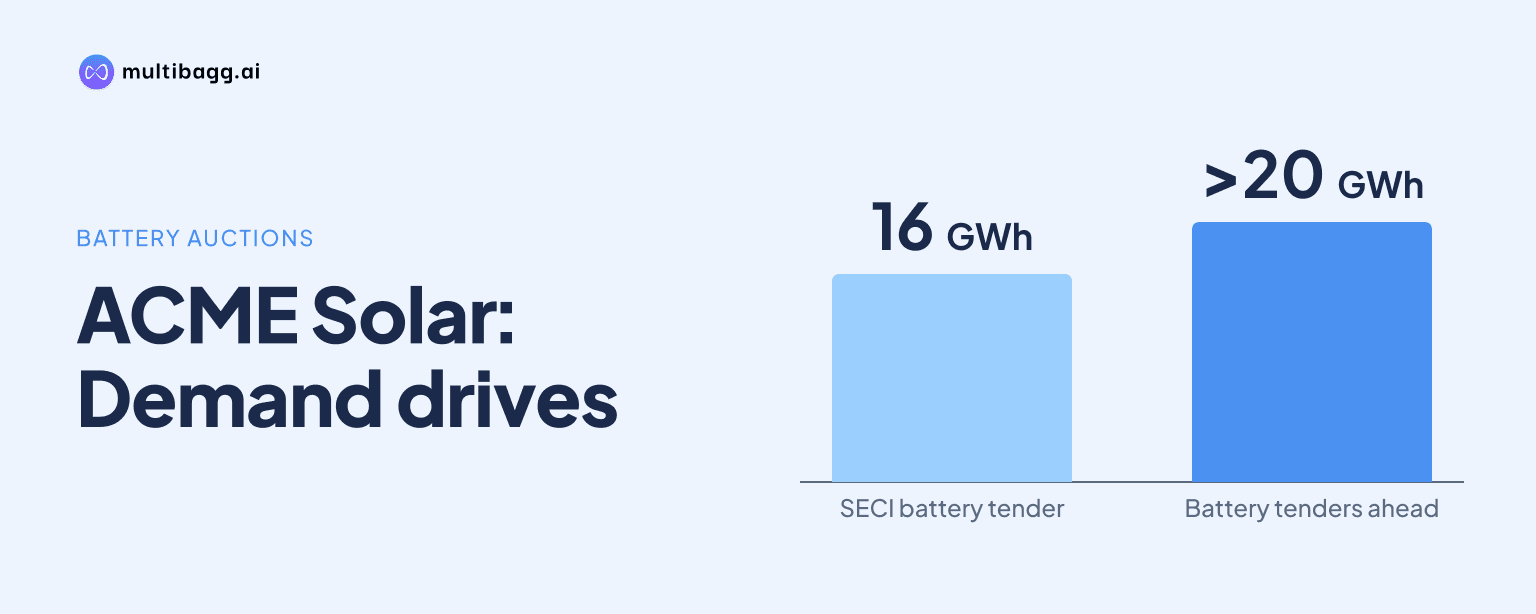
- ACME Solar said more than 20 GWh of battery tenders are upcoming.
- A recent SECI tender cited by ACME Solar is sized at 16 GWh, or 4 GW for four hours.
- ACME Solar said 85% of DEEP portal procurement volumes are thermal RTC tenders.
powered by IRIS
ACME Solar Holdings Limited says state demand, rather than tender issuance alone, is driving peak-power battery energy storage system (BESS) auctions, with 50 gigawatts (GW) of peak-power bids rolled out through September 2027. Management said states facing peak-supply shortages are contracting power because grid-connected generation can be delayed by connectivity constraints.
Know ACME Solar Holdings inside out
Results, valuation, peers and who's buying, in one view.
Why does ACME Solar say states are driving peak-power tenders?
ACME Solar says the tender pipeline is primarily supported by state demand because the Solar Energy Corporation of India (SECI) does not have electricity demand of its own. Management said ACME Solar’s short-term power sales have helped it map state requirements across short-, medium- and long-term periods, with particularly high short- and medium-term demand for peak power.
ACME Solar said states are signing a mix of five-year power purchase agreements (PPAs) and, in some cases, 20-year PPAs. Management said shorter contracts can reflect expectations that thermal generation, pumped storage projects (PSPs), or slower demand growth will ease shortages, while longer contracts depend on each state’s requirements.
Management said some states are contracting more power than their immediate plans may suggest because they do not want to depend on weather patterns, future capacity additions or delayed commissioning. ACME Solar named Chhattisgarh, Odisha, Bihar, Telangana and Andhra Pradesh as states where bids are emerging, and said West Bengal and other states are buying through a SECI tender.
What is causing states to seek more battery-backed peak power?
ACME Solar says delays in General Network Access (GNA), which allows projects to use the transmission network, are making states uncertain about when planned plants will begin supplying power. Management said some plants have not come online in the short term because of GNA delays, causing buyers to contract surplus power rather than rely solely on projected generation and transmission availability.
The company cited a recent SECI tender for 16 gigawatt hours (GWh), structured as 4 GW for four hours. Management said the tender includes viability gap funding (VGF) and requires commissioning within 12 months, reflecting a need to bring battery installations online sooner for buyers ready to procure power.
ACME Solar said states differ in their contract lengths and supply needs, but the common issue is a shortage of firm peak-power arrangements. Management contrasted this with solar supply: some states may be surplus in solar generation, but it said procurement is increasingly designed to convert renewable electricity into peak-hour supply rather than simply send solar power to the grid.
Got a follow-up? Ask IRIS
How is peak-power procurement changing from RTC contracts?
ACME Solar says 85% of volumes on the DEEP portal, where distribution companies procure short- and medium-term power, have historically been thermal round-the-clock (RTC) tenders. Management said the remaining 15% came from gas or other sources, and that buyers had often used RTC contracts even when their underlying requirement was concentrated in peak hours.
Management cited Gujarat as an example of the shift. It said Gujarat had previously bought a large amount of RTC power but bought a large amount of peak power this year, reducing its short- and medium-term RTC purchase volume. ACME Solar did not disclose volumes for Gujarat, but its comparison indicates a move toward procurement matched more closely to peak-hour demand.
ACME Solar also referred to an RTC bid at a tariff of Rs 5.25 that it described as competitive and currently being sold. Management said buyer confidence in renewable RTC PPAs could rise once projects commission and GNA becomes live, while solar, wind, batteries and PSPs will retain distinct roles in supplying power and system stability.
How is ACME Solar seeking earlier revenue from peak-power projects?
ACME Solar says most of its peak-power projects are being installed where GNA is operational or nearly operational, reducing their exposure to connectivity delays. Management contrasted these projects with some RTC and Railway Energy Management Company (REMCL) projects, where a new grid-facing solar installation can be more dependent on GNA becoming available.
The company said battery capacity can be commissioned earlier than linked solar capacity where rights of way and land acquisition delay solar construction. Management said a signed PPA also makes debt available, allowing potential early revenue from power sales to the grid or to ACME Solar’s own BESS before the full solar project is complete.
For one peak-power project with a tariff of Rs 6, management said it expects a high-teen return even after assuming six to 12 months of short-term power operations. It said the available short-term opportunity could be about 24 months, with the assessment based on earlier battery commissioning and operational GNA rather than a portfolio-wide return forecast.
Conclusion
ACME Solar’s view is that the expansion of peak-power BESS tenders reflects a state-level need for firm supply during high-demand periods. The 50 GW of bids rolled out through September 2027, more than 20 GWh of upcoming tenders, and the 16 GWh SECI tender are the company’s disclosed indicators of that demand outlook.
Investors can watch whether the 16 GWh SECI tender meets its 12-month commissioning requirement and whether GNA becomes live for awarded projects. Management also said module purchases for newer PPAs are planned from June of the following year, ahead of commissioning targets from December through March 2028, while larger central aggregation of battery procurement may emerge through SECI or other agencies.