










GACL H1 profit jumps more than fivefold as sales reach 20-year high
Key highlights
- GACL's H1 FY27 PAT rose to approximately Rs 133 crore from Rs 24 crore in H1 FY26.
- H1 FY27 revenue from operations increased to Rs 2,602 crore from Rs 2,188 crore.
- GACL's H1 FY27 EBITDA margin improved to 16.95% from 11.45%.
- Renewable energy supplied approximately 57% of GACL's H1 FY27 power consumption, up from 38%.
powered by IRIS
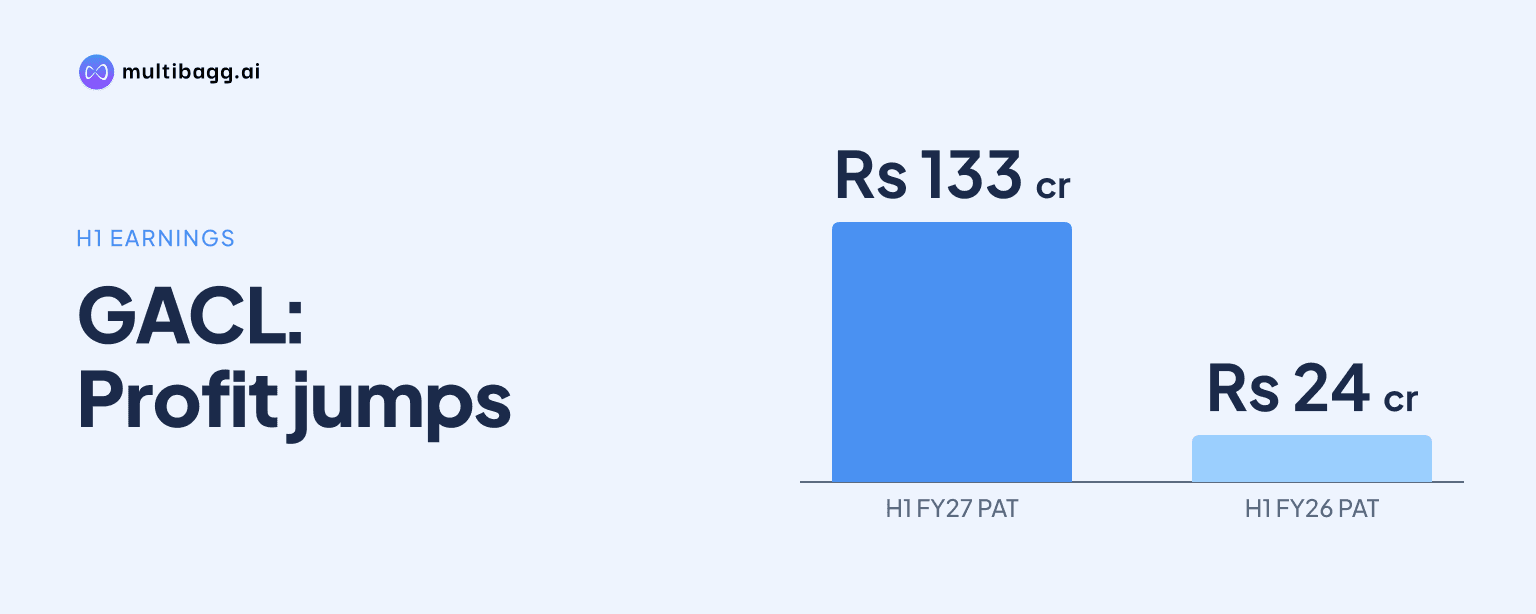
Gujarat Alkalies and Chemicals Limited reported H1 FY27 profit after tax of approximately Rs 133 crore, up from Rs 24 crore a year earlier, as revenue from operations reached Rs 2,602 crore and external sales of Rs 2,559.63 crore marked its highest half-yearly sales in two decades.
Know Gujarat Alkalies & Chemicals inside out
Results, valuation, peers and who's buying, in one view.
Why did GACL's H1 FY27 profit rise more than fivefold?
GACL's H1 FY27 profit after tax, or PAT, increased to approximately Rs 133 crore from Rs 24 crore in H1 FY26, a rise of more than fivefold. Revenue from operations increased by Rs 414 crore to Rs 2,602 crore, while earnings before interest, tax, depreciation and amortisation, or EBITDA, rose by Rs 193 crore to Rs 451 crore.
The profit increase came with a wider H1 EBITDA margin of 16.95%, compared with 11.45% in the corresponding prior-year period. Profit before tax, or PBT, rose to Rs 212 crore from Rs 23 crore, showing that the improvement extended beyond higher revenue to operating profitability and other components of the income statement.
What drove GACL's revenue and margin improvement?
GACL attributed the Q2 FY27 improvement primarily to better realisations and a more favourable product and market mix, while domestic sales rose 29% year on year and exports rose 14%. Management cited pricing improvements in chlorotoluene, anhydrous aluminium chloride, phosphoric acid, hydrogen peroxide and caustic soda.
External sales were Rs 1,334.79 crore in Q2 FY27 and Rs 2,559.63 crore in H1 FY27, which management described as GACL's highest quarterly and half-yearly sales in the last two decades. The H1 external-sales figure was close to the reported Rs 2,602 crore revenue from operations, reflecting the scale of market sales during the period.
GACL expanded exports of phosphoric acid, caustic soda prills and methylene dichloride, and strengthened chlorotoluene sales in the United States, United Kingdom and Europe. It also commenced benzaldehyde exports to the United States, linking its higher-value product and premium-market focus to the reported improvement in product mix.
In Q2 FY27, revenue from operations rose to about Rs 1,358 crore from Rs 1,083 crore in Q2 FY26, while EBITDA rose to Rs 222 crore from Rs 133 crore. The quarterly EBITDA margin on total income increased to 15.74% from 11.6%, although it was below the H1 FY27 margin of 16.95%.
How did renewable power affect GACL's cost position?
GACL reduced its average H1 FY27 power rate to Rs 7.09 per unit from Rs 7.60 per unit in H1 FY26 as renewable energy accounted for approximately 57% of consumption, up from 38%. In Q2 FY27, renewables represented about 55% of power use, compared with 38% a year earlier.
Management said energy is a key competitiveness factor in chlor-alkali operations and plans to move beyond 70% renewable-energy greening over the next two years. The plan involves existing solar and wind capacity, projects involving ABRen and CleanMax, and additional renewable capacity, rather than a disclosed near-term earnings target.
The lower H1 average power rate occurred despite a Rs 0.45 increase in distribution-company power rates during the quarter and a delay in commissioning ABRen's long-term renewable supply, management said. GACL responded by buying short-term renewable energy as a backup, which it said helped raise renewable power's share of the overall mix.
Cost and supply risks were not eliminated in H1 FY27. Management reported plant shutdowns, grid disturbances, feedstock constraints and other operating issues, while noting that total capacity utilisation averaged about 92% and was marginally below the prior year because of those disruptions.
Got a follow-up? Ask IRIS
Which plants and projects could change GACL's second half?
GACL said chlorotoluene production increased substantially as utilisation ramped up, with the plant reaching approximately 90% utilisation in the period. The company plans to add chlorotoluene downstream units during the year, following the higher production level at a plant inaugurated in the prior year.
Several projects have stated target dates: a 200 tonnes-per-day, or TPD, caustic soda flaking facility at Dahej and cell-element replacement are targeted for December 2026, while a 120 TPD hydrogen chloride, or HCl, synthesis unit is targeted around January 2027. GACL also has another HCl unit with in-principle board approval for later commissioning.
Chlorine integration was close to 45%, according to management, which expects the HCl synthesis units to raise that percentage. Other longer-duration projects under implementation include food-grade phosphoric acid expansion, caustic soda revamping, potassium hydroxide expansion, electronic-grade hydrogen peroxide and an additional HCl unit.
Management said hydrazine hydrate remains strategically important because GACL is India's sole producer and its technology was developed indigenously. It did not provide a production or profit target, saying market development, utilisation and operating performance require evaluation over a longer operating horizon than one or two quarters.
What does GNAL's recovery add to GACL's outlook?
GACL-NALCO Alkalies and Chemicals Private Limited, or GNAL, reported H1 FY27 sales growth of 27% and EBITDA growth of 73%, while PBT moved to a Rs 8 crore profit from a Rs 36 crore loss in H1 FY26. Management attributed the change to higher production and sales, improved realisations and lower financing costs.
For Q2 FY27, management's opening remarks reported GNAL sales growth of approximately 14% and EBITDA growth of approximately 19%. In the subsequent discussion, management referred to Q2 sales growth of around 23% and said it expected performance to be sustained through plant stabilisation, higher caustic soda and hydrogen sales, improved caustic realisation and operation at optimal capacity utilisation.
At the parent level, GACL reported annualised return on capital employed, or ROCE, of approximately 8.52% for H1 FY27, compared with 1.87% for FY26. Management said its Project Ahvaan programme focuses on structural performance improvement, long-term growth and diversification, and digital transformation.
Management has articulated an aspiration for GACL to become a Rs 10,000 crore-plus revenue company with EBITDA margins above 20% by FY2031. It explicitly described this as a medium-term aspiration rather than near-term financial guidance, dependent on market conditions, project execution, energy and raw-material prices, and the chemical cycle.
Conclusion
GACL's H1 FY27 recovery combined a Rs 414 crore increase in revenue from operations with a 5.5-percentage-point improvement in EBITDA margin and PAT of approximately Rs 133 crore. Better realisations, export expansion, a higher-value product mix and a Rs 0.51-per-unit reduction in the H1 average power rate were the mechanisms management identified behind the result.
The next indicators are project delivery and operating reliability: the 200 TPD caustic soda flaking facility is targeted for December 2026 and the 120 TPD HCl unit around January 2027. Management will also need to address grid disturbances, feedstock constraints and plant shutdowns while pursuing renewable-energy greening beyond 70% over the next two years.