










Gala targets 70% Chennai utilisation in FY27 after spending
Key highlights
- Gala targets Chennai facility utilisation of 70% in FY27, up from 35% in FY26.
- Gala had used Rs 31.94 crore of the Rs 37 crore allocated to Chennai capital expenditure.
- Wada facility utilisation ranged from 70% at CSS to 85% at DSS.
- Gala reported Q2 FY27 order-booking growth of 44% year on year, exceeding Rs 100 crore for the first time in a quarter.
powered by IRIS
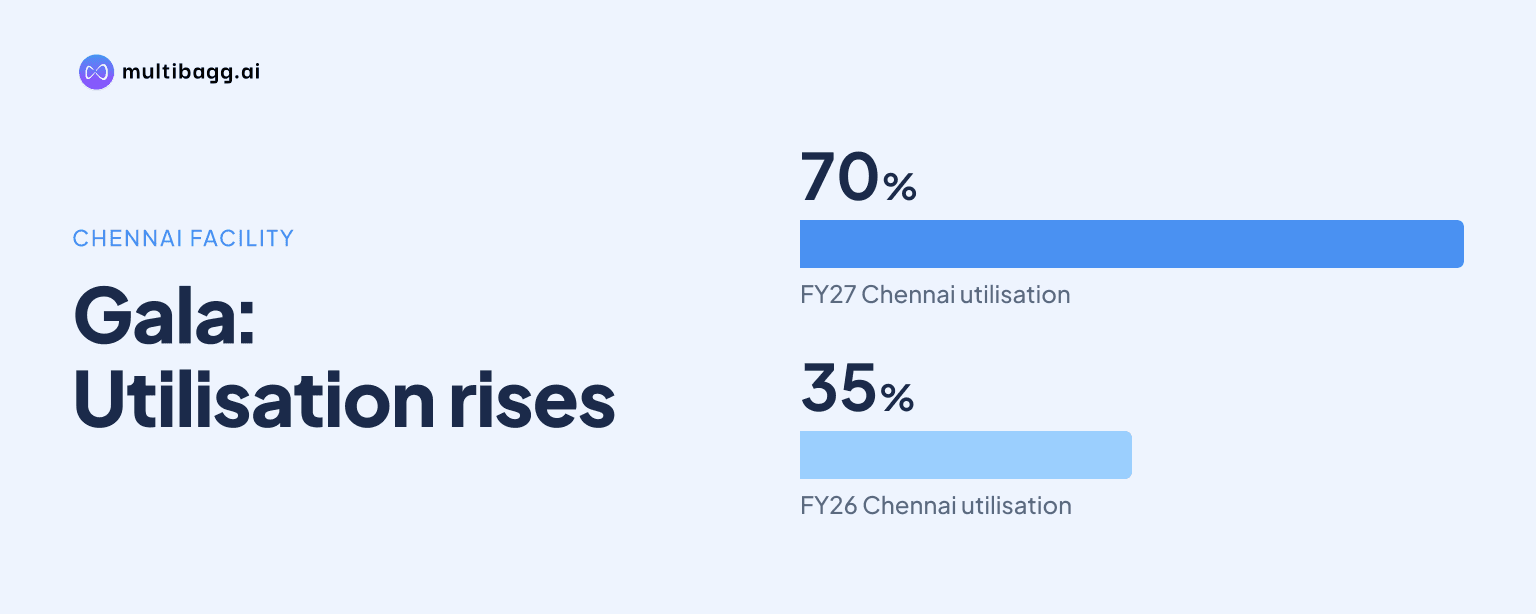
Gala Precision Engineering targets 70% utilisation at its Chennai facility in FY27, double the 35% reported in FY26, after using Rs 31.94 crore of Rs 37 crore earmarked from initial public offering proceeds for Chennai capital expenditure. The target would add 35 percentage points of utilisation at the 4,600-metric-tonne facility.
Know Gala Precision Engineering inside out
Results, valuation, peers and who's buying, in one view.
What is Gala’s Chennai utilisation target for FY27?
Gala’s stated objective is to raise Chennai facility utilisation to 70% in FY27 from 35% in FY26. The presentation lists installed capacity of 4,600 metric tonnes and 4,000 square metres of area for the Chennai capacity disclosure. It does not provide quarterly utilisation, a commissioning schedule, production volumes or a specific date within FY27 for achieving the 70% level.
Applying the disclosed rates to the 4,600-metric-tonne capacity implies use of 1,610 metric tonnes at 35% and 3,220 metric tonnes at 70%. That is an implied increase of 1,610 metric tonnes, but it is a calculation based on installed capacity rather than Gala’s production or sales forecast. Gala does not disclose how much of the target is expected to come from existing customers, new products or exports.
Gala describes the Chennai location as having customers in close proximity, local job-work vendors and nearby raw-material suppliers. These are the stated operating advantages of the site, but the presentation gives no rupee value for freight, procurement or conversion-cost benefits. The move from 35% to 70% is therefore the clearest measurable Chennai operating objective disclosed for FY27.
How does Chennai compare with Gala’s Wada facilities?
Chennai’s FY26 utilisation of 35% was below every disclosed Wada facility, where rates ranged from 70% to 85%. Gala reports 85% at the DSS facility, 75% at the facility labelled SFS, and 70% at the facility labelled CSS. Chennai’s 70% FY27 target would equal the CSS rate, while remaining below the other two Wada rates if they do not change.
The presentation reports Wada capacity in numbers of units, while Chennai capacity is reported in metric tonnes. Wada’s DSS facility has capacity of 225,517,000 units, CSS has 20,941,200 units and the SFS facility has 420,000 units. Those unlike measures mean the disclosures cannot establish a comparable output scale between Chennai and Wada.
Gala’s manufacturing overview gives the Wada plant a land area of 28,800 square metres and the Vallam plant near Chennai an area of 6,718 square metres. The strategic-expansion page separately associates 4,000 square metres with Chennai’s 4,600-metric-tonne capacity. Gala does not explain the difference between the 6,718-square-metre Vallam site figure and the 4,000-square-metre capacity-area figure.
Got a follow-up? Ask IRIS
How much IPO funding has Gala used for Chennai?
Gala has used Rs 31.94 crore of the Rs 37 crore allocated to Chennai capital expenditure, leaving Rs 5.06 crore available. The deployment table shows Chennai as the second-largest specific use of net initial public offering proceeds after Rs 45.43 crore of loan repayment. Gala does not identify the equipment, construction work, capacity additions or project milestones financed by the Chennai spending.
The proceeds update records Rs 121.24 crore received in the monitoring account and Rs 89.58 crore used for payments. It also records fixed deposits of Rs 20 crore with HDFC Bank and Rs 11.49 crore with Yes Bank, plus interest earned of Rs 17 lakh. The monitoring-account balance is shown as nil after these entries.
Wada’s entire Rs 11.07 crore capital-expenditure allocation has been used, whereas Chennai retains Rs 5.06 crore. General corporate purposes have Rs 26.61 crore unutilised, the largest balance in the deployment table. Gala provides no spending timetable for either the outstanding Chennai amount or the general-corporate-purpose balance.
What disclosed plans could support Chennai utilisation?
Gala’s growth strategy includes finding uses for existing products in the hydrogen value chain, electrolyzers, electric vehicles and high-speed trains. It also plans to expand fasteners and springs, offer advanced materials, kitting solutions and smart fasteners, and increase application engineering and customised solutions. The presentation does not assign these initiatives to Chennai or quantify their contribution to the 70% FY27 utilisation target.
Gala also plans to increase its export presence by hiring locally and developing warehouse or logistics tie-ups in Europe and the United States. In H1 FY27, India accounted for 64% of geographical sales, Europe 26%, America 7% and rest of the world 3%. Europe was therefore the largest disclosed export market, but Gala does not say whether Chennai capacity will supply domestic or export customers.
In Q2 FY27, Gala said order booking rose 44% year on year and crossed Rs 100 crore for the first time in a quarter. It also reported approvals for Gallock in railway safety, offshore wind and mining equipment, alongside product development in offshore wind, electrolyzers and railway safety with estimated annual customer potential of Rs 100 crore. These disclosures show potential demand areas, but no order allocation or delivery schedule is linked to Chennai.
Conclusion
Gala’s Chennai plan combines a defined FY27 utilisation objective with largely deployed capital expenditure. The facility is targeted to move from 35% utilisation in FY26 to 70% in FY27, while Rs 31.94 crore of the Rs 37 crore allocation has been used. Achieving the target would bring Chennai level with the disclosed 70% rate at Wada’s CSS facility, though not with Wada’s 75% and 85% rates.
The next disclosures to watch are deployment of the remaining Rs 5.06 crore of Chennai capital expenditure and any production, customer or commissioning data connecting that spending to the FY27 target. Gala’s plans in fasteners, springs, advanced materials, emerging technologies and export logistics may shape future demand, but the presentation sets no Chennai-specific sales target beyond FY27 utilisation.