










Gala Precision Engineering: Renewables Lead H1-FY27 Mix
Key highlights
- Renewable energy contributed 42% of GALA’s H1-FY27 revenue, versus 33% from industrial and 25% from mobility.
- DSS represented 53% of GALA’s H1-FY27 product mix, followed by SFS at 31% and CSS at 16%.
- Exports contributed 36.2% of GALA’s H1-FY27 sales, while Europe represented 26% of geographical sales.
- GALA says Vallam utilisation will rise from 35% in FY26 to 70% in FY27.
powered by IRIS
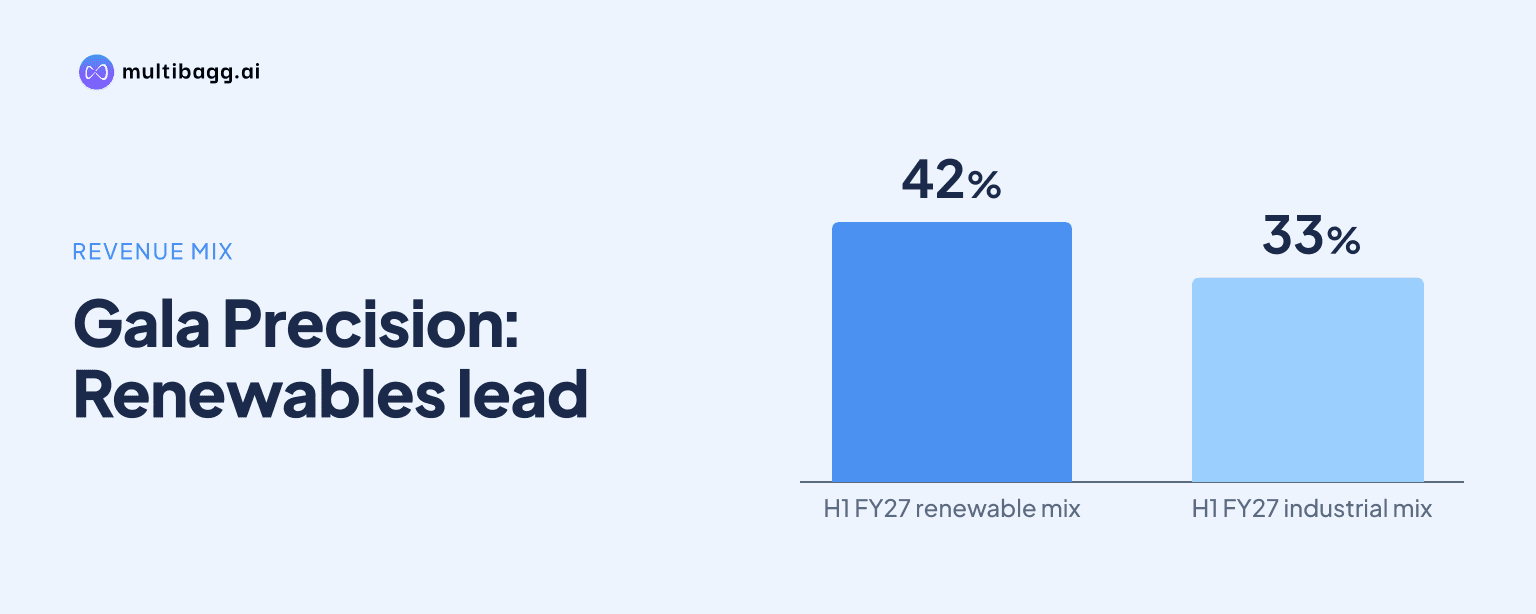
Gala Precision Engineering reported renewable energy as its largest H1-FY27 end market, contributing 42% of revenue versus 33% from industrial and 25% from mobility. GALA also reported exports at 36.2% of H1-FY27 sales, with Europe accounting for 26% of geographical sales.
Know Gala Precision Engineering inside out
Results, valuation, peers and who's buying, in one view.
Why is renewable energy GALA’s largest end market?
Renewable energy is GALA’s largest disclosed H1-FY27 end market because it generated 42% of revenue, ahead of industrial at 33% and mobility at 25%. The renewable-energy share was 9 percentage points above industrial and 17 percentage points above mobility, making it the largest of the three industry categories reported by GALA.
The three end-user industries total 100% of GALA’s H1-FY27 revenue mix. Renewable energy was therefore larger than either industrial or mobility individually, although industrial and mobility together represented 58%. The presentation does not disclose prior-period end-market shares, so it does not quantify how the 42% renewable-energy mix developed before H1-FY27.
GALA’s end-market mix differs from its product mix. Disc and Strip Springs, or DSS, contributed 53% of H1-FY27 product revenue, while Special Fastening Solutions, or SFS, contributed 31% and Coil and Spiral Springs, or CSS, contributed 16%. The product categories identify what GALA sells, whereas renewable energy, industrial and mobility identify the applications and customers served.
Which GALA products serve renewable-energy customers?
GALA supplies the renewable-energy market mainly through DSS and SFS products used in wind, hydroelectric and hydrogen-related applications. DSS and wedge-lock washer products are identified for yaw brakes, thrust-bearing mechanisms and electrolyzers, while the relevant end-user industries include wind turbines, hydroelectric power plants and the hydrogen value chain.
SFS products are used in renewable applications including foundations, towers, hydroelectric plants and electrolyzers. GALA identifies steel rods as an SFS input and lists high-tensile fastening products such as studs, anchor bolts, cross bolts, hex bolts and nuts in its portfolio. The same product group also includes Gallock wedge-lock and grip-lock washers.
GALA’s market-segment matrix shows that both DSS and SFS address wind energy, the hydrogen value chain and hydroelectric applications. CSS is instead marked for off-highway, infrastructure, automotive and railway uses, rather than the three renewable-energy columns. This indicates that the 42% renewable-energy revenue share is supported by two of GALA’s three reported product categories.
GALA reports more than 800 stock-keeping units, or SKUs, and more than 175 customers. Its named renewable-energy clients include Vestas, GE Vernova, Enercon, Senvion and Regal Rexnord. The presentation does not disclose the H1-FY27 sales contribution, contract value or customer concentration associated with any of these companies.
Got a follow-up? Ask IRIS
How much of GALA’s H1-FY27 revenue came from exports?
GALA reported export revenue equal to 36.2% of H1-FY27 sales, while India represented 64% of geographical sales. Europe accounted for 26%, America for 7% and the rest of the world, or ROW, for 3%. The geographical percentages total 100%, while the 36% non-India geographic share is separately reported as 36.2% export revenue.
Europe was GALA’s largest overseas geography at 26% of H1-FY27 sales. Its share was 19 percentage points above America’s 7% and 23 percentage points above ROW’s 3%, while India remained the largest single geography at 64%. GALA states that it exports to more than 25 countries and has an office in Frankfurt, Germany.
The presentation does not provide a product-level split of the 36.2% export share between DSS, CSS and SFS. It also does not state how much of Europe’s 26% geographical sales came from renewable-energy customers, or provide individual country sales data for Europe, America or ROW. Those omissions limit conclusions on the overlap between export demand and the 42% renewable-energy mix.
What capacity plans could support GALA’s product mix?
GALA operates plants at Wada near Mumbai and Vallam near Chennai. At Wada, its DSS facility had 85% capacity utilisation, compared with 75% for SFS and 70% for CSS. DSS was also the largest H1-FY27 product category at 53% of revenue, compared with 31% for SFS and 16% for CSS.
The Wada plant’s disclosed installed capacity was 225,517,000 units for DSS, 20,941,200 units for CSS and 420,000 units for SFS. These capacity measures are reported in units and should not be compared directly with Vallam’s 4,600 metric-tonne capacity, because the presentation uses different measurement bases for the two facilities.
At Vallam, GALA reported capacity of 4,600 metric tonnes across 4,000 square metres. The presentation states that utilisation was 35% in FY26 and will rise to 70% in FY27, which would be a 35-percentage-point increase if achieved. The Chennai operation is identified as an SFS facility, a product line serving wind foundations, towers, hydroelectric plants and electrolyzers.
GALA lists in-house tool design and development, blanking and forming, coiling, heat treatment, shot peening, grinding, thread rolling and computer numerical control machining among its production capabilities. The source does not disclose capital expenditure, incremental output from Vallam’s FY27 utilisation plan, or a revenue target for the facility. Management’s utilisation statement is therefore a capacity-use plan rather than a disclosed sales forecast.
Conclusion
GALA’s H1-FY27 revenue mix places renewable energy first at 42%, ahead of industrial at 33% and mobility at 25%. DSS remained the largest product category at 53%, while SFS contributed 31% and is relevant to renewable installations including wind towers, foundations, hydroelectric plants and electrolyzers. Exports represented 36.2% of sales, with Europe contributing 26% of geographical revenue.
The disclosed measure to watch is Vallam utilisation, which management says will increase from 35% in FY26 to 70% in FY27 at the 4,600-metric-tonne SFS facility. GALA has not disclosed whether this plan will alter its renewable-energy share, export mix or product revenue split, leaving those outcomes unresolved until later reporting.