










Galaxy Surfactants Limited Q2 EBITDA rises 68% on mix
Key highlights
- Galaxy reported Q2FY27 EBITDA of Rs 195.9 crore, up 68.4% year-on-year.
- Galaxy’s Q2FY27 EBITDA margin expanded to 10.8% from 8.7%.
- Galaxy recorded Q2FY27 revenue of Rs 1,816.8 crore, up 36.4% year-on-year.
- Galaxy’s H1FY27 PAT of Rs 285.7 crore exceeded FY26 PAT of Rs 267.4 crore.
powered by IRIS
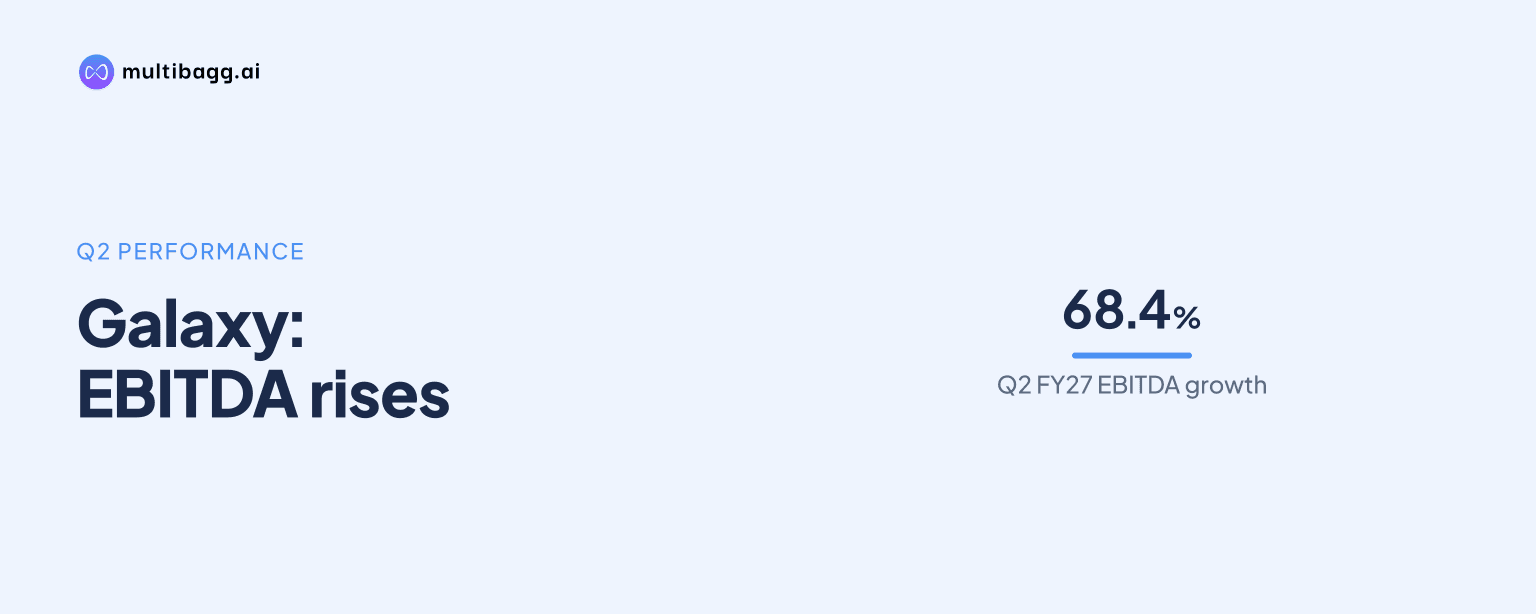
Galaxy reported Q2FY27 consolidated EBITDA of Rs 195.9 crore, up 68.4% year-on-year, as its EBITDA margin rose to 10.8% from 8.7% on high-single-digit volume growth and a richer Specialty Care mix. Q2FY27 revenue increased 36.4% to Rs 1,816.8 crore, while profit after tax rose 80.1% to Rs 119.8 crore.
Know Galaxy Surfactants inside out
Results, valuation, peers and who's buying, in one view.
How did Galaxy perform in Q2FY27?
Galaxy recorded Q2FY27 consolidated revenue of Rs 1,816.8 crore, up 36.4% from Rs 1,332.0 crore in Q2FY26, while EBITDA increased 68.4% to Rs 195.9 crore from Rs 116.3 crore. EBITDA therefore grew 32 percentage points faster than revenue, and the EBITDA margin expanded by 2.1 percentage points to 10.8%.
Galaxy’s Q2FY27 profit after tax, or PAT, was Rs 119.8 crore, an 80.1% increase from Rs 66.5 crore a year earlier. PAT margin rose to 6.6% from 5.0%, while the company reported earnings before interest, tax, depreciation and amortisation per metric tonne of Rs 26,920, up 56% year-on-year.
The reported figures show that Galaxy generated Rs 10.8 of EBITDA for every Rs 100 of revenue in Q2FY27, compared with Rs 8.7 in Q2FY26. The company attributed the change to volume-led growth, an improved Specialty Care portfolio mix, and demand for premium and masstige offerings in domestic and international markets.
Why did Galaxy’s Q2FY27 margin increase?
Galaxy said its 10.8% Q2FY27 EBITDA margin reflected higher volumes, an improved Specialty Care mix and sustained demand for premium and masstige products. Consolidated sales volume increased at a high-single-digit year-on-year rate, while EBITDA per metric tonne rose 56% to Rs 26,920.
India and AMET, covering Asia, Middle East and Turkey, each delivered mid-teens volume growth in Q2FY27, according to Galaxy. The company linked that growth to resilient customer demand and execution, contrasting with a high-single-digit volume decline in Rest of the World markets amid logistics disruption and elevated freight costs.
Galaxy reported Specialty Care revenue of Rs 635 crore in Q2FY27, compared with Rs 1,175 crore for Performance Surfactant, out of category revenue of Rs 1,810 crore. Specialty Care volume was flat year-on-year in the quarter, whereas Performance Surfactant volume grew at a mid-teens rate; the company nevertheless identified a richer Specialty Care mix as a contributor to consolidated profitability.
The release did not disclose separate category margins, regional revenue or freight-cost figures for Q2FY27. It therefore supports Galaxy’s explanation of a 2.1-percentage-point consolidated margin expansion, but does not quantify the individual contribution from Specialty Care, pricing, procurement or logistics actions.
Got a follow-up? Ask IRIS
What does Galaxy’s H1FY27 result show?
Galaxy reported H1FY27 revenue of Rs 3,602.0 crore, EBITDA of Rs 448.4 crore and PAT of Rs 285.7 crore. Against H1FY26, revenue rose 37.4% from Rs 2,621.1 crore, EBITDA rose 78.4% from Rs 251.4 crore and PAT rose 95.7% from Rs 146.0 crore.
H1FY27 EBITDA margin was 12.4%, compared with 9.6% in H1FY26 and 9.4% in FY26. The first-half margin was also above the 10.8% in Q2FY27, while H1FY27 revenue included Rs 2,304 crore from Performance Surfactant and Rs 1,288 crore from Specialty Care.
Galaxy’s H1FY27 PAT of Rs 285.7 crore exceeded the Rs 267.4 crore PAT reported for all of FY26. Management described that outcome as a significant milestone, and the release reported H1FY27 PAT margin of 7.9%, against 1.2% in H1FY26 and 5.1% in FY26.
What demand trends and risks did Galaxy identify?
Galaxy said demand indicators remained encouraging in India, AMET and Specialty Care markets across geographies after Q2FY27 consolidated volumes grew at a high-single-digit rate. India and AMET recorded mid-teens growth during the quarter, while AMET volume growth was mid-single digit for H1FY27.
Rest of the World volume declined at a high-single-digit rate in Q2FY27 because of logistics disruption and elevated freight costs, although Galaxy said demand for premium and masstige Specialty Care products remained healthy. For H1FY27, the company reported that Rest of the World volume was flat and Specialty Care volume grew at a low-single-digit rate.
Management said it remained vigilant about developments in West Asia and their potential implications for global logistics, freight rates and feedstock availability. It also credited teams in procurement, global logistics, manufacturing and operations with maintaining business continuity amid significant external disruptions during the two quarters of FY27.
Management said improving business mix and continued Specialty Care momentum supported its confidence in sustainable and profitable growth. That view is forward-looking and is subject to the West Asia, logistics, freight-rate and feedstock risks identified in the November 4, 2026 release.
Conclusion
Galaxy’s Q2FY27 results showed earnings growing faster than sales: revenue increased 36.4% to Rs 1,816.8 crore, EBITDA rose 68.4% to Rs 195.9 crore and EBITDA margin expanded to 10.8% from 8.7%. The first-half figures continued that pattern, with EBITDA up 78.4% to Rs 448.4 crore and PAT of Rs 285.7 crore exceeding the Rs 267.4 crore reported for all of FY26.
The next results will show whether mid-teens volume growth in India and AMET, together with Specialty Care demand, can offset the Q2FY27 high-single-digit volume decline in Rest of the World. Management has specifically flagged West Asia developments, logistics, freight rates and feedstock availability as factors to monitor.