










Ganesha Ecosphere Limited says approved rPET capacity masks supply
Key highlights
- India had about 4.2 lakh to 4.5 lakh tonnes of FSSAI-approved rPET capacity, but management said other producers’ utilisation remained lower.
- Ganesha Ecosphere estimated monthly Indian rPET sales at 25,000 to 50,000 tonnes and its own sales at about 5,000 tonnes.
- Ganesha Ecosphere’s FSSAI-approved rPET capacity reached 65,000 tonnes after the fourth Warangal line received approval.
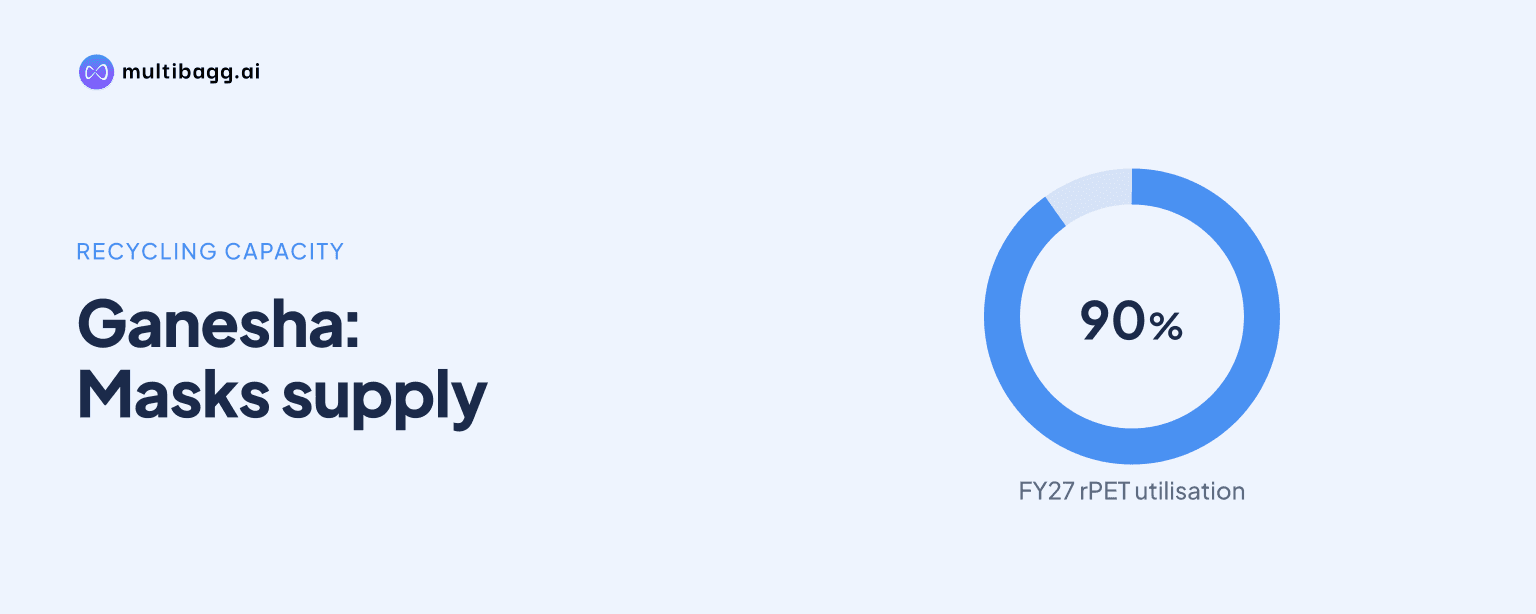
- Management expects rPET utilisation to reach 90% by the end of FY '27 after debottlenecking.
powered by IRIS
Ganesha Ecosphere Limited said in its Q2 FY '27 earnings call that India’s recycled polyethylene terephthalate, or rPET, market remained supply-constrained despite 4.2 lakh to 4.5 lakh tonnes of approved capacity, because other producers’ operational utilisation was lower; Ganesha Ecosphere sold about 5,000 tonnes a month, or roughly 20% of market sales.
Know Ganesha Ecosphere inside out
Results, valuation, peers and who's buying, in one view.
Why is India’s rPET supply constrained despite approved capacity?
India’s rPET supply is constrained because approved capacity has not translated into equally high operating output. Ganesha Ecosphere said total capacity approved by the Food Safety and Standards Authority of India, or FSSAI, was approximately 4.2 lakh to 4.5 lakh tonnes, while actual utilisation at other industry players was lower. The company’s statement separates an approval-based industry capacity figure from material that can consistently reach customers.
The gap is visible in Ganesha Ecosphere’s estimate of current rPET sales in the market, which it placed at 25,000 to 50,000 tonnes a month. Ganesha Ecosphere attributed the shortfall to operating performance rather than a lack of FSSAI approvals alone, saying some approved facilities were not performing well operationally. Management also said customers were increasingly recognising differences in polymer quality between suppliers.
The capacity and sales figures are not directly comparable because management described one as total approved capacity and the other as monthly market sales. However, the comparison explains management’s point: food-contact approval does not by itself establish utilisation, polymer quality or effective supply to the market.
What is supporting rPET demand in India?
Demand is being supported by elevated virgin polymer prices and the government mandate to use 40% recycled content, according to management. Ganesha Ecosphere said industry participants were seeking to comply with the mandate, while higher virgin polymer prices had increased demand for recycled polymers. The company described rPET demand as strong and healthy during Q2 FY '27.
The price relationship cited on the call illustrates the substitution mechanism, although management cautioned that prices were volatile. rPET was about Rs 130 per kg, compared with virgin polyethylene terephthalate, or PET, at about Rs 140 to Rs 145 per kg. For recycled polyester staple fibre, or rPSF, management cited Rs 110 to Rs 114 per kg, compared with Rs 130 per kg for virgin polyester staple fibre.
Management said higher virgin polymer prices over the prior six months had enabled even inefficient recyclers to operate at higher utilisations, rather than prompting industry closures or distressed-asset purchases. This differed from an analyst’s suggestion that market turmoil might have created acquisition opportunities. Ganesha Ecosphere instead said it was carrying out brownfield capacity expansion at its Warangal plant.
Got a follow-up? Ask IRIS
How is Ganesha Ecosphere increasing food-grade rPET output?
Ganesha Ecosphere has increased its FSSAI-approved rPET capacity to 65,000 tonnes and is ramping its fourth Warangal production line after receiving food-grade approval. Before the approval, management said the line was operating at about 60% utilisation for non-food applications and exports. Food-contact approval now permits the output to be supplied into food-grade packaging applications.
Ganesha Ecosphere said the fourth line had achieved high utilisation within one month of approval, although it did not disclose a line-specific rate after approval. Management estimated additional food-grade rPET volume of about 1,500 to 2,000 tonnes each quarter. Blended utilisation across operating rPET lines was about 75% to 76% in the last quarter, partly because one line had started in June and FSSAI approval arrived later.
This ramp-up differs from the broader industry picture because Ganesha Ecosphere is converting existing non-food production capacity into food-contact output rather than waiting for a new plant to be built. Management said the company was constrained by its own capacity, not by a lack of buyers, and that demand for its material was rising as customers assessed polymer quality.
What utilisation and contract protections does Ganesha Ecosphere expect?
Ganesha Ecosphere expects optimum rPET utilisation of about 85% and said it was working on debottlenecking to reach 90% by the end of FY '27. Management described 85% as effective utilisation because the product mix sold in the market makes full nameplate utilisation difficult. The company also expects a fifth rPET granule line at Warangal to be commissioned during Q4 FY '27.
About 85% to 90% of Ganesha Ecosphere’s current rPET capacity is covered by annual contracts, according to management. These contracts use a formula of raw-material price, yield and fixed conversion cost, with raw-material changes passed to customers with a one-month lag. Management said this structure fixes conversion economics under the contracts even when scrap and polymer prices fluctuate.
For the Warangal subsidiary business, management said it expected blended earnings before interest, tax, depreciation and amortisation, or EBITDA, of Rs 22 to Rs 24 per kg after normalisation. That outlook is affected by the August 2026 fire at the Warangal rPSF division, which halted rPSF production and caused lost earnings plus continuing fixed costs. Management estimated lost rPSF volume at roughly 2,500 to 3,000 tonnes per quarter and expected operations to be restored by Q4 FY '27.
Conclusion
India’s approved rPET capacity appears to overstate effective supply, based on management’s estimate of 4.2 lakh to 4.5 lakh tonnes of FSSAI-approved capacity and 25,000 to 50,000 tonnes of monthly market sales. Ganesha Ecosphere supplies about 5,000 tonnes monthly, or roughly 20% of the market estimate, while management linked the supply gap to lower industry utilisation and variation in polymer quality.
The next indicators are the fourth line’s post-approval utilisation, commissioning of the fifth Warangal rPET line in Q4 FY '27, and management’s stated aim of 90% utilisation by FY '27-end. The planned restoration of the Warangal rPSF operation by Q4 FY '27 also remains relevant because management said the fire has resulted in both lost EBITDA and continuing fixed costs.