










Ganesha Ecosphere targets 150,000-tonne rPET capacity by FY28
Key highlights
- Ganesha is working toward 150,000 tonnes of rPET capacity by the end of FY28.
- Warangal is expected to have about 100,000 tonnes of rPET capacity, with no further capex planned there.
- The next 50,000-tonne rPET project is estimated to cost Rs 250 crore to Rs 300 crore.
- Management said a new rPET facility would take about 12 to 15 months to go on stream.
powered by IRIS
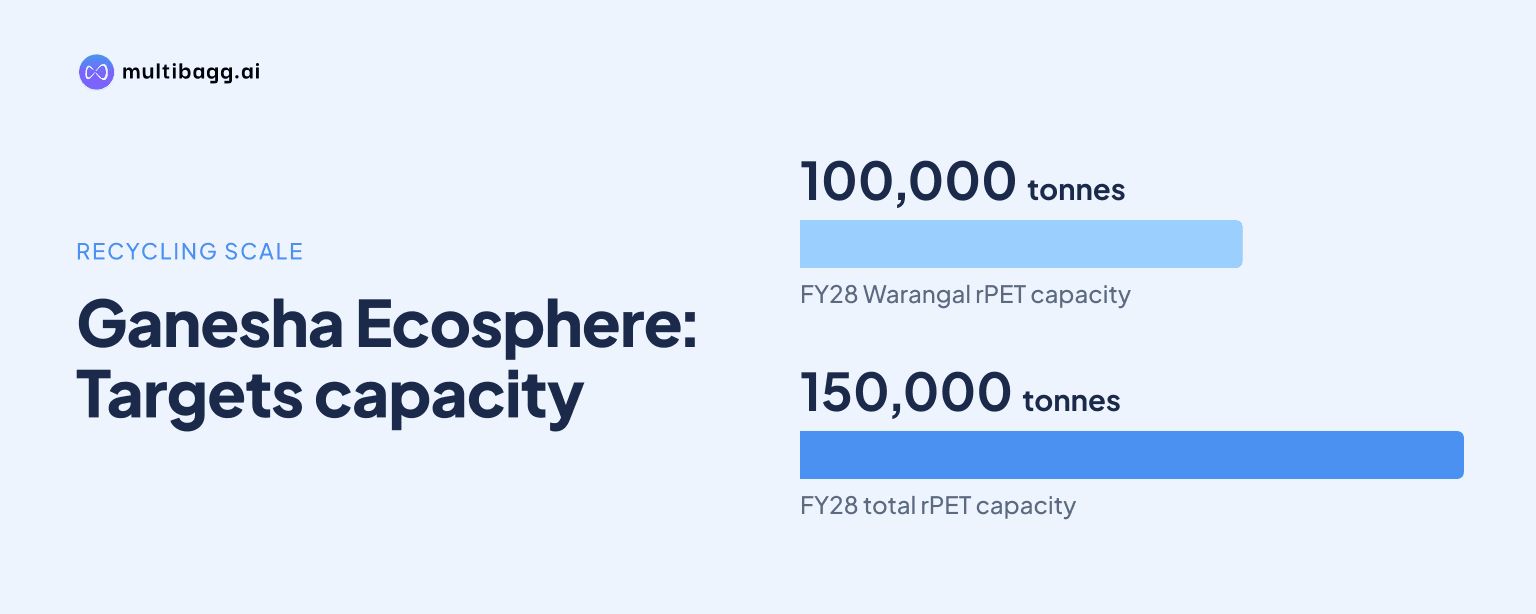
Ganesha Ecosphere is working toward 150,000 tonnes of recycled polyethylene terephthalate, or rPET, capacity by the end of FY28, comprising about 100,000 tonnes at Warangal and a proposed 50,000-tonne second site. Management estimated the additional facility would require Rs 250 crore to Rs 300 crore and take 12 to 15 months to go on stream.
Know Ganesha Ecosphere inside out
Results, valuation, peers and who's buying, in one view.
How will Ganesha reach 150,000 tonnes of rPET capacity?
Ganesha plans to add 50,000 tonnes of rPET capacity outside Warangal after the Warangal site reaches about 100,000 tonnes. Management said it would not undertake further capital expenditure at Warangal and was considering northern India or another location for the next facility. The end-FY28 objective therefore depends on finalising a separate project rather than extending the existing site.
The proposed addition would lift capacity by 50% from the planned 100,000 tonnes at Warangal to 150,000 tonnes across sites. Management said it was working on the project and “hopefully” expected it to be delivered by the end of FY28. That wording makes 150,000 tonnes a management target, not a commissioned-capacity result.
Management also outlined a larger long-term ambition than the FY28 plan. It said it viewed rPET demand at around 1 million tonnes and was looking for a 25% share, implying about 250,000 tonnes of capacity. However, the call provided a cost estimate and execution timeline only for the next 50,000 tonnes, not a funded schedule for reaching 250,000 tonnes.
What will Ganesha's next rPET plant cost and how long will it take?
Ganesha estimates that a 50,000-tonne rPET facility would cost Rs 250 crore to Rs 300 crore and take 12 to 15 months to go on stream. Management repeated those parameters when asked about capacity beyond 100,000 tonnes. It did not disclose the final location, financing method, equipment supplier or approval date for the proposed project.
The disclosed estimate applies to the complete 50,000-tonne addition, while the 12-to-15-month period is the stated time to bring new capacity into production. Management said it would proceed with the capex once the project was finalised. As a result, the timing of a final investment decision is central to achieving the end-FY28 target.
The expansion follows the build-out of rPET lines at Warangal. Management said another line was due in January and could serve non-food applications before food-grade approval. A line that had received Food Safety and Standards Authority of India, or FSSAI, approval had already reached about 60% utilisation in non-food applications, and management expected utilisation to rise after approval.
Is rPET demand sufficient for Ganesha's planned capacity?
Ganesha said demand for high-quality rPET exceeds supply currently available for sale. Management clarified that a 30,000-tonne figure raised during the call represented actual sales, not total demand, and said demand was probably more than twice that level because of material shortages. It also said not all brand owners had started using mandatory rPET volumes.
Management cited industry feedback that current compliance was around 25% for the year, with bottlers seeking to increase usage where quality feedstock is available. The company did not provide standalone quarterly rPET production, reporting instead blended output of about 15,500 tonnes across rPET, recycled polyester staple fibre, or rPSF, and yarn.
Ganesha linked demand to food-grade product quality and regulatory approvals. Management said it had United States Food and Drug Administration and European Food Safety Authority certifications, allowing exports after country-specific food-safety approvals. Exports continued, but management said volumes had declined because freight effects, higher Indian prices and domestic demand had changed the economics.
Got a follow-up? Ask IRIS
How do Ganesha's contracts affect rPET pricing and margins?
Ganesha said 85% to 90% of rPET capacity is covered by annual contracts using a raw-material-price, yield and fixed-conversion-cost formula. Raw-material price changes are passed on with a one-month lag, meaning current-month prices are reflected in the following month. Management said the formula is agreed in the contract and price movements average out over a year.
That arrangement differs from the fibre business, where management said sales are entirely spot-based and scrap prices can rise alongside finished-product prices. At the time of the call, management cited rPET prices of about Rs 130 per kg, compared with Rs 140 to Rs 145 per kg for virgin polyethylene terephthalate, or PET, while cautioning that prices were volatile.
For larger-scale rPET operations, management reiterated earnings before interest, tax, depreciation and amortisation, or EBITDA, guidance of Rs 20 to Rs 22 per kg. It also guided to FY27 EBITDA of Rs 225 crore to Rs 250 crore and said it expected a result near the upper end, at about Rs 235 crore to Rs 240 crore. The call did not quantify the proposed second facility's utilisation or customer contracts.
What operating issues could affect Ganesha's execution?
Ganesha's rPSF line at Warangal remained halted following a fire incident, which management said had caused lost EBITDA from stopped output as well as continuing fixed expenses. The original equipment manufacturer received a visa in the current month and visited the plant in the last week to assess equipment that could be repaired or replaced.
Management expected the rPSF line to be restored around the end of February or March, subject to procurement time for imported equipment. The repair is separate from the 50,000-tonne rPET proposal, but it creates an existing execution task while the company develops a new-site project.
Ganesha also said its filament-yarn operation was gradually adding customers and seeking approvals from more customers. Management did not disclose separate yarn revenue or margins, but said reaching optimum utilisation would add to overall EBITDA. The company therefore has a rPSF restoration, yarn ramp-up and rPET expansion plan progressing simultaneously.
Conclusion
Ganesha's next disclosed rPET expansion is a 50,000-tonne facility beyond Warangal's planned 100,000 tonnes, taking its targeted network to 150,000 tonnes by end-FY28. The proposal is supported by management's view that demand for high-quality material exceeds supply, while annual formula-based contracts cover 85% to 90% of rPET capacity.
The next developments to watch are finalisation of the new site and capital expenditure, since the Rs 250 crore to Rs 300 crore estimate and 12-to-15-month timeline are not yet a confirmed project announcement. Management's expected end-February or March rPSF restoration, December contract renewals and FY27 EBITDA expectation of Rs 235 crore to Rs 240 crore are additional disclosed milestones.