










Garg Furnace starts alloy billets as Q2 revenue rises 29%
Key highlights
- Vaneera began Phase I alloy-steel forgeable-billet operations on 21 August 2026.
- Consolidated Q2 FY27 revenue rose 29% year on year to Rs 79.63 crore.
- Consolidated Q2 FY27 net profit was Rs 1.91 crore, down 33% year on year.
- Vaneera billets received approvals from vendors supplying Railways and auto-parts makers.
powered by IRIS
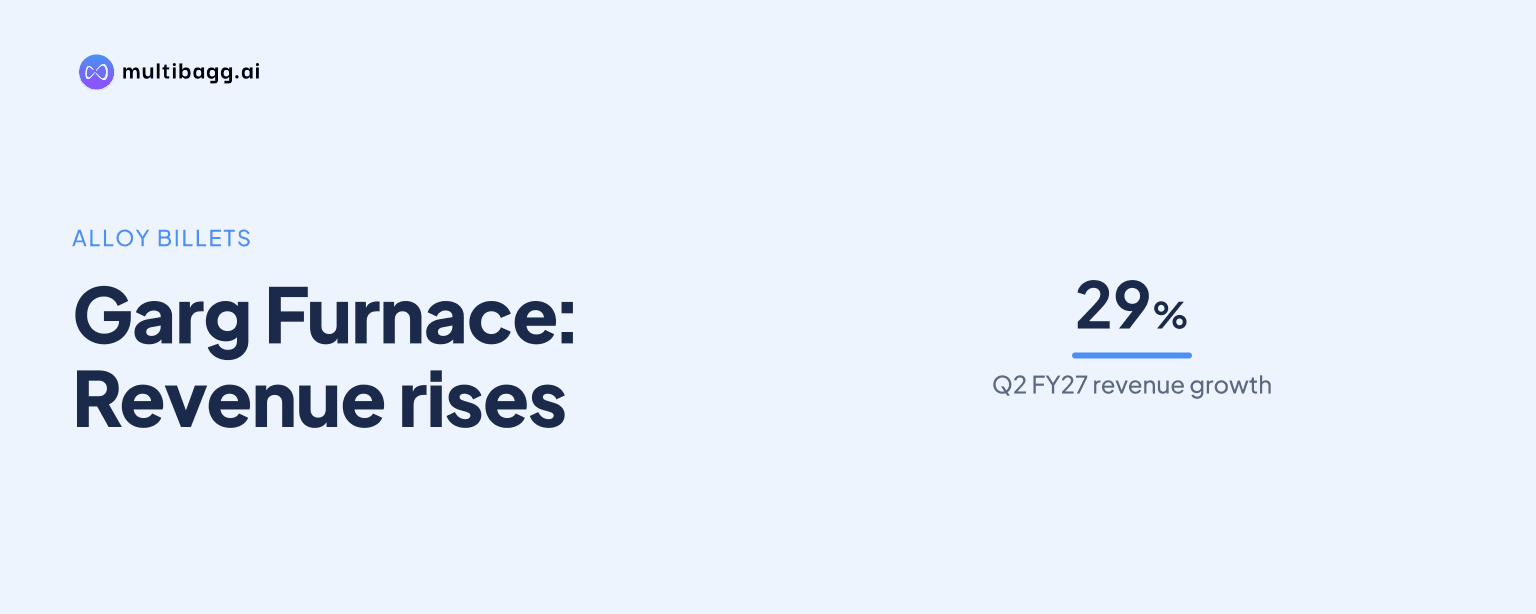
Garg Furnace Limited said its subsidiary, Vaneera Industries Limited, began Phase I alloy-steel forgeable-billet production on 21 August 2026, while consolidated revenue rose 29% year on year to Rs 79.63 crore in Q2 FY27. Vaneera received vendor approvals in railway and auto-parts supply chains, although ramp-up costs and a higher tax provision reduced consolidated net profit to Rs 1.91 crore.
Know Garg Furnace inside out
Results, valuation, peers and who's buying, in one view.
What did Vaneera start producing in Q2 FY27?
Vaneera started Phase I operations at Kaddon, Doraha on 21 August 2026 and produces alloy-steel forgeable billets. Q2 FY27, ended 30 September 2026, was the first quarter in which the subsidiary contributed production, Garg Furnace said in its 19 November 2026 release. The Board approved the unaudited quarterly and half-year results on 14 November 2026.
The alloy-billet facility uses a Ladle Refining Furnace (LRF), Vacuum Degasser (VD) and Electromagnetic Stirring (EMS). Garg Furnace said these systems enable close control over chemistry, low gas content and a clean, uniform billet, which forging customers require. Vaneera adds alloy-steel forgeable billets to the group’s mild-steel (MS) billets and rounds made by Garg Furnace at Ludhiana.
How did Garg Furnace’s Q2 FY27 financial results change?
Garg Furnace reported consolidated Q2 FY27 revenue of Rs 79.63 crore, up 35% from Rs 59.16 crore in Q1 FY27 and 29% from Rs 61.73 crore in Q2 FY26. Consolidated earnings before interest, tax, depreciation and amortisation (EBITDA) rose to Rs 4.53 crore from Rs 3.34 crore in both comparison quarters. The quarter included Vaneera’s first production contribution following its 21 August 2026 start.
Consolidated profit before tax increased 35% sequentially to Rs 3.33 crore in Q2 FY27, but net profit was 33% below Rs 2.83 crore a year earlier. Garg Furnace attributed the year-on-year net-profit decline to Vaneera’s capacity ramp-up and initial costs, along with a higher tax provision. Sequentially, consolidated net profit increased 8% from Rs 1.77 crore in Q1 FY27.
On a standalone basis, Q2 FY27 revenue reached Rs 68.33 crore, compared with Rs 57.18 crore in Q1 FY27 and Rs 61.38 crore in Q2 FY26. Standalone net profit rose 74% quarter on quarter to Rs 2.93 crore and 7% year on year from Rs 2.74 crore. Garg Furnace said better margins supported standalone profit growth, separating the Ludhiana business performance from the subsidiary’s start-up costs.
Which supply-chain approvals has Vaneera received?
Vaneera’s billets have been approved by vendors that supply to Railways and by vendors serving auto-parts makers. The announcement does not identify the vendors, approved billet grades, volumes, purchase orders or commercial terms. Garg Furnace said the approvals were obtained within months of production commencing on 21 August 2026.
Managing Director Toshak Garg said the approvals place Vaneera in a middle alloy-steel category between commodity steel and special steel. This is management’s description of product positioning, rather than a disclosed market-size or pricing estimate. He also said Garg Furnace is moving towards value addition through the new product while Vaneera’s capacity utilisation is still being ramped up.
The stated technical route is relevant to the approved customer channels because the LRF, VD and EMS equipment is designed to control billet chemistry, gas content and uniformity. Garg Furnace specifically linked those qualities to forging-customer requirements. The filing does not disclose a rated Phase I capacity, utilisation at 30 September 2026, or a timetable for further production phases.
Got a follow-up? Ask IRIS
How does Vaneera affect the half-year comparison?
For H1 FY27, consolidated revenue was Rs 138.79 crore, 14% higher than Rs 121.89 crore in H1 FY26, while consolidated EBITDA increased 56% to Rs 7.87 crore from Rs 5.04 crore. Consolidated profit before tax rose 41% to Rs 5.81 crore. However, consolidated net profit declined 10% to Rs 3.67 crore from Rs 4.08 crore, reflecting the ramp-up-cost and tax factors cited for Q2.
The standalone and consolidated half-year outcomes differed: standalone net profit grew 15% to Rs 4.61 crore in H1 FY27, while consolidated net profit fell 10%. The comparison shows that Vaneera’s first-quarter and Q2 contribution lifted consolidated revenue and EBITDA, while its early operating costs and the higher tax provision affected profit after tax. The release does not quantify the start-up cost or tax provision separately.
Garg Furnace’s established Ludhiana operation makes MS billets and rounds and holds ISO 9001:2015 certification, Bureau of Indian Standards licences for IS 7283:1992 and IS 14650:2023, and ZED Bronze certification. Vaneera makes alloy-steel forgeable billets at Kaddon, Doraha. The filing provides no segment-wise revenue or profitability split between the two operations.
Conclusion
Garg Furnace’s Q2 FY27 release shows that Vaneera began alloy-steel billet production on 21 August 2026 and gained approvals from vendors in railway and auto-parts supply chains as consolidated revenue rose 29% to Rs 79.63 crore. The contrast between 56% H1 EBITDA growth and a 10% decline in H1 consolidated net profit shows the reported effect of start-up costs and a higher tax provision during the subsidiary’s ramp-up.
The next disclosed operational marker is higher capacity utilisation at Vaneera. Management said profitability should improve in coming quarters as utilisation rises, but the release gives no capacity target, approval-to-order conversion figure, production volume or further-phase commissioning date. Subsequent results will show whether the 21 August 2026 start produces a larger earnings contribution.