










Garg Furnace Ltd Q2 FY27 Revenue Rises 29%, Profit Falls 32.5%
Key highlights
- Garg Furnace Ltd's Q2 FY27 consolidated revenue rose 29.0% year-on-year to ₹79.63 crore.
- Consolidated net profit fell 32.5% year-on-year to ₹1.91 crore in Q2 FY27.
- Consolidated EBITDA margin was 5.4% in Q2 FY27, compared with 5.3% in Q2 FY26.
- The stock closed 4.98% lower at ₹194.65 on 16 November 2026 after the results announcement.
powered by IRIS
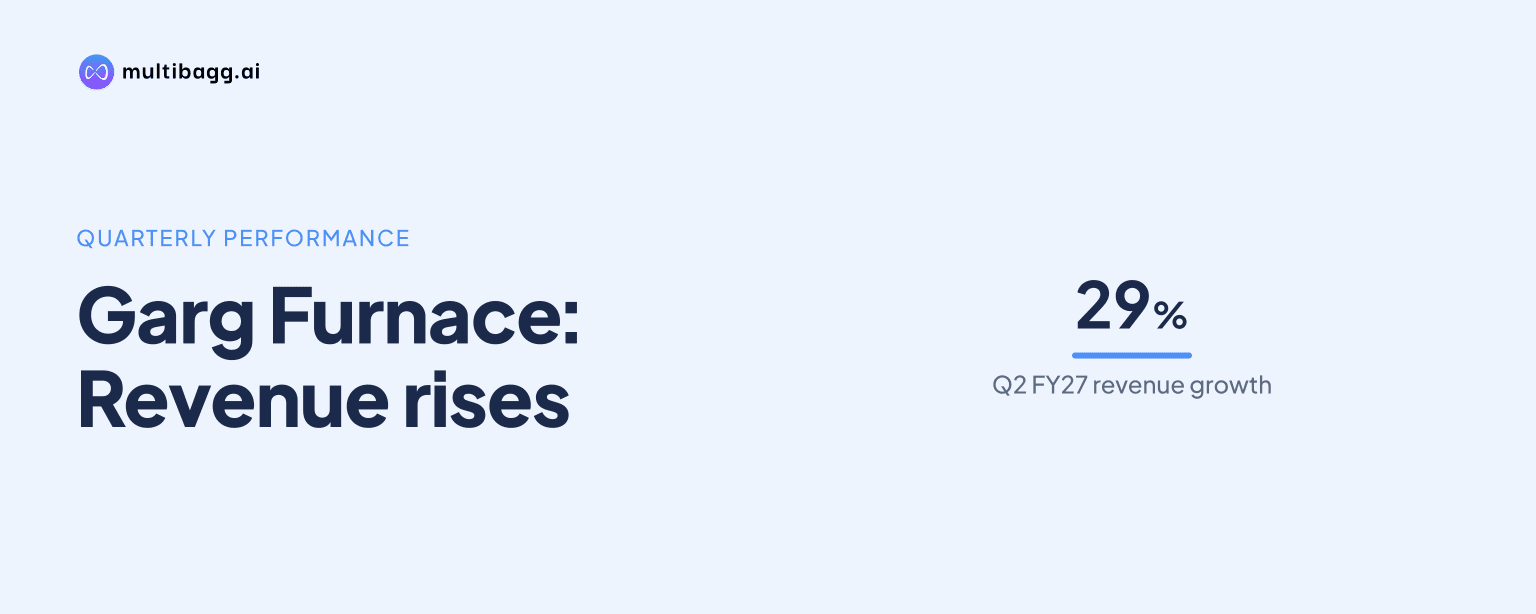
Garg Furnace Ltd reported Q2 FY27 consolidated revenue of ₹79.63 crore, up 29.0% year-on-year, but consolidated net profit fell 32.5% to ₹1.91 crore from ₹2.83 crore in Q2 FY26. The result shows stronger sales and a modest margin improvement, while bottom-line performance remained weaker than a year earlier.
Know Garg Furnace inside out
Results, valuation, peers and who's buying, in one view.
How did Garg Furnace perform in Q2 FY27?
Garg Furnace recorded consolidated revenue of ₹79.63 crore for the quarter ended 30 September 2026, compared with ₹61.73 crore in the year-ago period. Revenue was also 34.6% higher than ₹59.16 crore in Q1 FY27, indicating a recovery in quarterly sales volumes and realisations.
Consolidated profit before tax rose 16.0% year-on-year to ₹3.33 crore from ₹2.87 crore. It was 34.3% above the ₹2.48 crore reported in the preceding quarter. However, profit after tax declined to ₹1.91 crore from ₹2.83 crore a year earlier, even as it increased 7.9% sequentially from ₹1.77 crore.
EBITDA, excluding other income, stood at ₹4.30 crore and the EBITDA margin was 5.4%. The reported margin was slightly above 5.3% in Q2 FY26. Basic earnings per share for the consolidated business were ₹3.53.
What drove the quarter-on-quarter revenue recovery?
Garg Furnace's consolidated revenue rose 34.6% from Q1 FY27, when net sales were ₹59.16 crore. The quarterly increase coincided with a rise in consolidated profit after tax from ₹1.77 crore to ₹1.91 crore, although the profit increase was substantially slower than the growth in revenue.
The supplied results analysis described the improvement as reflecting higher sales and better margins. Operating performance improved modestly, with EBITDA margin at 5.4%. This indicates that the company generated a higher operating surplus on the expanded sales base, but the gain did not translate into year-on-year growth in consolidated net profit.
The standalone financials presented a different picture. Standalone revenue from operations was ₹68.33 crore in Q2 FY27, up 11.3% year-on-year and 19.5% sequentially. Standalone profit after tax was ₹2.93 crore, compared with ₹2.74 crore in Q2 FY26 and about ₹1.70 crore in Q1 FY27.
Why did consolidated profit lag revenue growth?
The key contrast in the results was between the 29.0% rise in consolidated revenue and the 32.5% fall in consolidated profit after tax. The data shows that profit before tax increased, whereas the reported post-tax profit was lower than the prior-year quarter. Investors therefore need to distinguish between improved operating and pre-tax performance and the final consolidated profit figure.
Finance cost was also visible in the standalone quarter. Standalone finance cost was ₹0.50 crore, versus nil in the year-ago quarter, and was higher than ₹0.40 crore in Q1 FY27. The reported analysis linked rising borrowings to negative operating cash flow and higher working-capital requirements.
Inventories and receivables rose sharply during the half year, according to the supplied information. Half-year consolidated operating cash flow was negative ₹2.14 crore. For a steel-products manufacturer, the movement in inventory, receivables and borrowings is material because sales growth can require additional funding before customer collections are received.
Got a follow-up? Ask IRIS
What do the standalone results show?
Garg Furnace's standalone results showed revenue of ₹68.33 crore and profit after tax of ₹2.93 crore in Q2 FY27. Standalone profit before tax was reported at about ₹3.35 crore, while another result summary stated ₹2.74 crore; the board approved unaudited standalone and consolidated results for the quarter and half year on 14 November 2026.
On the operating line, standalone operating profit was reported at approximately ₹4.10 crore, up 32.0% year-on-year and 34.6% quarter-on-quarter. Standalone operating margin improved to 6.0% from 5.1% a year earlier and 5.3% in the June quarter. Materials and purchases were ₹56.50 crore, employee cost was ₹0.60 crore and other expenses were ₹7.20 crore.
For the six months ended 30 September 2026, standalone income was ₹125.78 crore versus ₹121.85 crore a year earlier. Standalone net profit rose to ₹4.61 crore from ₹3.99 crore, while profit before tax increased 43% to ₹5.71 crore. These half-year numbers suggest that the standalone business improved over the first half despite the increased finance cost in the September quarter.
How did investors respond and what are the capital plans?
Garg Furnace's stock declined 4.98% to close at ₹194.65 on 16 November 2026 following the results announcement. The market reaction came despite the sequential improvement in revenue and profit, indicating that investors also focused on the year-on-year fall in consolidated profit and the working-capital position.
The company also approved the issue of 13,98,000 convertible warrants at ₹126.50 per warrant, aggregating ₹17.68 crore. The proposed warrant issue is a disclosed capital action that investors may track alongside borrowings, cash flow and the pace of receivable collections.
As a micro-cap iron and steel products manufacturer based in Ludhiana, Garg Furnace operates in a sector where input costs, sales volumes, margins and working-capital cycles can affect quarterly results. The Q2 data points to improved sales momentum, but the difference between revenue growth and consolidated profit growth remains central to assessing earnings quality.
Conclusion
Garg Furnace delivered a stronger revenue quarter, with consolidated sales rising 29.0% year-on-year to ₹79.63 crore and 34.6% sequentially. Yet consolidated net profit of ₹1.91 crore was 32.5% lower than the prior-year quarter, while negative half-year operating cash flow, rising inventories and receivables, and higher borrowings added to the financial context.
The next areas to watch are the execution of the proposed ₹17.68 crore convertible-warrant issue, changes in operating cash flow and working capital, and whether margin improvement is sustained in subsequent quarters. The company has disclosed both consolidated and standalone results for the period ended 30 September 2026, approved by its board on 14 November 2026.