










Gateway Distriparks sees up to 15,000 monthly DFC TEUs
Key highlights
- Gateway Distriparks estimates 10,000 to 15,000 TEUs per month could move from road to rail from JNPT.
- Gateway Distriparks ran its first double-stack train after DFC completion on June 20, 2026.
- JNPT's rail coefficient was 14% to 15%, according to Gateway Distriparks management.
- Gateway Distriparks targets at least 100,000 rail TEUs per quarter for the rest of FY27.
powered by IRIS
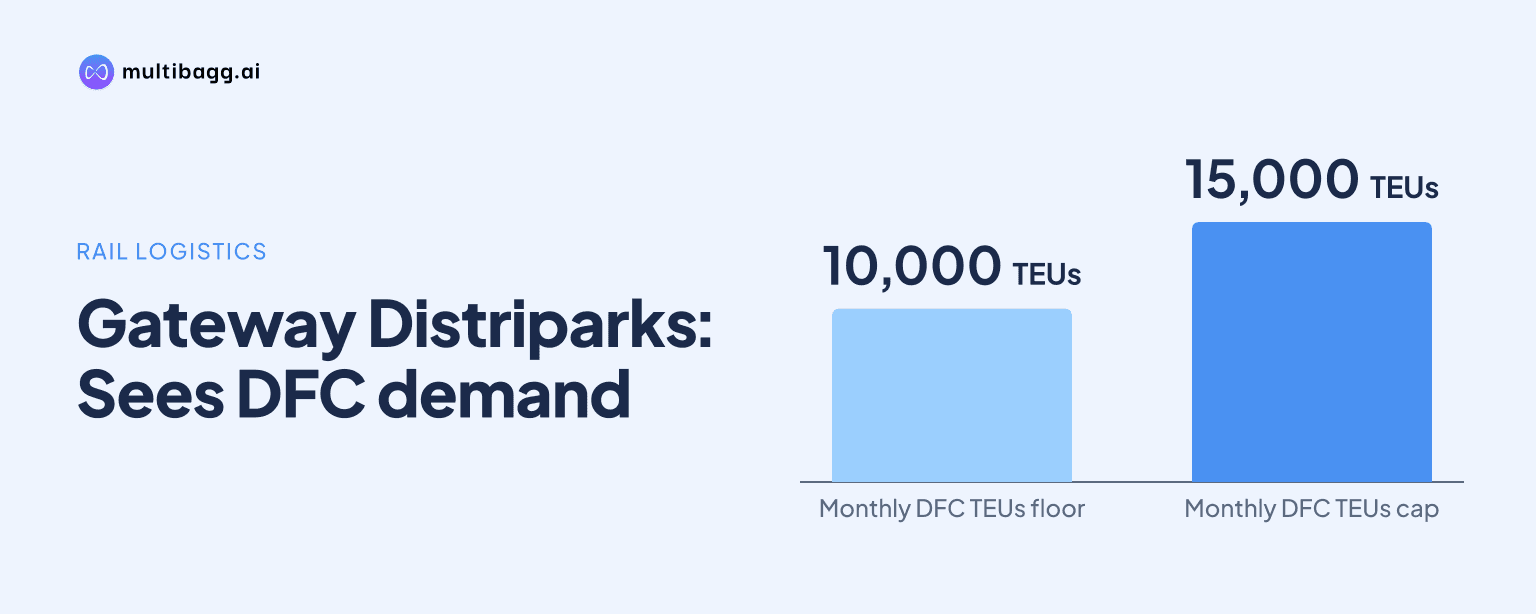
Gateway Distriparks Limited said on October 28, 2026, that the Dedicated Freight Corridor, or DFC, could target 10,000 to 15,000 twenty-foot equivalent units, or TEUs, per month now moving by road from JNPT to North India, although management said shipping-line routing and rail tariffs leave the eventual volume and earnings benefit uncertain.
Know Gateway Distriparks inside out
Results, valuation, peers and who's buying, in one view.
What road-to-rail opportunity does Gateway Distriparks see at JNPT?
Gateway Distriparks sees a potential 10,000-to-15,000-TEU monthly road-to-rail pool from JNPT, but it has not forecast that all of this cargo will convert or be carried by the company. Management said the estimate covers containers currently moving north by road, rather than a projection of new JNPT port traffic created by the DFC connection.
The company said it ran its first double-stack train after DFC completion on June 20, 2026. Management expects the direct port connection to improve turnaround time and asset utilisation, while double-stack trains can carry containers in two layers. Those operating gains do not establish how much of the addressable road traffic will select rail.
Gateway Distriparks also identified cargo moving from other ports to JNPT as a separate opportunity, especially when Mundra or Pipavav face congestion. Management did not quantify this possible port shift and said the 10,000-to-15,000-TEU estimate applies only to road cargo that could move onto rail. That distinction makes the identified rail-conversion pool more measurable than any gain in JNPT port calls.
Why are Gateway Distriparks' DFC gains still uncertain?
Gateway Distriparks said shipping lines' decisions on vessel calls at JNPT will determine the larger volume opportunity, and the company has received no indication that calls will increase. Management said it meets shipping lines regularly, but could not comment on how much cargo may move to JNPT until those lines alter their routing.
Management said JNPT's overall port volume must also increase for the broader opportunity to develop. Road-to-rail conversion can occur within present throughput, but Gateway Distriparks described it as the smaller component. The larger variable is whether shipping lines send more vessels to JNPT and whether the port terminals offer conditions that support higher traffic.
Rail tariffs remain another unresolved issue. Management said representations had been made to Indian Railways seeking tariff rationalisation so JNPT could compete with Mundra and Pipavav, given the 350-kilometre distance factor it cited. It said it was too early to determine the ultimate benefit or how much could be passed to customers, and suggested waiting another couple of months after the October 28 call for incremental JNPT rail volumes.
Gateway Distriparks did not provide an earnings before interest, tax, depreciation and amortisation, or EBITDA, estimate from the DFC. Management said the outcome will depend on pricing passed to customers, savings retained by operators, additional costs not yet recovered, and competition from other container train operators. It specifically said the potential JNPT traffic would be divided among multiple operators rather than flowing to one company.
Got a follow-up? Ask IRIS
How is Gateway Distriparks preparing for DFC traffic?
Gateway Distriparks plans to combine export-import, or EXIM, volumes from Ankleshwar with domestic cargo for northbound movements. Ankleshwar had secured its EXIM permissions by the Q2 FY27 call, and management expected some volumes in the third quarter. The plan gives Gateway Distriparks an additional source of rail cargo beyond a possible rise in JNPT throughput.
Management said JNPT ports were working to increase the rail coefficient, which it put at 14% to 15%. Gateway Distriparks said it wants to participate in both this possible improvement in rail usage and the road-to-rail conversion enabled by the DFC. However, the company did not disclose Ankleshwar throughput, saying EXIM operations were just beginning and bills-of-lading points were being opened.
Gateway Distriparks said it has offered bundled rail and terminal services since 2008. Its Chief Business Officer cited terminals in the National Capital Region, Punjab and Uttarakhand, alongside application-programming-interface integration, container tracking and optical character recognition, as measures intended to retain customers. These capabilities are relevant because the DFC opportunity will be contested by other operators.
What do current rail volumes and transit times show?
Gateway Distriparks targets at least 100,000 rail TEUs per quarter for the rest of FY27, while management described demand as uneven from month to month. An analyst on the call cited an approximately 11% sequential recovery in railway-specific volumes in Q2, and management said the 100,000-TEU level was its minimum quarterly target despite continuing macroeconomic uncertainty.
Management maintained an expectation of double-digit growth in the following year, when Ankleshwar EXIM operations should contribute for a full year. For FY27, it said the outlook required reassessment because Q1 had taken a significant hit. This compares a Q2 recovery with a weaker first quarter, rather than presenting DFC capacity as the sole driver of rail growth.
Gateway Distriparks said timetable trains can improve service reliability for exporters. Management gave the Gurgaon-to-Mundra route as an example: normal trains had taken from 40 hours to 80 or 100 hours, while timetable trains were taking about 30 to 35 hours. It said timetable services had started for Pipavav and that trials had also been conducted for JNPT.
An analyst also cited blended realisation growth of about 5% year on year and 7% quarter on quarter in Q2. Management attributed the increase mainly to fuel-cost pass-throughs, saying its own costs had also risen. It added that Ankleshwar EXIM cargo could reduce realisation per TEU because of shorter lead distances, so management said it would focus on aggregate EBITDA as the mix changes.
Conclusion
Gateway Distriparks has identified a specific 10,000-to-15,000-TEU monthly road-to-rail pool at JNPT and began double-stack operations after DFC completion on June 20, 2026. Yet the 14% to 15% JNPT rail coefficient, shipping-line vessel calls, tariff decisions, port offerings and operator competition mean the potential cannot yet be translated into a company volume or EBITDA forecast.
The next indicators are whether JNPT rail traffic increases in the months following the October 2026 call, whether Indian Railways rationalises tariffs, and whether shipping lines route more vessels to the port. Gateway Distriparks also expects Ankleshwar EXIM volumes to begin in Q3 FY27, targets at least 100,000 rail TEUs per quarter for the rest of FY27, and expects a full year of Ankleshwar operations to support growth in the following year.