










Snowman Logistics limits 5PL growth to protect warehouse margins
Key highlights
- Snowman added no new 5PL customer in the financial year to date, and the segment grew 1% to 2%.
- Snowman is constructing about 23,000 pallet positions and discussing another 20,000-odd positions.
- Warehouse utilisation was 85% to 86%, below management’s 88% to 89% target.
- Management said minimum wages rose close to 70% in Karnataka and 35% in Haryana.
powered by IRIS
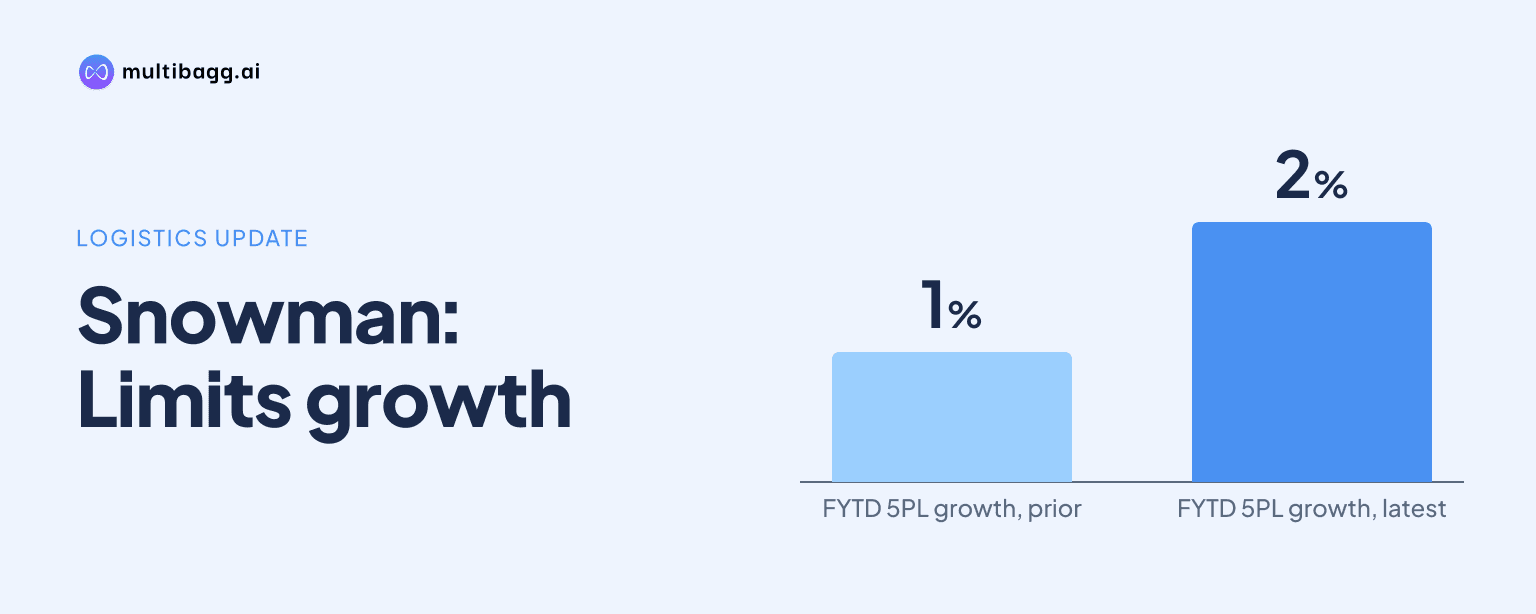
Snowman Logistics is restricting fifth-party logistics, or 5PL, additions to contracts with acceptable margins while constructing about 23,000 temperature-controlled pallet positions. Management said 5PL grew only 1% to 2% in the period discussed, while warehouse utilisation was 85%, below its 88% to 89% target range.
Know Gateway Distriparks inside out
Results, valuation, peers and who's buying, in one view.
Why is Snowman limiting 5PL customer additions?
Snowman is limiting 5PL additions because management will not pursue accounts with negative or near-zero margins. The company had added no new 5PL customer in the financial year to date, although management said a couple of discussions were nearing closure. Some prospective accounts did not close because of commercial terms, indicating that management is applying a profitability threshold before adding revenue.
The existing 5PL customer base produced only 1% to 2% overall growth in the period discussed. One customer recorded negative growth, while the other partners grew, according to management. Snowman expected the business to recover in the third and fourth quarters and meet its targets, but that expectation depends on pending customer discussions and growth from existing accounts rather than completed new wins.
A larger assignment with one major customer could support the segment. Snowman had earlier operated in two or three geographies for that customer and said it would now work on a pan-India basis. Management said 5PL pricing is mostly linked to a customer’s overall sales, while contractual guardrails cover inventory exposure and allow Snowman to slow procurement when customer sales decline.
How is Snowman expanding temperature-controlled storage capacity?
Snowman is constructing about 23,000 pallet positions and has another 20,000-odd pallet positions under discussion. Management said it is considering both build-to-suit, or BTS, facilities and capacity it owns, with expansion to proceed in line with profit-and-loss requirements rather than a stated fixed pace. The programme is focused on temperature-controlled storage rather than a broad addition of dry capacity.
Snowman said its new facilities are all cold, temperature-controlled sites with only a minimal dry component. Management described a typical approach of initially shutting a chamber and then converting it into frozen storage. Dry capacity represents around 10% to 12% of total capacity, excluding three dedicated dry warehouses adjoining cold facilities that are not included as part of a cold facility.
Snowman manages customer mix at each warehouse to balance rates and occupancy across seasonal categories, including pharmaceuticals and ice cream. Management said it replaces the lowest-paying available customers with higher-paying customers at individual sites while maintaining utilisation. That approach kept utilisation around 85% to 86% through the year, although the company had targeted 88% to 89% in the period discussed.
Got a follow-up? Ask IRIS
Why do Snowman’s reported warehousing margins look lower?
Snowman’s reported warehousing margin looks lower because the division includes 5PL, dry warehousing and short-term park-and-pay activity alongside cold storage, management said. An analyst noted that the reported margin had moved from about 18% before and around the COVID period to roughly 10% to 11% now. Management responded that the percentage had declined while the absolute earnings before interest, tax, depreciation and amortisation, or EBITDA, amount had increased.
Management attributed part of the change since financial year 2022 to park-and-pay capacity and dry warehousing, including operations at Shoolagiri and previously Tauru. Park-and-pay is short-term, spot-based capacity taken from one party and supplied to another for a few months, and management said its margin is under 10%. Snowman did not have this activity before financial year 2022, reducing comparability with later divisional margin figures.
BTS projects also have lower margins than owned or long-term leased cold storage, management said, but they require no Snowman capital expenditure and can be better at the profit-after-tax level. Management also cited a reclassification of fixed costs between verticals, previously discussed in its first-quarter transcript. These factors mean the reported warehousing margin does not isolate the economics of owned and long-term leased cold storage.
How is Snowman protecting core warehouse profitability?
Snowman said margins at its core owned and long-term leased cold-storage warehouses remain intact, distinguishing them from the blended warehousing figure. Warehousing revenue grew close to 10% to 11% in the period, according to management, while 5PL revenue was broadly flat. The 85% utilisation rate, rather than the 88% to 89% target, reduced overall margin by an estimated 2% to 3%, management said.
Cost inflation is also affecting reported margins because warehouse contracts are annual and not every cost increase can be immediately passed through. Management cited minimum-wage increases of close to 70% in Karnataka and 35% in Haryana, alongside wage-code effects on gratuity and a change in the provident-fund ceiling. Management said these items had not all been passed through when it discussed the quarter.
Snowman said it normally builds an expected 6% to 8% annual increase in power costs into contract pricing for the coming year. At renewal, it renegotiates power costs with customers, while some contracts allow the expense to be passed through. This mechanism addresses energy-cost inflation over an annual contract cycle but can create a timing gap between a cost rise and customer recovery.
Conclusion
Snowman’s strategy combines temperature-controlled capacity expansion with greater selectivity in 5PL. It is constructing about 23,000 pallet positions, discussing another 20,000-odd positions and declining 5PL opportunities with negative or near-zero margins. Management attributed lower reported warehousing margins to mix, including park-and-pay, dry capacity and BTS projects, rather than deterioration in core owned and long-term leased cold storage.
The next measures to watch are whether the couple of near-closing 5PL accounts are signed, whether the pan-India customer assignment adds revenue and whether utilisation rises from 85% toward the 88% to 89% target. Management also identified contract renewals as the mechanism for recovering the expected 6% to 8% power-cost increase and wage costs not yet fully passed through.