










IC Electricals says EPC capital employed peaked at Rs 97 crore
Key highlights
- IC Electricals said Rs 97 crore of contract-division capital employed had reached its peak as of September 30, 2026.
- The contract division generated Rs 59 crore of FY26 revenue from Rs 75 crore of capital employed.
- IC Electricals reported Rs 231 crore of outstanding orders at September 30, 2026, including Rs 140 crore in contracts.
- Management expects more than Rs 100 crore of additional orders over the next four to five months.
powered by IRIS
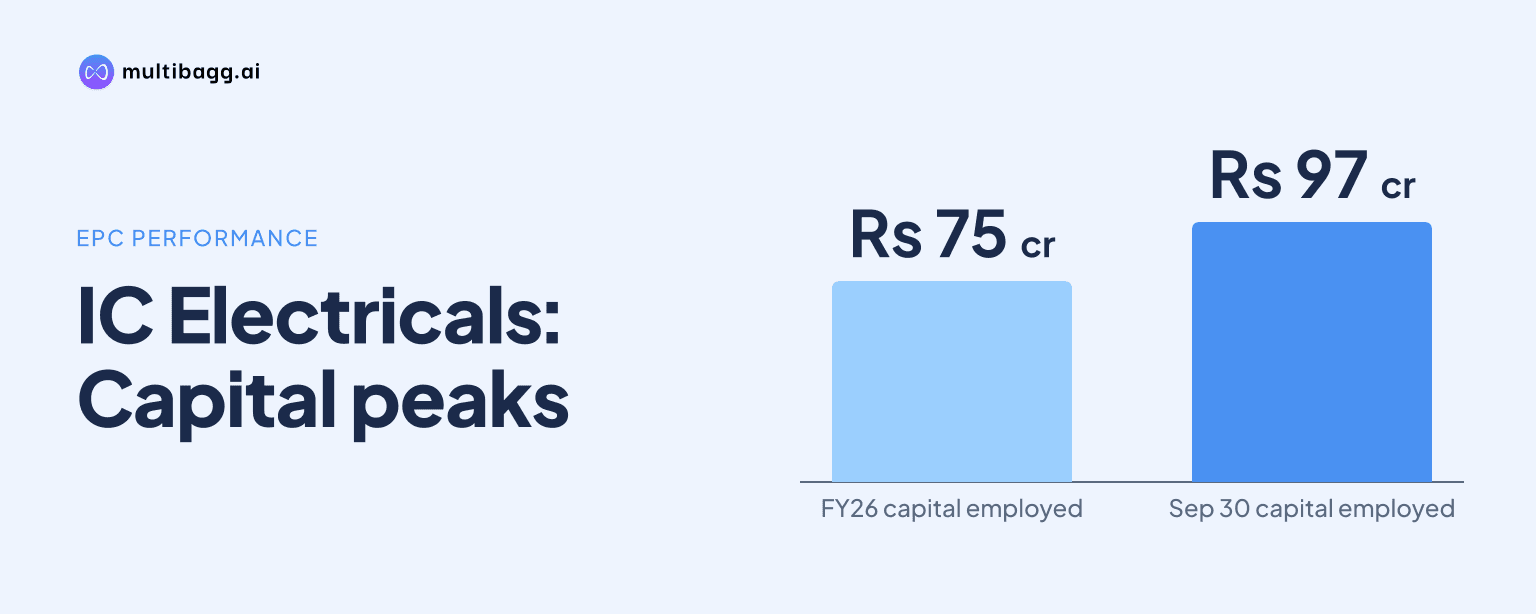
IC Electricals Company Ltd. said Rs 97 crore of capital employed in its engineering, procurement and construction (EPC) contract division had peaked as of September 30, 2026, after inventory was built ahead of the busier field-execution season; management said that inventory should now reduce as projects advance.
Know IC Electricals Company inside out
Results, valuation, peers and who's buying, in one view.
Why did IC Electricals' EPC capital employed peak?
IC Electricals said its Rs 97 crore of contract-division capital employed was at a peak because it had built inventory before the main execution period. Management said the inventory was accumulated to ensure EPC projects were not delayed by material shortages during the more favourable field-work season. The company did not say that Rs 97 crore was the inventory balance itself.
The explanation followed an investor's comparison of the contract division with manufacturing in financial year 2026 (FY26). The investor said the contract division generated Rs 59 crore of FY26 revenue from Rs 75 crore of capital employed, while the manufacturing business generated turnover of about 1.2 times its Rs 70 crore of capital employed. Management did not provide a contract-division turnover or return-on-capital target, instead citing seasonality and the next execution phase.
When should IC Electricals' contract inventory decline?
IC Electricals said contract inventory should begin reducing going forward as materials are consumed in project execution. Management said the first half is difficult for its field-based contract division because April through August include hot-weather disruption and about two months of rain, while the subsequent period is more conducive to work.
Management said the contract business should pick up over the next five months and that the project division should overtake manufacturing in the next six months. Those are operational expectations rather than reported results for the period ended September 30, 2026. The call did not disclose a separate inventory value, a targeted reduction amount or a date by which capital employed would fall below Rs 97 crore.
How seasonal is IC Electricals' railway contract business?
IC Electricals said its railway contract activity is seasonal because site work is constrained during April to August, making the first half less productive than the following months. This operating pattern was management's central explanation for the contract division's FY26 revenue of Rs 59 crore on Rs 75 crore of capital employed.
The contract order book also has a longer delivery cycle than the product business. At September 30, 2026, IC Electricals reported Rs 140 crore of outstanding contract orders, executable over six months to 1.5 years, within a total order book of Rs 231 crore. In a later response, management said contract delivery can generally range from one to two years depending on site conditions and railway requirements, compared with three months to one year for product contracts.
Got a follow-up? Ask IRIS
Does IC Electricals have sufficient orders for execution?
IC Electricals had Rs 231 crore of outstanding orders at September 30, 2026, including Rs 140 crore in contracts and Rs 91 crore in products. Management expected more than Rs 100 crore of fresh orders over the next four to five months and said it aimed to finish the financial year with pending orders of more than Rs 200 crore.
Management's comparison showed that the order book rose from Rs 120 crore at March 31, 2025 to Rs 170 crore at March 2026, after FY26 turnover of Rs 143 crore. It said the March 2027 pending order book should exceed Rs 200 crore. Management also gave FY27 revenue guidance of around Rs 270 crore and agreed with the investor's characterisation that this implied growth of close to 35%.
What railway EPC work is IC Electricals pursuing?
IC Electricals said it is pursuing both remaining railway electrification and modernisation of installed systems. Management said about 90% of electrification had been completed, but viewed the remaining 10% as a significant opportunity. It also described a move from 1x25 kilovolt to 2x25 kilovolt systems, which it said would require substations and upgrades to overhead transmission equipment.
Management said it was discussing technology with Korean vendors for electronics, rotating machines and the contract division, but could not identify counterparties before non-disclosure agreements are signed. It said the intended EPC technology would support capacity augmentation, with an upgrade potentially enabling four trains rather than two to run in a 40-kilometre range. Management described Korean systems as operating at more than 200 kilometres per hour, with high-speed trains exceeding 300 kilometres per hour.
Conclusion
IC Electricals' Rs 97 crore contract-division capital-employed peak reflects management's stated decision to stock inventory ahead of the execution season, rather than a disclosed permanent inventory requirement. The FY26 comparison remains important: the contract division recorded Rs 59 crore of revenue on Rs 75 crore of capital employed, while the investor described manufacturing turnover as about 1.2 times its Rs 70 crore capital base.
The next measures to watch are contract execution over the next five to six months, whether inventory and capital employed decline from the stated Rs 97 crore peak, and progress toward management's target of more than Rs 200 crore in pending orders by March 2027. Management also disclosed a pending bid book of more than Rs 250 crore and a historical win rate of around 30% to 35%, while saying it bids according to its financial capability.