










IC Electricals electronics revenue more than quintupled by FY26
Key highlights
- IC Electricals’ Electronic Division revenue rose from Rs 8.12 crore in FY24 to Rs 43.7167 crore in FY26.
- Government customers contributed Rs 117.3061 crore, or 82.01%, of IC Electricals’ FY26 revenue.
- IC Electricals’ Contract Division remained the largest FY26 vertical with revenue of Rs 58.9304 crore.
- Export sales fell to Rs 5.0936 crore in FY26 from Rs 9.7403 crore in FY24.
powered by IRIS
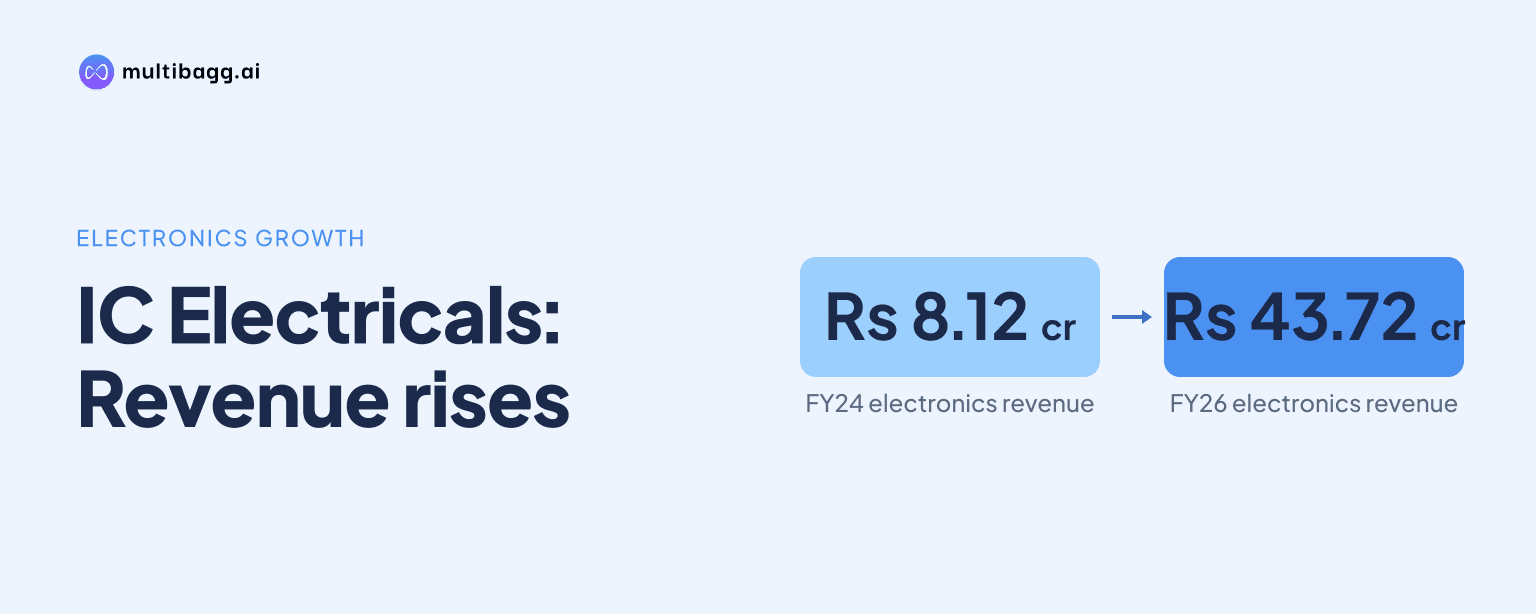
In FY26, IC Electricals Company Limited recorded electronics revenue of Rs 43.7167 crore, more than five times FY24's Rs 8.12 crore, raising its share to 30.56% from 8.18%; government customers supplied Rs 117.3061 crore, or 82.01%, of Rs 143.0415 crore total revenue.
Know IC Electricals Company inside out
Results, valuation, peers and who's buying, in one view.
How did IC Electricals’ revenue mix change in FY26?
IC Electricals’ FY26 revenue mix shifted towards electronics, although the Contract Division remained the largest vertical at Rs 58.9304 crore. The Electronic Division generated Rs 43.7167 crore, ahead of the Rotating Division’s Rs 40.3944 crore. In FY24, by contrast, the Rotating Division generated Rs 44.6266 crore and the Electronic Division was the smallest of the three verticals at Rs 8.12 crore.
Total revenue increased from Rs 99.2492 crore in FY24 to Rs 121.8859 crore in FY25 and Rs 143.0415 crore in FY26. Over the two-year period, Electronic Division revenue increased by Rs 35.5967 crore and Contract Division revenue increased by Rs 12.4278 crore, while Rotating Division revenue declined by Rs 4.2322 crore. The reported revenue expansion was therefore concentrated in electronics rather than being evenly distributed among the three verticals.
In share terms, the Electronic Division gained 22.38 percentage points between FY24 and FY26, reaching 30.56% of revenue. The Contract Division’s share fell to 41.20% from 46.86%, despite its revenue increasing by Rs 12.4278 crore. The Rotating Division’s contribution declined to 28.24% from 44.96%, alongside a Rs 4.2322 crore reduction in revenue.
Why did electronics become IC Electricals’ second-largest division?
IC Electricals’ Electronic Division became its second-largest vertical because revenue rose by Rs 18.0367 crore to Rs 43.7167 crore in FY26 from Rs 25.68 crore in FY25. Its FY26 revenue exceeded the Rotating Division’s Rs 40.3944 crore by Rs 3.3223 crore, reversing the relative position seen in FY24.
IC Electricals identifies electronic systems as an operating segment and lists regulators, chargers, inverters and Vigilance Control Devices, or VCDs, among its critical railway products. Its research and development work covers microprocessor-based electronic systems and customised railway control systems. The presentation does not provide a product-level split of the Rs 43.7167 crore FY26 Electronic Division revenue.
Electronic Division revenue increased by Rs 17.56 crore from FY24 to FY25, followed by a further Rs 18.0367 crore in FY26. Contract Division revenue rose by Rs 9.0976 crore in FY25 and Rs 3.3302 crore in FY26, while Rotating Division revenue fell by Rs 4.0209 crore and then Rs 0.2113 crore. Electronics was consequently the largest contributor to the Rs 43.7923 crore increase in total revenue between FY24 and FY26.
Got a follow-up? Ask IRIS
How reliant was IC Electricals on government and domestic revenue?
IC Electricals derived Rs 117.3061 crore, or 82.01%, of FY26 revenue from government customers, compared with Rs 67.2283 crore, or 67.74%, in FY24. Government revenue increased by Rs 50.0778 crore over the period, while non-government revenue decreased to Rs 25.7354 crore from Rs 32.0209 crore. The non-government share correspondingly declined to 17.99% from 32.26%.
The company describes its model as business-to-government, with the Ministry of Railways and other government departments accounting for most revenue. Its business spans railway electronic systems, rotating electrical machines and turnkey railway electrification contracts. The FY26 government-revenue concentration is consistent with that disclosed customer focus, although the presentation provides no customer-by-customer split within the Rs 117.3061 crore government category.
Domestic sales accounted for Rs 137.9479 crore, or 96.44%, of FY26 revenue, compared with Rs 89.5089 crore, or 90.19%, in FY24. Export sales declined from Rs 9.7403 crore in FY24 to Rs 5.7695 crore in FY25 and Rs 5.0936 crore in FY26. Exports represented 3.56% of FY26 revenue, down 6.25 percentage points from the FY24 share of 9.81%.
What does the revenue mix mean for IC Electricals’ disclosed plans?
IC Electricals’ disclosed plans are directed at a FY26 revenue base that was 82.01% government-funded and 96.44% domestic. Management says it is focusing on rail contracts associated with railway modernisation, 100% electrification, speed enhancement, network expansion and high-speed corridors. The presentation cites a rolling-stock budget of around Rs 54,113 crore for FY26-27, but does not quantify revenue that IC Electricals expects from this allocation.
For electronics, management says it is developing microprocessor-based systems and high-tech electrical equipment for railway applications. The Electronic Division contributed 30.56% of FY26 revenue, compared with 21.07% in FY25. The presentation names regulators, chargers, inverters and VCDs as products, but discloses no divisional order book, production target or future Electronic Division revenue target.
Management also says it aims to strengthen exports in markets where direct-current traction systems remain widely used, naming the United States, Canada, Brazil, Mexico and Africa. That plan follows export revenue declining to Rs 5.0936 crore in FY26 from Rs 9.7403 crore in FY24. Separately, management anticipates domestic demand for alternating-current traction motors could grow by 10% to 15% annually, but presents this as an expectation rather than an IC Electricals sales forecast.
Conclusion
IC Electricals’ FY26 mix shows that electronics drove the company’s revenue growth: Electronic Division revenue rose from Rs 8.12 crore in FY24 to Rs 43.7167 crore in FY26, while its revenue share reached 30.56%. The Contract Division remained the largest vertical at Rs 58.9304 crore, but the Rotating Division’s share fell from 44.96% to 28.24% over the same period.
Next, investors can watch management’s pursuit of rail-modernisation and electrification contracts, development of microprocessor-based electronic systems, and export-market expansion. These plans are relevant to a FY26 mix in which government customers supplied 82.01% of revenue and exports contributed 3.56%, while the presentation does not disclose divisional targets or an order-book figure to assess their future effect.