










Vinyas H1 FY27 PAT rises 48% as operating cash stays negative
Key highlights
- Vinyas’s standalone H1 FY27 revenue increased 37.0% to Rs 290.4 crore.
- Vinyas’s standalone H1 FY27 PAT increased 47.6% to Rs 13.8 crore.
- Vinyas used Rs 10.5 crore in operating activities in H1 FY27, compared with Rs 20.9 crore in H1 FY26.
- Vinyas’s standalone inventory increased to Rs 178.2 crore at September 2026 from Rs 128.6 crore at March 2026.
powered by IRIS
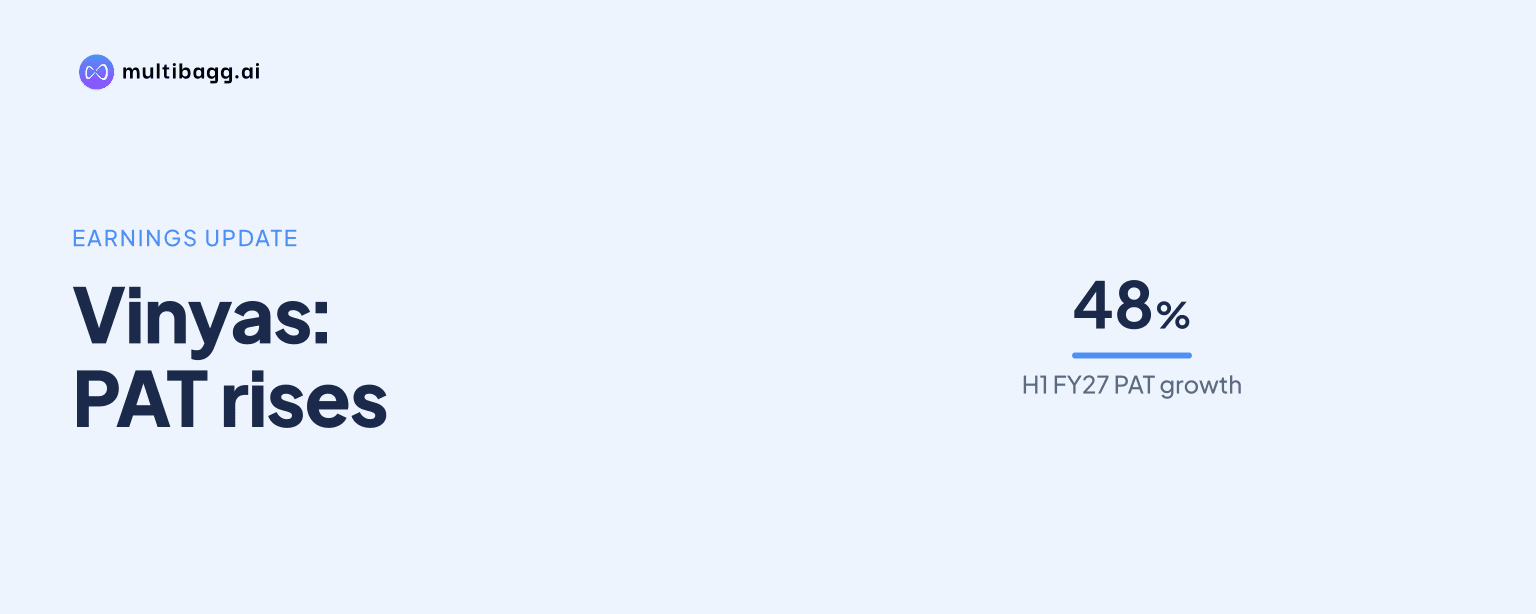
Vinyas it reported standalone H1 FY27 profit after tax of Rs 13.8 crore, up 47.6% year on year, while net cash used in operating activities was Rs 10.5 crore after a Rs 39.6 crore working-capital movement exceeded Rs 34.1 crore of operating profit before working-capital changes.
Know Vinyas Innovative Technologies inside out
Results, valuation, peers and who's buying, in one view.
How fast did Vinyas’s H1 FY27 revenue and profit grow?
Vinyas’s standalone revenue rose 37.0% year on year to Rs 290.4 crore in H1 FY27, while total income, including Rs 1.7 crore of other income, increased 36.3% to Rs 292.2 crore. Profit after tax, or PAT, grew 47.6% to Rs 13.8 crore from Rs 9.3 crore in H1 FY26, while profit before tax increased 49.2% to Rs 18.8 crore.
The H1 FY27 result showed profit growth outpacing revenue growth at several stages of the standalone income statement. Gross profit, defined by Vinyas as revenue less cost of goods sold, increased by Rs 17.1 crore against a Rs 78.5 crore revenue increase, while earnings before interest, tax, depreciation and amortisation, or EBITDA, rose by Rs 11.1 crore to Rs 35.0 crore.
Did Vinyas’s H1 FY27 margins improve?
Vinyas’s reported standalone gross, EBITDA and PAT margins all increased in H1 FY27 compared with H1 FY26. Gross margin rose to 19.5% from 18.6%, EBITDA margin increased to 12.0% from 11.3%, and PAT margin moved to 4.7% from 4.4%, alongside the 37.0% revenue increase.
Costs also rose during the half year, with cost of goods sold increasing to Rs 233.9 crore from Rs 172.6 crore, employee cost rising to Rs 16.1 crore from Rs 12.4 crore, and other expenses increasing to Rs 7.1 crore from Rs 5.5 crore. Below EBITDA, depreciation rose to Rs 5.6 crore from Rs 3.4 crore and interest increased to Rs 10.6 crore from Rs 7.9 crore, while profit-before-tax margin increased to 6.4% from 6.0%.
Why was Vinyas’s operating cash flow negative despite higher profit?
Vinyas recorded net cash used in operating activities of Rs 10.5 crore in H1 FY27 because a Rs 39.6 crore working-capital movement and Rs 5.0 crore of direct taxes paid exceeded Rs 34.1 crore of operating profit before working-capital changes. The operating outflow was lower than the Rs 20.9 crore outflow in H1 FY26, when operating profit before working-capital changes was Rs 23.0 crore and the working-capital movement was Rs 40.7 crore.
The cash-flow statement does not separately identify the inventory, receivable or other-current-asset components of the working-capital movement. The standalone balance sheet shows inventory increased by Rs 49.6 crore to Rs 178.2 crore between March 2026 and September 2026, while trade receivables declined by Rs 62.3 crore to Rs 164.8 crore and other current assets increased by Rs 33.6 crore to Rs 53.7 crore.
Got a follow-up? Ask IRIS
How did Vinyas’s borrowings and liquidity change?
Vinyas’s standalone borrowings increased by Rs 36.2 crore between March 2026 and September 2026. Long-term borrowings rose to Rs 22.1 crore from Rs 7.0 crore, while short-term borrowings increased to Rs 144.1 crore from Rs 123.0 crore, taking total borrowings to Rs 166.2 crore at September 2026.
Financing activities generated Rs 30.4 crore of cash in H1 FY27, compared with Rs 75.5 crore in H1 FY26, while investing activities used Rs 10.1 crore compared with Rs 24.0 crore a year earlier. These movements, together with the operating outflow, increased cash and cash equivalents by Rs 9.8 crore to Rs 11.2 crore; property, plant and equipment increased to Rs 71.4 crore from Rs 63.9 crore.
What expansion plans does Vinyas disclose after H1 FY27?
Vinyas says it is moving from printed circuit board assembly, or PCBA, into cable harness assembly, system-level manufacturing, subsystem integration and lifecycle support. Its disclosed capacity plan includes a 25,000-square-foot dedicated Class 3 facility for mechanical assemblies, while lifecycle support includes maintenance, repair and overhaul, or MRO, upgrades, sustenance and obsolescence management.
Management’s roadmap also identifies investment in capacity, automation and Industry 4.0, plus global customer access through a US presence. Vinyas says it has secured NADCAP AC7120 accreditation and intends to expand across North America and Europe, pursue technology-transfer and original equipment manufacturer partnerships, and scale in medical electronics and transportation; these are management’s stated strategic objectives rather than H1 FY27 financial targets.
Conclusion
Vinyas’s H1 FY27 standalone accounts combine 37.0% revenue growth, 43.5% gross-profit growth and 47.6% PAT growth with higher gross, EBITDA and PAT margins. However, the Rs 39.6 crore working-capital movement and Rs 5.0 crore of direct taxes paid resulted in a Rs 10.5 crore operating cash outflow despite Rs 34.1 crore of operating profit before working-capital changes.
The next financial update can show whether inventory of Rs 178.2 crore, other current assets of Rs 53.7 crore and total borrowings of Rs 166.2 crore change alongside operating cash generation. It can also provide evidence of progress on the disclosed 25,000-square-foot Class 3 mechanical-assembly facility and the planned move toward system-level manufacturing and overseas expansion.