










Patil Automation Limited has ₹130 crore-plus orders in hand
Key highlights
- PAL's order book was above ₹130 crore as of October 2026.
- PAL had more than ₹800 crore of proposals submitted and under negotiation.
- Automotive represented about 60-62% of the May 2026 order-book mix, versus about 38-40% for non-auto.
- PAL expects capacity to double after a preferential issue.
powered by IRIS
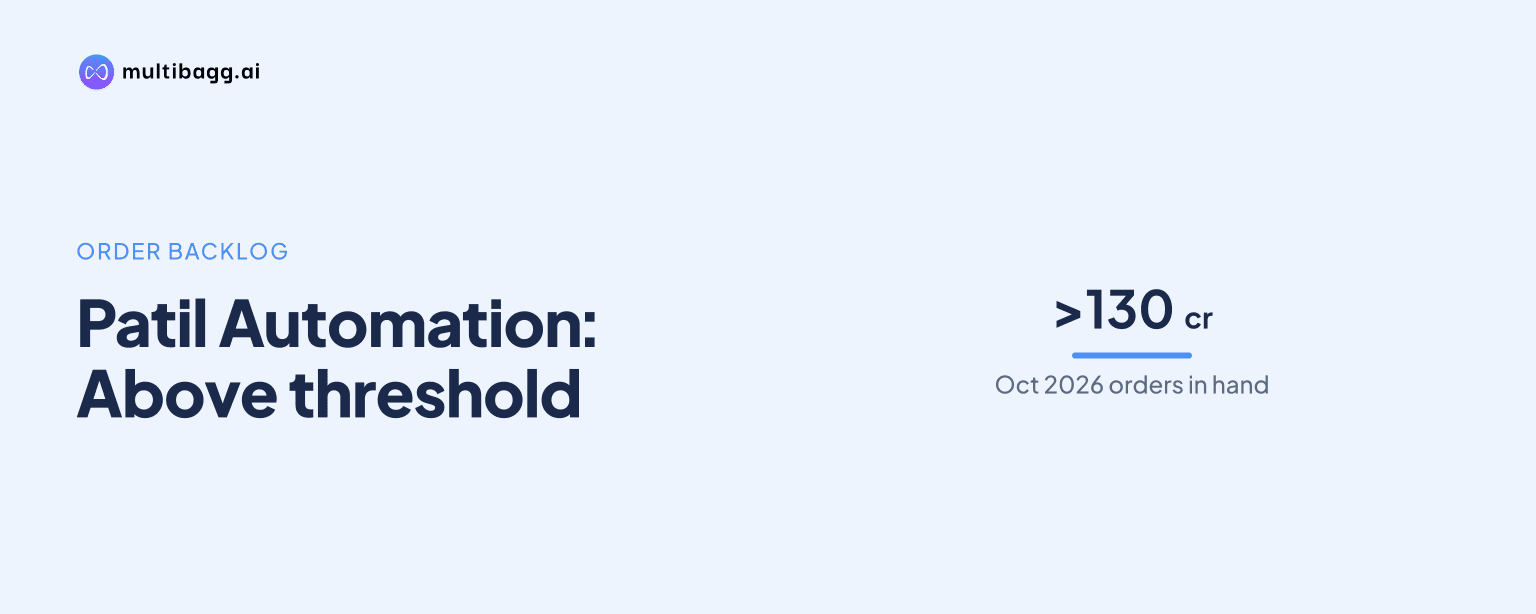
Patil Automation Limited reported an order book above ₹130 crore as of October 2026, alongside proposals above ₹800 crore under negotiation, giving PAL an identified execution base while management says it screens bids for margin, delivery timing and payment terms rather than volume.
Know Patil Automation inside out
Results, valuation, peers and who's buying, in one view.
What does PAL's October 2026 order book show?
PAL's disclosed order book was above ₹130 crore as of October 2026. The presentation says this is a point-in-time figure disclosed on the FY26 earnings call, so it indicates work contracted at that date rather than a revenue forecast or a measure of all bids being pursued.
The ₹130 crore-plus order book is supported by a business spread across automotive and non-auto applications. In the order-book mix shown for May 2026, automotive accounted for about 60-62%, while non-auto contributed about 38-40%, including defence, data centres and heavy welding. Automotive remained the larger component, but non-auto represented close to two-fifths of the book.
How large is PAL's proposal pipeline?
PAL had proposals worth more than ₹800 crore submitted and under negotiation, compared with its October 2026 order book above ₹130 crore. Using the disclosed lower bounds, the proposal pipeline was more than six times the order book, but proposals remain prospective until negotiations result in orders.
Management's stated approach is to convert the pipeline selectively rather than maximise order volume. PAL says it evaluates bids on margin, delivery timeline and payment terms, meaning that the ₹800 crore-plus figure should not be treated as an order backlog or as assured future revenue.
The strategy page identifies bid conversion as one of eight priorities. It also says PAL is working to increase project ticket sizes to optimise resource use, while dedicated pre-sales and consultant teams are intended to support larger and more complex turnkey projects. These actions link pipeline conversion to commercial terms and project execution capacity.
Which orders has PAL announced recently?
PAL announced four selected orders between October 2025 and June 2026 with a combined disclosed value of ₹40.77 crore. The identified awards cover onsite assembly-line installation, automotive robotics, defence automatic lines and a Tier-1 spot-welding project, illustrating the mix of applications represented in its customer activity.
In H1 FY27, PAL says it secured a strategic spot-welding line project from a Tier-1 customer, added more than five defence clients, and onboarded more than 10 new clients across electric vehicles, automotive and defence. It also says it executed projects automating high-demand artillery-shell production, adding a defence application to its historically automotive-led mix.
Got a follow-up? Ask IRIS
How is PAL screening and executing projects?
PAL says it is screening bids by margin, delivery timeline and payment terms, rather than by volume alone. This stated discipline is particularly relevant because the order book is above ₹130 crore while the submitted-proposal pool is above ₹800 crore, creating a large set of potential projects from which management intends to choose.
PAL's delivery proposition is turnkey lines in about 4-4.5 months, compared with about six months for the wider market, according to the presentation. The company also says it assembles and trials complete lines in-house before dispatch, allowing customers to witness the line at its facility; this process is enabled by about 2 lakh square feet of in-house build and trial space.
The presentation identifies local commissioning and after-sales service as an advantage over lines sourced from China. PAL operates from seven sales and service locations in India, while its lines have been delivered in 10 countries; it says international deliveries are largely to overseas plants of Indian original equipment manufacturers, extending domestic customer relationships.
What capacity and market mix support PAL's plans?
PAL expects capacity to double after a preferential issue, according to the October 2026 order-book page. Its strategy is to utilise the Chakan and Faridabad footprint funded in FY26, and management characterises growth as an execution issue rather than a new capital-expenditure requirement.
The company serves eight end-markets from one engineering platform, including automotive, electric vehicles, defence, heavy fabrication, data centres and renewables. About 23% of its workforce is in design, supported by a 13,000 square foot Design Hub and in-house coordinate measuring machine, weld-validation and Internet of Things traceability capabilities.
PAL also reports more than 60 marquee original equipment manufacturer and Tier-1 customers, with more than 60% of business from repeat customers. The presentation says its lines have a six-to-seven-year life, a feature it links to follow-on orders. This repeat-business measure complements the May 2026 mix, in which non-auto sectors were about 38-40% of the order book.
Conclusion
PAL's disclosed figures show a contracted order base above ₹130 crore in October 2026 and a much larger proposal pool above ₹800 crore. The key distinction is commercial: management does not present the proposal value as assured work and says it will select projects on margin, timing and payment terms, while automotive remains the largest order-book segment.
The next disclosed execution markers are conversion of the ₹800 crore-plus proposal pipeline, use of the Chakan and Faridabad footprint, and the expected doubling of capacity after the preferential issue. Investors can also watch whether PAL's stated plans to scale Mii Robotics, Pentaco and PAL Green Energy translate into additional orders across defence, assembly, battery energy storage systems and renewable-energy applications.