










Patil Automation FY26 investment lifted inventory days to 221
Key highlights
- Patil Automation’s inventory days increased to 221 in FY26 from 105 in FY25.
- Patil Automation spent ₹64.19 crore on investing activities in FY26, versus ₹5.53 crore in FY25.
- Patil Automation’s debt-to-equity ratio declined to 0.14 times in FY26 from 0.43 times.
- Patil Automation’s ROE fell to 11.60% in FY26 from 21.80% in FY25.
powered by IRIS
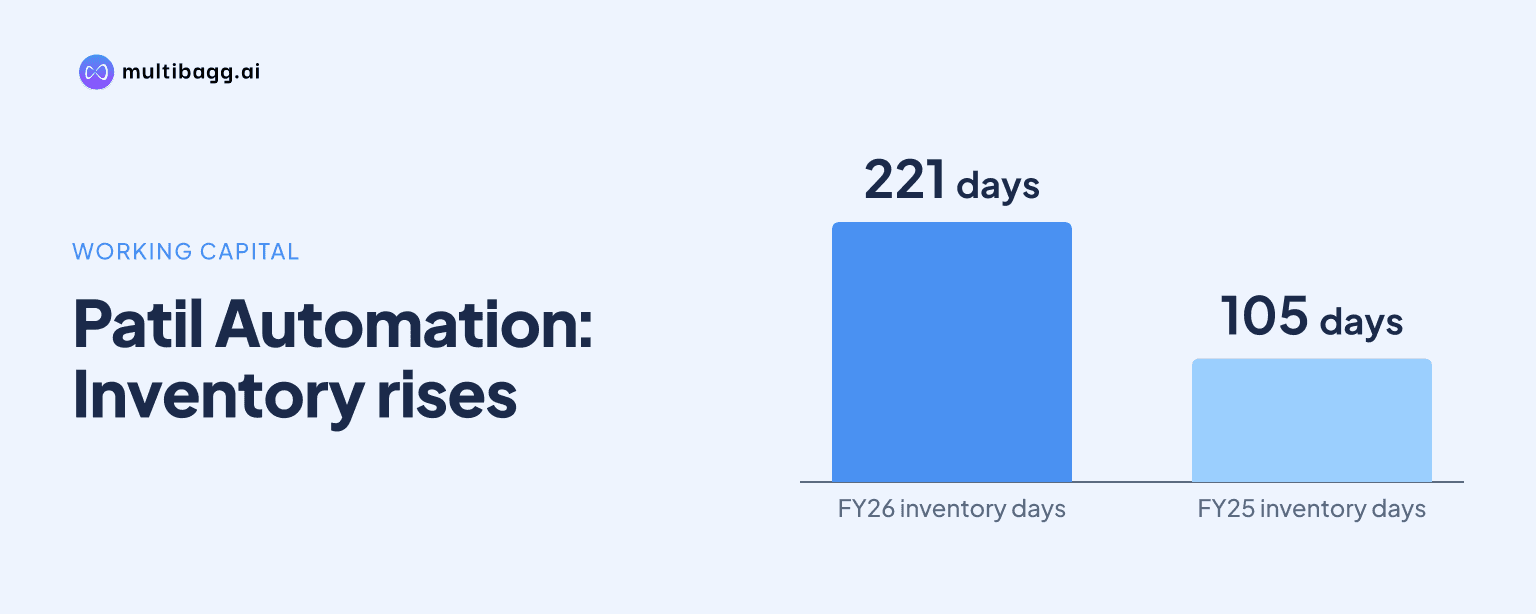
Patil Automation Limited’s FY26 expansion lifted inventory days to 221 from 105 in FY25 and reduced return on equity to 11.60% from 21.80%, even as debt-to-equity declined to 0.14 times from 0.43 times. The company funded ₹64.19 crore of investing outflow largely through ₹60.60 crore of financing inflow.
Know Patil Automation inside out
Results, valuation, peers and who's buying, in one view.
What did Patil Automation invest in during FY26?
Patil Automation invested ₹64.19 crore through cash outflows from investing activities in FY26, compared with ₹5.53 crore in FY25. The company says this outflow funded new Chakan capacity, the Faridabad facility, the Design Hub and two acquisitions, making FY26 a substantially larger investment year than the preceding period.
Fixed assets rose to ₹54.65 crore at FY26 end from ₹13.34 crore at FY25 end, an increase of ₹41.31 crore. Total non-current assets increased to ₹87.28 crore from ₹25.97 crore, while total assets grew to ₹203.92 crore from ₹115.35 crore. These balance-sheet changes show the scale at which capital was committed to assets and facilities during the year.
The expanded asset base arrived alongside higher business volume. Standalone revenue from operations rose to ₹150.05 crore in FY26 from ₹118.05 crore in FY25, while total income increased to ₹156.82 crore from ₹122.04 crore. The presentation therefore records both a ₹34.78 crore rise in standalone total income and a much larger rise in fixed and non-current assets.
Why did Patil Automation’s inventory days reach 221 in FY26?
Patil Automation’s inventory days rose to 221 in FY26 from 105 in FY25 because inventory increased to ₹47.79 crore from ₹17.94 crore while the company prepared work in progress for orders scheduled for execution in the first quarter of FY27. The presentation directly links negative operating cash flow to this increase in inventory.
Operating cash flow was negative ₹4.38 crore in FY26, compared with a positive ₹0.63 crore in FY25. Inventory rose by ₹29.85 crore over the year, whereas trade receivables declined to ₹43.96 crore from ₹49.93 crore. This means the working-capital pressure identified in the presentation was concentrated in stock and work in progress rather than an increase in outstanding customer receivables.
Receivable days improved to 107 in FY26 from 154 in FY25, a fall of 47 days, while payable days increased to 124 from 105. Patil Automation says projects are executed against customer advances and management expects receivable days to remain around 110 days as revenue scales. The contrast is clear: collections, measured by receivable days, improved in FY26, but the inventory cycle lengthened by 116 days.
Got a follow-up? Ask IRIS
How did Patil Automation fund its FY26 expansion?
Patil Automation funded FY26 investment primarily with ₹60.60 crore of financing inflow, which the presentation says principally reflected proceeds from its June 2025 NSE Emerge listing. This financing inflow was slightly below the ₹64.19 crore investing outflow, and closing cash and bank balances fell to ₹12.66 crore from ₹20.63 crore.
Total equity increased to ₹136.60 crore in FY26 from ₹53.69 crore in FY25, driven by equity share capital rising to ₹21.82 crore from ₹16.02 crore and reserves and surplus rising to ₹114.77 crore from ₹37.67 crore. Meanwhile, short-term borrowings declined to ₹18.64 crore from ₹22.93 crore, and long-term borrowings remained nil at FY26 end.
The reported debt-to-equity ratio consequently declined to 0.14 times in FY26 from 0.43 times in FY25. The current ratio, which compares current assets with current liabilities, rose to 1.79 times from 1.48 times, with current assets of ₹116.65 crore and current liabilities of ₹65.12 crore. The figures show that equity growth and lower borrowings changed the funding mix even though cash declined by ₹7.97 crore during the year.
Why did Patil Automation’s return ratios decline in FY26?
Patil Automation’s return on equity (ROE) declined to 11.60% in FY26 from 21.80% in FY25, while return on capital employed (ROCE) fell to 14.70% from 21.69%. The reported reductions occurred even though standalone profit after tax increased to ₹15.85 crore from ₹11.70 crore and profit before tax rose to ₹20.65 crore from ₹15.18 crore.
The comparison indicates that profit growth did not keep pace with the enlarged capital and asset base in FY26. Total equity rose by ₹82.91 crore, total assets rose by ₹88.57 crore and fixed assets rose by ₹41.31 crore, while standalone profit after tax rose by ₹4.15 crore. This is an analytical reading of the reported figures, rather than a separate management explanation of the ratios.
Fixed-asset turnover declined to 2.75 times in FY26 from 8.85 times in FY25. Interest coverage also eased to 10.52 times from 11.51 times, despite finance costs rising to ₹2.17 crore from ₹1.44 crore. Earnings per share increased to ₹7.71 in FY26 from ₹7.62 in FY25.
Conclusion
Patil Automation’s FY26 accounts show the trade-off of an equity-backed expansion year. The company added facilities, a Design Hub and acquisitions while reducing borrowings by ₹4.29 crore, but it also ended the year with ₹47.79 crore of inventory, negative operating cash flow of ₹4.38 crore and lower reported ROE and ROCE.
The next items to watch are the conversion of FY26 work in progress into scheduled Q1 FY27 execution, management’s expectation of roughly 110 receivable days, and the completion of remaining plant spending. Patil Automation also disclosed ₹9.16 crore of unutilised listing proceeds at September 2026, with board approval to reallocate the amount from plant capital expenditure to working capital by December 2026.