










Patil Automation Limited cuts automotive revenue share to 67%
Key highlights
- PAL's non-automotive revenue reached Rs 49.52 crore in FY26, up from Rs 12.93 crore in FY25.
- Automotive contributed 67.00% of PAL's FY26 revenue, down from 88.84% in FY25.
- PAL reported FY26 revenue from operations of Rs 150.05 crore, compared with Rs 118.05 crore in FY25.
- PAL said approximately 60% to 62% of its May 2026 order book was automotive.
powered by IRIS
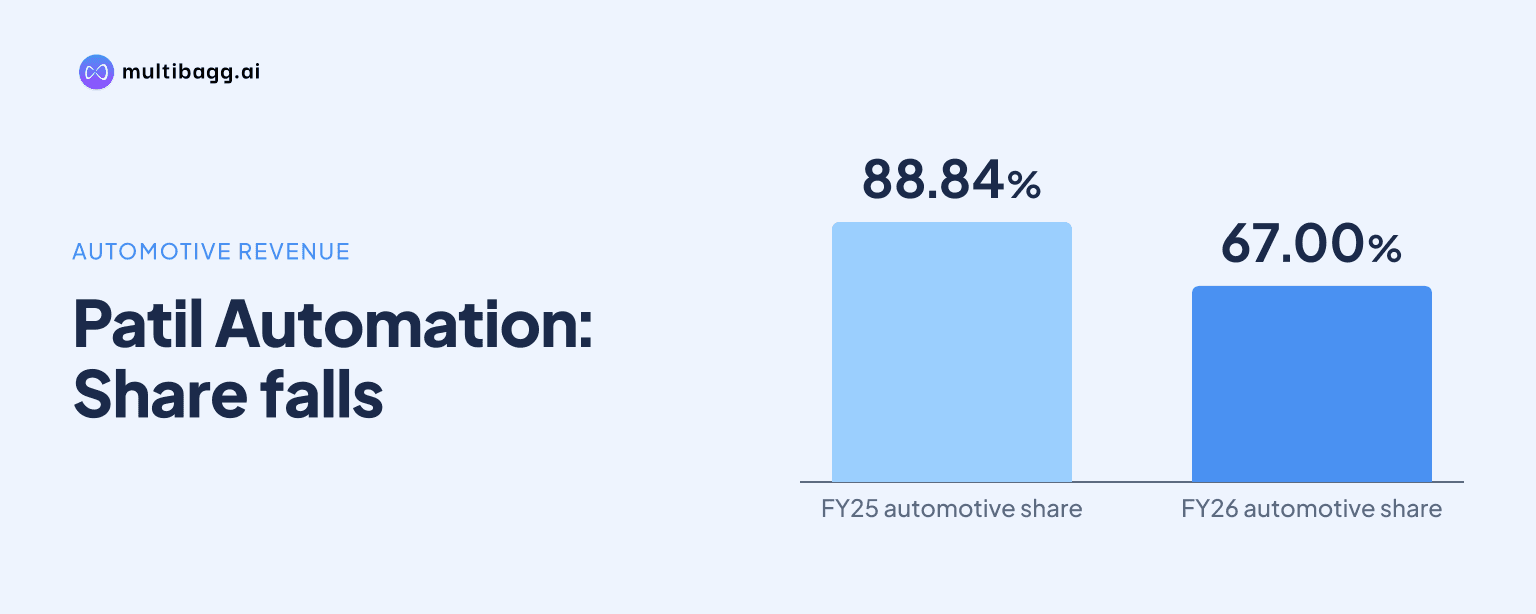
Patil Automation Limited cut automotive revenue share to 67% in FY26, while non-automotive revenue reached Rs 49.52 crore from Rs 12.93 crore in FY25. The shift raised non-automotive share from 10.95% to 33% as revenue from operations climbed to Rs 150.05 crore.
Know Patil Automation inside out
Results, valuation, peers and who's buying, in one view.
How did PAL's revenue mix change in FY26?
PAL's FY26 mix moved toward non-automotive work: automotive contributed 67.00% and non-automotive contributed 33.00%, compared with 88.84% and 10.95%, respectively, in FY25. The presentation describes the change as deliberate diversification away from a single sector and says the non-automotive share was three times its FY25 level.
The longer comparison shows that the mix shift followed two years of near-total automotive concentration. Automotive accounted for 97.46% of revenue in FY23 and 98.30% in FY24, while non-automotive represented 2.47% and 1.64%, respectively. A small others category accounted for the difference in those earlier years, at Rs 0.05 crore in FY23, Rs 0.07 crore in FY24 and Rs 0.25 crore in FY25, before falling to nil in FY26.
The presentation says the industry revenue amounts are derived by applying reported industry shares to standalone revenue from operations. On that basis, FY26 revenue from operations increased by Rs 32.00 crore from Rs 118.05 crore in FY25, while non-automotive revenue increased by Rs 36.59 crore. Automotive revenue, by contrast, declined by Rs 4.35 crore year on year.
Which businesses are behind PAL's non-automotive revenue?
PAL identifies defence, data-centre battery energy storage systems, construction equipment and renewables as live revenue lines in FY26, rather than only prospective end-markets. Its eight stated end-markets include defence and railways, construction and heavy engineering, solar, renewables and data centres, and consumer, food and pharma, alongside automotive categories and electric-vehicle automation.
The data-centre offering includes turnkey battery energy storage system, or BESS, assembly and laser-welding lines, plus container cabins for data centres. PAL identifies DCNT and Tata Gotion as clients for this work. For renewables, the stated scope includes solar-panel and water-heater assembly, while its technology stack includes programmable logic controller, supervisory control and data acquisition, or SCADA, systems and Internet of Things traceability.
Defence and railways are another named non-automotive area, with component assembly, precision machining and testing systems listed as the scope. The presentation gives a specific defence example: robotic metal inert gas, or MIG, welding of a 155 millimetre artillery-shell nub to its shell body. PAL says five such lines have been delivered to Blue Stampings, Goodluck Defence and Glove Forge.
Construction work covers robotic welding of arms, cabins and structures as well as heavy-duty conveyors. PAL cites a JCB cabin-welding line for heavy-equipment cabins and an aluminium scaffolding-welding line for construction applications. These applications use the same engineering platform that also supports robotic welding, assembly automation, special-purpose machines and material-handling systems.
Got a follow-up? Ask IRIS
What happened to PAL's automotive revenue in FY26?
PAL's automotive revenue was Rs 100.53 crore in FY26, making it the largest revenue segment despite its lower 67.00% share. The amount was Rs 4.35 crore below FY25 automotive revenue of Rs 104.88 crore and Rs 12.79 crore below the Rs 113.32 crore reported in FY24, even as total FY26 revenue from operations rose to Rs 150.05 crore.
The automotive base spans two-wheelers, four-wheelers, buses, tractors, cargo vehicles and electric-vehicle automation. The stated work includes body-in-white, chassis and powertrain lines; door, dashboard and seat assembly; frame welding; robotic handling; leak testing; and end-of-line inspection. The presentation also lists battery-pack and motor assembly and prismatic-cell compression within electric-vehicle automation.
PAL says it earns project-based revenue from turnkey lines as they are built, delivered and commissioned. It states that projects are funded in part by customer advances, which contribute to working-capital funding. Its process runs from feasibility, concept design and simulation through in-house build, trial and validation, then installation and commissioning.
The company presents a roughly four to four-and-a-half-month delivery time for a turnkey line, compared with roughly six months for the wider market. This operating model applies across automotive and newer end-markets because PAL builds fixtures, robotic cells, conveyors and special-purpose machines at its plants before complete-line testing and dispatch.
What does PAL's May 2026 order book indicate?
PAL says its order book at May 2026 was approximately 60% to 62% automotive, with the remaining share in defence, data centres and heavy welding. That order-book mix remains automotive-led, but it is less concentrated than the 67.00% automotive share reported for FY26 revenue and below the 88.84% share in FY25.
The disclosure does not provide an absolute order-book value, project completion schedule or revenue-recognition timing. It therefore shows the sector composition of work in hand rather than a quantified forecast of future revenue. The balance outside automotive is specifically linked to defence, data centres and heavy welding, not to every non-automotive vertical listed by PAL.
PAL frames diversification as a way to reduce dependence on the automotive capital-expenditure cycle. That is management's stated rationale, while the reported figures show the practical change: non-automotive revenue rose from Rs 1.89 crore in FY24 to Rs 12.93 crore in FY25 and then Rs 49.52 crore in FY26.
The next test is whether the non-automotive order-book balance converts into delivered and commissioned lines under PAL's project-revenue model. The presentation offers examples in BESS, artillery-shell welding, construction equipment and scaffolding, but it does not disclose revenue or order values by individual customer, product line or end-market.
Conclusion
PAL's FY26 figures show a measurable revenue-mix change rather than only an expansion of stated capabilities. Revenue from operations reached Rs 150.05 crore, automotive remained the largest stream at Rs 100.53 crore, and non-automotive revenue increased to Rs 49.52 crore. The resulting 33.00% non-automotive share compares with 10.95% in FY25 and 1.64% in FY24.
What to watch next is conversion of the May 2026 order book, which PAL says is approximately 60% to 62% automotive and otherwise includes defence, data centres and heavy welding. The presentation does not disclose the order book's value, project timing or expected segment-level revenue contribution as those lines are built, delivered and commissioned.