










Patil Automation FY26 EBITDA margin reaches 17.02% standalone
Key highlights
- Patil Automation’s standalone EBITDA margin rose from 11.24% in FY23 to 17.02% in FY26.
- Patil Automation’s standalone profit after tax increased from Rs 4.20 crore in FY23 to Rs 15.85 crore in FY26.
- Patil Automation reported standalone total income of Rs 156.82 crore in FY26, up 28.5% year on year.
- Patil Automation’s FY26 operating cash flow was negative Rs 4.38 crore as inventory reached Rs 47.79 crore.
powered by IRIS
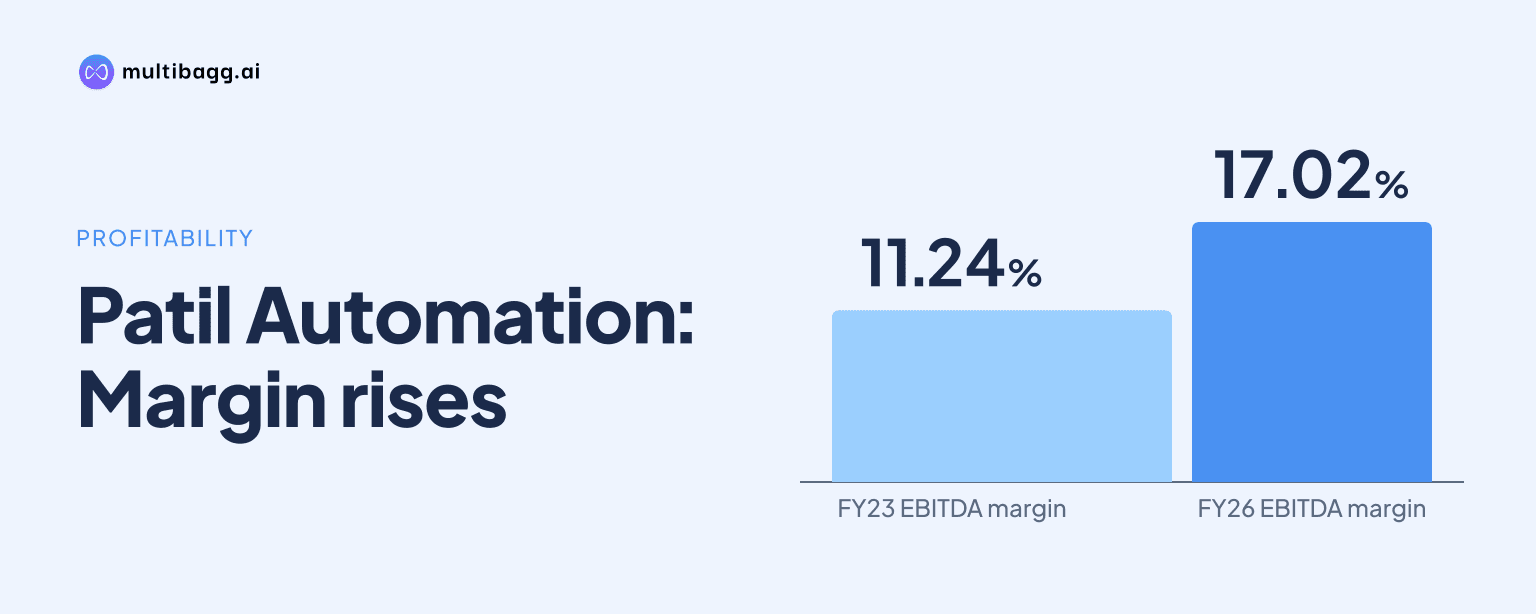
Patil Automation Limited increased its standalone EBITDA margin to 17.02% in FY26 from 11.24% in FY23, a 5.78-percentage-point increase, while standalone profit after tax grew at a 55.69% compound annual growth rate to Rs 15.85 crore. EBITDA and profit rose faster than total income across the comparable four-year standalone period.
Know Patil Automation inside out
Results, valuation, peers and who's buying, in one view.
How did Patil Automation’s standalone margin change from FY23 to FY26?
Patil Automation’s standalone EBITDA margin increased in each reported financial year, from 11.24% in FY23 to 13.34% in FY24, 15.78% in FY25 and 17.02% in FY26. EBITDA rose from Rs 9.26 crore to Rs 26.69 crore over the period, representing a 42.31% CAGR and 2.9 times the FY23 amount.
Total income also increased, but at a lower 23.95% CAGR than EBITDA. Patil Automation reported standalone total income of Rs 82.35 crore in FY23, Rs 118.72 crore in FY24, Rs 122.04 crore in FY25 and Rs 156.82 crore in FY26. Income increased by Rs 3.32 crore in FY25 before rising by Rs 34.78 crore, or 28.5%, in FY26.
What drove Patil Automation’s EBITDA margin expansion?
Patil Automation’s reported cost mix shows that other expenses accounted for a smaller share of total income as the margin expanded. Other expenses declined from 21.0% of total income in FY23 to 17.9% in FY26, a reduction of 3.1 percentage points. Materials decreased from 53.0% to 50.3%, while employee costs were 14.7% in both FY23 and FY26.
These movements left Rs 17.0 of every Rs 100 of standalone total income as EBITDA in FY26, compared with Rs 11.2 in FY23. The presentation identifies the cost split as derived, while its profit and loss statement shows total expenditure rose from Rs 73.10 crore in FY23 to Rs 130.13 crore in FY26. That Rs 57.03 crore expenditure increase was below the Rs 74.47 crore increase in total income.
FY26 continued the improvement recorded in FY25. EBITDA rose by Rs 7.43 crore from Rs 19.26 crore in FY25 to Rs 26.69 crore in FY26, while total income rose by Rs 34.78 crore. The EBITDA margin increased by 1.24 percentage points from 15.78% to 17.02%, after a 2.44-percentage-point expansion between FY24 and FY25.
How much faster did Patil Automation’s profit grow than income?
Patil Automation’s standalone profit after tax rose from Rs 4.20 crore in FY23 to Rs 15.85 crore in FY26, a 3.8-times increase and a 55.69% CAGR. This exceeded both the 42.31% EBITDA CAGR and the 23.95% total-income CAGR. In FY26, profit after tax increased 35.4% from Rs 11.70 crore, compared with 28.5% growth in total income.
Net profit margin rose from 5.10% in FY23 to 10.10% in FY26. Profit before tax increased from Rs 5.46 crore to Rs 20.65 crore, while finance costs rose from Rs 1.83 crore to Rs 2.17 crore and depreciation increased from Rs 1.96 crore to Rs 3.87 crore. Tax expense increased from Rs 1.26 crore to Rs 4.80 crore across the same period.
Earnings per share rose from Rs 2.78 in FY23 to Rs 7.71 in FY26, while equity share capital increased from Rs 5.04 crore to Rs 21.82 crore. Patil Automation also reported standalone net worth of Rs 136.60 crore in FY26 and debt-to-equity of 0.14 times, compared with 1.35 times in FY23.
Got a follow-up? Ask IRIS
Why should Patil Automation’s standalone history be separated from consolidated results?
Patil Automation states that FY26 was the group’s first consolidated year because subsidiaries were consolidated from 19 September 2025. Its FY23-to-FY26 trend tables therefore use standalone figures to compare like with like. The four-year margin and profit record is a standalone series, while consolidated FY26 is a separate group-level reference point.
For FY26, Patil Automation reported consolidated total income of Rs 172.79 crore, EBITDA of Rs 30.65 crore and an EBITDA margin of 17.74%. Consolidated profit after tax was Rs 19.07 crore, but Rs 1.29 crore was attributable to non-controlling interests, leaving net profit attributable to owners of Rs 17.78 crore. The consolidated net profit margin was 10.29%, against 10.10% on the standalone basis.
The half year ended 30 September 2026 shows differences between the two reporting bases. In H1 FY27, standalone EBITDA was Rs 18.04 crore on total income of Rs 104.01 crore, producing a 17.34% margin. Consolidated EBITDA was Rs 19.48 crore on total income of Rs 100.45 crore, producing a 19.39% margin; both H1 FY26 margins were 17.62%.
How did Patil Automation’s FY26 cash flow compare with reported profit?
Patil Automation reported negative operating cash flow of Rs 4.38 crore in FY26 despite standalone profit after tax of Rs 15.85 crore. The presentation attributes the operating outflow to inventory rising to Rs 47.79 crore, including work in progress for orders scheduled for execution in Q1 FY27. This distinguishes the timing of cash conversion from the reported profit result.
Investing cash outflow was Rs 64.19 crore in FY26, while financing cash inflow was Rs 60.60 crore. Patil Automation says the investing outflow funded new Chakan capacity, the Faridabad facility, the Design Hub and two acquisitions. It says the financing inflow principally reflected June 2025 NSE Emerge listing proceeds, while short-term borrowings fell to Rs 18.64 crore from Rs 22.93 crore.
Inventory days rose to 221 in FY26 from 105 in FY25, while receivable days fell to 107 from 154 and payable days increased to 124 from 105. Patil Automation says projects are executed against customer advances and states that management expects receivable days to hold at roughly 110 days as revenue scales. That expectation is management’s view rather than a reported result.
Conclusion
Patil Automation’s comparable standalone record shows margin-led earnings improvement between FY23 and FY26. Total income rose 1.9 times to Rs 156.82 crore, while EBITDA rose 2.9 times to Rs 26.69 crore and profit after tax rose 3.8 times to Rs 15.85 crore. The EBITDA-margin increase of 5.78 percentage points accompanied profit growth that exceeded revenue growth over the period.
The next disclosure to watch is cash conversion alongside margins. FY26 inventory reached Rs 47.79 crore and operating cash flow was negative Rs 4.38 crore, while management expects receivable days to remain around 110 days as revenue scales. H1 FY27 standalone EBITDA margin of 17.34%, versus 17.62% in H1 FY26, is the first disclosed partial-period reading after FY26.