










Altius InvIT NAV rises as tax assets offset higher rates
Key highlights
- Altius NAV increased Rs 4, from Rs 171 to Rs 175, despite a 40-basis-point rise in the risk-free rate to 7.2%.
- Altius said DTAs from past losses and unabsorbed depreciation outweighed the valuation effect of higher rates and tax assumptions.
- H1 FY27 adjusted revenue rose 3.6% year on year to Rs 6,320 crore, while cash EBITDA rose 5.3% to Rs 4,340 crore.
- Altius distributed Rs 2,450 crore in H1 FY27, equivalent to Rs 8.03 per unit.
powered by IRIS
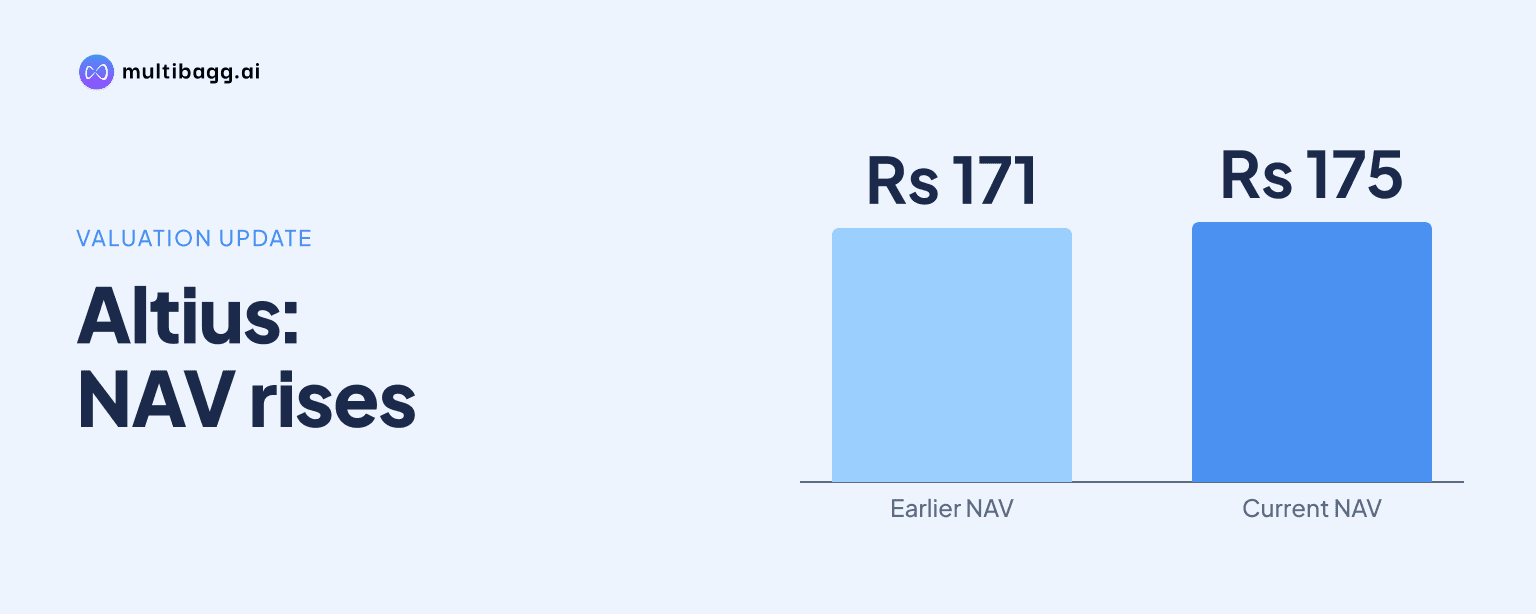
In Q2 FY27, Altius InvIT's NAV rose Rs 4, from Rs 171 to Rs 175, because recognising deferred tax assets from past business losses and unabsorbed depreciation more than offset a 40-basis-point increase in the valuer's risk-free-rate assumption. The change followed management's review of filed tax returns and assessment status.
Know Altius Telecom Infrastructure Trust inside out
Results, valuation, peers and who's buying, in one view.
Why did Altius NAV rise despite a higher risk-free rate?
Altius NAV rose because management began including deferred tax assets, or DTAs, from carried-forward business losses and unabsorbed depreciation when projecting tax outflows. Chief Financial Officer Rahul Katiyar said Altius had not used this treatment in earlier valuations, but considered it appropriate after discussions with stakeholders. Management based the assessment on income-tax returns filed and their assessment status.
The revised tax treatment reduced projected tax outflows in the initial years of the valuation, as the analyst noted during the call. Katiyar said the resulting benefit more than offset the effects of both the higher tax rate referenced in his response and the increased risk-free rate. That combination produced the Rs 4 NAV increase, from Rs 171 to Rs 175, despite a Rs 4 distribution cited by the analyst.
The valuer's risk-free-rate assumption increased by 40 basis points, from 6.8% to 7.2%, according to the analyst's question. A basis point is one-hundredth of a percentage point, so the movement was 0.4 percentage points. Altius did not disclose a separate rupee effect on NAV from either the rate change or the recognition of DTAs.
What changed in Altius's valuation tax assumptions?
Altius changed its valuation model by recognising available DTAs from historic losses and unabsorbed depreciation in projected tax outflows. Management said it had not made this adjustment in the past and described the approach as an industry practice it would follow. The change concerns valuation assumptions rather than a disclosed change in quarterly operating revenue or cash earnings.
The call did not state the monetary value of the DTAs, the period over which tax outflows would be reduced, or a numerical bridge between the Rs 171 and Rs 175 NAV figures. Katiyar said the valuation report, uploaded on Altius's website the previous day, contained the detailed calculations. The available call disclosure therefore identifies the mechanism behind the increase but not the individual contribution of each assumption.
The tax revision came during a quarter in which management also referred to a higher tax rate in the NAV calculation. However, the source did not specify the earlier and revised tax-rate assumptions or quantify their impact. Altius's stated conclusion was that the DTA benefit exceeded the combined adverse effects of the tax-related assumption and the 6.8% to 7.2% risk-free-rate increase.
How did Altius's operating results compare with the NAV change?
Altius's H1 FY27 operating performance improved, but its NAV movement was driven by the separate tax and valuation treatment. Adjusted revenue rose 3.6% year on year to Rs 6,320 crore, while cash earnings before interest, tax, depreciation and amortisation, or cash EBITDA, rose 5.3% to Rs 4,340 crore. The 1.7-percentage-point gap reflected management's comments on cost discipline.
In Q2 FY27, adjusted revenue was Rs 3,170 crore, up 3.7% year on year, and cash EBITDA was Rs 2,190 crore, up 5.7%. Management attributed revenue growth to contractual escalations and tenancy additions, while it linked the faster cash-EBITDA growth to continued cost discipline. These operating drivers differ from the DTA recognition that management identified as the reason NAV rose despite higher valuation rates.
Altius distributed Rs 2,450 crore in H1 FY27, equal to Rs 8.03 per unit. Management also described the Rs 8 per-unit H1 distribution as fully backed by operating cash flows. Since FY21, Altius said cumulative distributions reached Rs 85.7 per unit, or about Rs 23,910 crore returned to unitholders, with about 94% of net distributable cash flow distributed quarterly.
Got a follow-up? Ask IRIS
What operating factors affected Altius's H1 FY27 growth?
Altius said timely contractual escalations supported H1 FY27 adjusted-revenue growth of 3.6%, while limited market rollouts constrained net tenancy additions. Management said the telecom-infrastructure market can be lumpy in terms of rollouts. An analyst noted that the 3.6% growth rate was below the 5% to 6% annual sector-growth range previously discussed.
The tower base remained about 258,000 in H1 FY27, with a tenancy ratio of 1.2 times. This compared with tower-base growth of about 13% compounded annually between FY21 and FY26, which management said was driven mainly by acquisitions and supplemented by organic additions. The stable H1 FY27 tower count indicates that first-half revenue growth occurred without a disclosed expansion in the asset base.
Altius reported a weighted average lease expiry of about 15.4 years, with more than 55% of tenancies locked in for up to 30 years. More than 80% of revenue came from blue-chip counterparties with strong credit ratings, according to management. These contractual features describe the cash-flow base, but the call did not quantify their direct contribution to the Rs 4 NAV increase.
What could influence Altius's future valuation and growth?
Altius reported net debt to assets under management, or AUM, of 45%, below the 70% regulatory leverage limit it described. Its cost of debt was 8.16%, and 75% of borrowings were fixed rate. Management said the trust had lending relationships with more than 40 institutions and held an AAA/Stable InvIT credit rating.
Management identified contractual escalations, organic tenancy expansion and selective acquisitions as its growth levers. It cited an independent research report estimating about 350,000 incremental macro tenancies in the market over the next four to five years, particularly in semi-urban and rural areas. Management said it was optimistic about capturing a large part of that opportunity, but did not provide a tenancy target, acquisition timetable or NAV target.
Between FY21 and FY26, Altius said adjusted revenue more than tripled at a 28% compound annual growth rate, while cash EBITDA nearly tripled at a 23% compound annual growth rate. Management attributed that growth to escalations, organic tower deployment, tenancy additions and acquisitions. In contrast, H1 FY27 growth reflected a stable tower base and limited market rollouts, making the pace of future tenancy additions relevant to its stated growth plans.
Conclusion
Altius's Rs 4 NAV increase in Q2 FY27 was principally a valuation outcome from recognising DTAs related to carried-forward losses and unabsorbed depreciation. Management said that adjustment outweighed the adverse effect of the 40-basis-point rise in the risk-free rate and tax-related valuation assumptions, while H1 FY27 operating growth came from escalations, tenancy additions and cost discipline.
The next items to watch are the detailed DTA and tax assumptions in the valuation report, the pace of tenancy additions after limited H1 FY27 market rollouts, and any update on the listing process. Management gave no tentative listing timeline, saying it remained a regulatory process, while pointing to an estimated market opportunity of about 350,000 additional macro tenancies over the next four to five years.