










Altius says direct InvIT acquisitions prevent value leakage
Key highlights
- Altius says assets are acquired directly at the Trust level with no development company, sponsor or affiliate layer.
- Altius reported a weighted average lease expiry of about 15.4 years.
- H1 FY27 adjusted revenue rose 3.6% to Rs 6,320.8 crore, while cash EBITDA rose 5.3% to Rs 4,335.7 crore.
- Altius reported 258,000 towers and a 1.2-times tenancy ratio in H1 FY27.
powered by IRIS
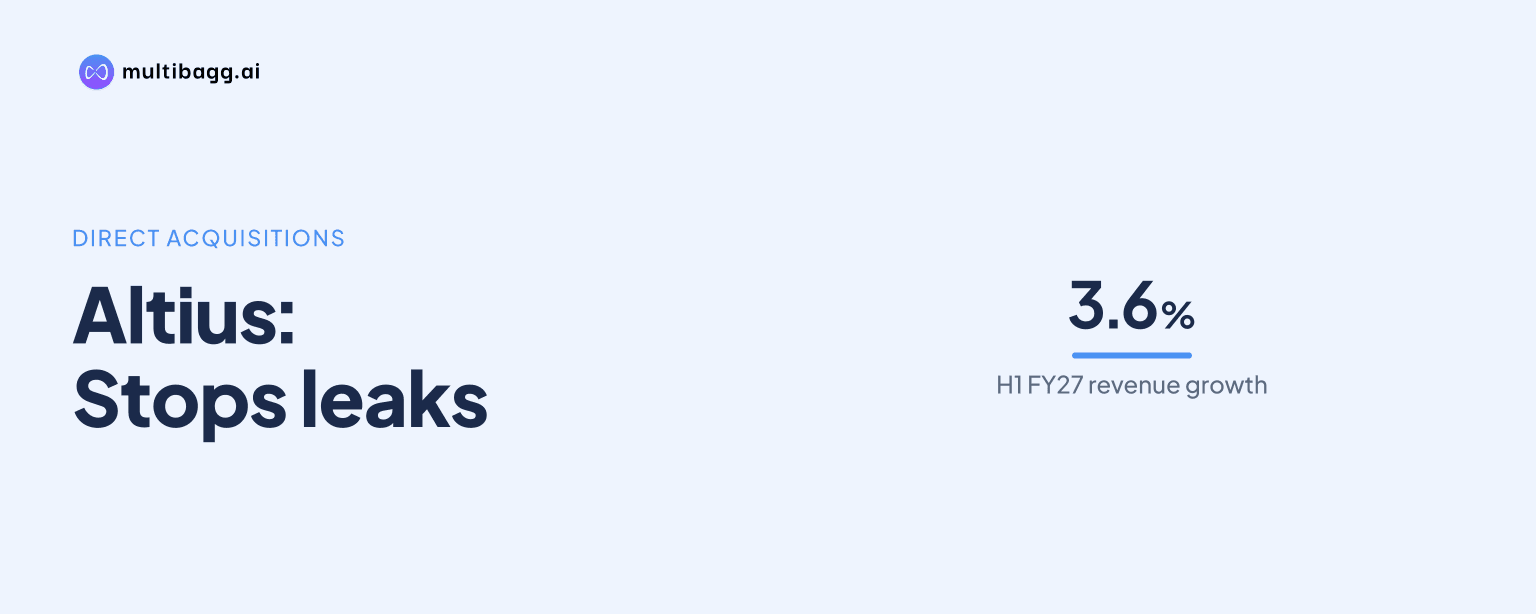
Altius says direct acquisitions by the InvIT and cost-plus management fees prevent sponsor-level value leakage by keeping transaction economics within the Trust; Altius also represented about 14% of listed InvIT assets under management as of September 30, 2026, based on the presentation’s cited market data.
Know Altius Telecom Infrastructure Trust inside out
Results, valuation, peers and who's buying, in one view.
How does Altius say acquisitions prevent value leakage?
Altius says it acquires assets directly at the Trust level, so transaction upside and value accretion accrue to unitholders. The structure described in its presentation has no development company, sponsor or affiliate layer between the asset acquisition and the InvIT, which Altius says keeps the related economics within the Trust.
The distinction matters because Altius frames its model as avoiding intermediary claims on the economics of asset purchases. Its presentation does not quantify an acquisition gain, a saving from an avoided affiliate layer, or the number of acquisitions completed under this structure; rather, it presents direct Trust-level acquisition as the mechanism intended to prevent sponsor-level value leakage.
Altius also says that direct Trust-level acquisition allows economics to flow transparently to unitholders. This claim sits alongside a weighted average lease expiry, or WALE, of about 15.4 years, a measure of the remaining average contractual lease term that Altius describes as among the best in its industry.
The presentation positions the acquisition structure as relevant to both organic and inorganic growth. However, it provides no forecast for acquisition spending, no identified acquisition pipeline and no target for assets to be bought by the Trust, so the disclosed point is about the ownership route rather than a quantified growth commitment.
What fee model does Altius use?
Altius says its Investment Management and Project Management fees operate on a cost-plus basis rather than as a percentage of revenue. The disclosed approach avoids a revenue-linked fee construct, under which fees would vary with revenue generated by the assets.
Management says avoiding percentage-of-revenue fees reduces fee-related leakage and aligns the manager’s incentives with unitholder distributions instead of asset growth. The presentation does not disclose the cost-plus uplift, the absolute fees paid, or a side-by-side calculation against a revenue-based arrangement, so investors cannot quantify the difference from the supplied material.
The fee description is paired with Altius’s sponsor-alignment statement, rather than with a stated distribution target. For H1 FY27, Altius reported adjusted revenue of Rs 6,320.8 crore, up 3.6% from Rs 6,101.8 crore in H1 FY26; adjusted revenue excludes energy and other recoveries, site-rent reimbursement and Indian Accounting Standard 116 adjustments.
Cash earnings before interest, tax, depreciation and amortisation, or cash EBITDA, were Rs 4,335.7 crore in H1 FY27, compared with Rs 4,116.8 crore a year earlier, a 5.3% increase. Altius defines cash EBITDA as EBITDA less Indian Accounting Standard 116 adjustments, including lease-liability payments reflected in financing cash flows and the Revenue Equalization Reserve.
Got a follow-up? Ask IRIS
How does Altius compare with the listed InvIT market?
Altius says it is the only listed telecom-tower InvIT, while the Securities and Exchange Board of India counted 26 listed InvITs across private and public markets as of October 29, 2026. The other categories shown in the presentation include 16 road InvITs, four power transmission and generation InvITs, two warehousing InvITs, and one each in optical fibre, pipeline and supply chain.
Within that listed InvIT universe, Altius reported about a 14% share of assets under management, or AUM, using Bharat InvIT Association data dated August 2026 and its own AUM as of September 30, 2026. This comparison measures AUM share, not revenue, distributions, market value or total returns, and the presentation does not provide the rupee value of Altius’s AUM.
The scarcity argument is also linked to telecom-infrastructure demand. The presentation cites Indian macro-tower tenancies rising from 916,000 in September 2026 to 1.266 million by March 2031, equivalent to 1.4 times growth, after increasing from 796,000 in March 2022 to 916,000 in September 2026.
What operating evidence accompanies Altius’s governance claims?
Altius reported 258,000 towers in H1 FY27, unchanged from FY26 but up from 257,000 in FY25. Its tenancy ratio remained 1.2 times in H1 FY27, FY26 and FY25, compared with 1.1 times in FY24 and FY23 and 1.0 times in FY21 and FY22.
That operating history shows that the increase in towers was concentrated before FY26: towers rose by 77,000 between FY24 and FY25, from 180,000 to 257,000, then increased by 1,000 in FY26 and did not change in H1 FY27. The presentation does not attribute this earlier expansion to direct Trust-level acquisitions, so a causal link between the governance structure and tower growth is not established in the supplied disclosure.
In Q2 FY27, adjusted revenue was Rs 3,167.3 crore, up 3.7% from Rs 3,054 crore in Q2 FY26. Cash EBITDA increased 5.7% to Rs 2,194.8 crore from Rs 2,075.9 crore, meaning cash EBITDA grew faster than adjusted revenue in the quarter by 2 percentage points.
The presentation also identifies built-in revenue escalation and low capital-expenditure intensity as differentiating factors. It does not disclose the escalation rate, the capital-expenditure amount, the tenant mix or contract-level terms, so these features should be read as management’s stated characteristics rather than as independently quantified drivers of the 3.7% quarterly revenue increase.
Conclusion
Altius presents its governance model as combining direct Trust-level asset purchases with cost-plus Investment Management and Project Management fees. Management says the design retains acquisition economics for unitholders, avoids sponsor or affiliate layers, and aligns management incentives with distributions; H1 FY27 adjusted revenue increased 3.6% and cash EBITDA increased 5.3%.
The next disclosed operating measures to watch are the 258,000-tower base, the 1.2-times tenancy ratio and the roughly 15.4-year WALE. Altius has not provided a target for Trust-level acquisitions or disclosed fee uplifts, while the presentation projects Indian macro-tower tenancies to reach 1.266 million by March 2031.