










Altius debt totals Rs 44,900 crore; net debt/AUM is 44.9%
Key highlights
- Altius reported Rs 44,900 crore of gross borrowings across five debt instruments.
- Altius's 44.9% net debt-to-AUM ratio was 25.1 percentage points below the 70.0% InvIT limit.
- Altius reported an 8.16% cost of debt, with 75% of borrowings at fixed rates.
- Altius held Rs 1,320 crore of closing cash and Rs 26,600 crore of NCDs.
powered by IRIS
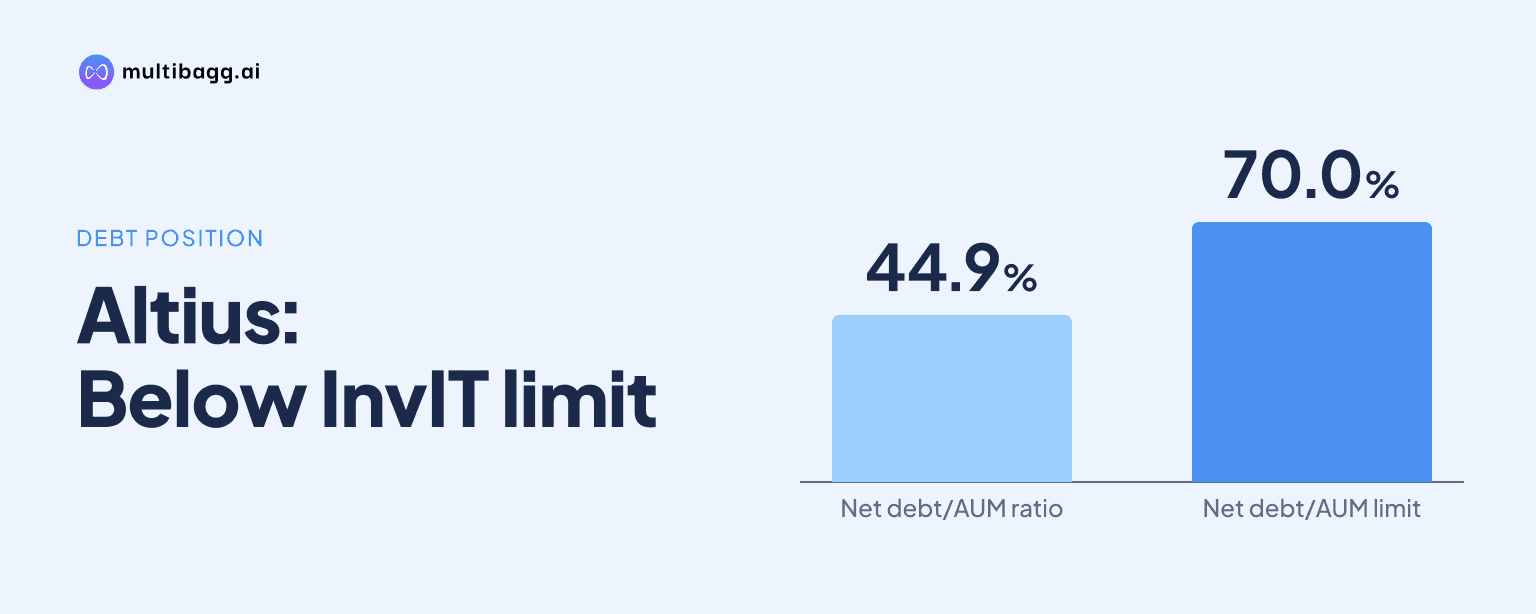
In its H1 FY27 presentation, Altius reported Rs 44,900 crore of gross borrowings and net debt to assets under management (AUM) of 44.9%, 25.1 percentage points below the 70.0% InvIT regulatory limit. The debt book carried an 8.16% cost, was 75% fixed rate and included Rs 1,320 crore of closing cash.
Know Altius Telecom Infrastructure Trust inside out
Results, valuation, peers and who's buying, in one view.
What makes up Altius's Rs 44,900 crore debt book?
Altius's Rs 44,900 crore gross borrowing book comprises bank debt, domestic non-convertible debentures (NCDs), foreign portfolio investment (FPI) NCDs, a United States dollar bond and financial-institution borrowings. Domestic NCDs were the largest instrument at Rs 18,700 crore, followed by bank borrowings of Rs 12,600 crore and FPI NCDs of Rs 7,900 crore.
Altius reported Rs 26,600 crore of NCDs in total, combining domestic and FPI NCDs. Its NCD investor breakdown lists banks at Rs 12,400 crore, infrastructure finance companies at Rs 6,600 crore, mutual funds at Rs 4,200 crore, insurance companies at Rs 1,300 crore, and pension funds and other investors at Rs 1,100 crore each.
The Rs 44,900 crore debt figure represents gross borrowings before mark-to-market provisions and unamortised borrowing costs. It is therefore different from the net-debt measure used for the 44.9% net debt-to-AUM ratio, while the presentation separately records Rs 1,320 crore of closing cash.
What does Altius pay for debt and how much is fixed rate?
Altius reported an 8.16% cost of debt and said 75% of its borrowings were fixed rate. The stated 8.16% measure includes both fixed- and floating-rate instruments and includes the Rs 7,900 crore of FPI debt.
Excluding the FPI debt, Altius disclosed a 7.76% cost of debt, 0.40 percentage points below the reported all-in 8.16% measure. The presentation does not provide maturity dates, floating-rate benchmarks, repayment schedules or an interest-coverage ratio for the Rs 44,900 crore debt book.
Altius also reported financing relationships with more than 40 lending partners. That funding base spans five instruments, from Rs 2,200 crore borrowed from financial institutions to Rs 18,700 crore of domestic NCDs, rather than relying solely on bank borrowing.
The presentation lists an AAA/Stable domestic InvIT credit rating from Crisil and CARE. It separately lists a BBB-/Stable rating for the Summit USD bond from S&P Global and Fitch, but does not link either rating to a future borrowing-cost target or a planned refinancing.
Got a follow-up? Ask IRIS
How much borrowing headroom does Altius report?
Altius reported 25.1 percentage points of headroom between its 44.9% net debt-to-AUM ratio and the 70.0% InvIT regulatory limit. Management describes this gap as significant headroom for growth capital expenditure, subject to meeting the criteria under InvIT regulations.
The 44.9% measure compares net debt with AUM, not gross borrowings with AUM. As a result, the Rs 44,900 crore gross-debt total cannot be used to derive either AUM or the additional rupee amount that would take Altius to the 70.0% threshold, because the presentation does not disclose absolute net debt or AUM.
Altius's operating scale expanded before the H1 FY27 debt presentation. Towers rose from 138,000 in FY21 to 258,000 in FY26 and remained at 258,000 in H1 FY27, while the tenancy ratio increased from 1.0 times in FY21 to 1.2 times from FY25 through H1 FY27.
The presentation pairs the 44.9% ratio with the AAA/Stable InvIT rating and more than 40 lending partners in describing Altius's financial position. It does not disclose a target leverage ratio, a borrowing programme, or a timetable for using the stated regulatory capacity.
How do Altius's growth plans relate to its financing capacity?
Altius reported adjusted revenue of Rs 12,300 crore and cash earnings before interest, tax, depreciation and amortisation (cash EBITDA) of Rs 8,300 crore in FY26, compared with Rs 3,600 crore and Rs 3,000 crore respectively in FY21. The presentation states compound annual growth of 28% for adjusted revenue and 23% for cash EBITDA over FY21 to FY26.
In H1 FY27, Altius reported Rs 6,300 crore of adjusted revenue and Rs 4,300 crore of cash EBITDA. The presentation notes that FY21 includes five months of pre-acquisition operations and FY25 includes about seven months of Elevar operations, which affects comparisons across those periods.
Altius identifies fixed escalations in master service agreements and increasing points of presence as organic growth drivers. Analysys Mason expects mobile network operators to add 350,000 macro tenancies between September 2026 and March 2031, while Altius says it will pursue opportunistic mergers and acquisitions to enhance scale and value.
Altius also reported a weighted average lease expiry of about 15.4 years, with 45% of tenancy share locked in for up to 10 years and 55% locked in for up to 30 years. More than 80% of total revenue comes from tenants carrying AAA ratings from leading Indian rating agencies, according to the presentation.
Conclusion
Altius's Rs 44,900 crore gross debt book is diversified across five instruments, led by Rs 18,700 crore of domestic NCDs and Rs 12,600 crore of bank debt. Its reported 8.16% cost of debt, 75% fixed-rate share, Rs 1,320 crore of closing cash and 44.9% net debt-to-AUM ratio together set out the current financing position.
What to watch next is whether Altius uses its stated 25.1-percentage-point gap to the 70.0% InvIT limit for organic capital expenditure or opportunistic acquisitions. The presentation points to 350,000 expected macro-tenancy additions by March 2031, but does not disclose a future debt target, capital-spending amount or acquisition timetable.