










Altius revenue growth slows to 3.6% as operator rollouts ease
Key highlights
- Altius reported H1 FY27 adjusted revenue of Rs 6,320 crore, up 3.6% year on year.
- Altius reported H1 FY27 cash EBITDA of Rs 4,340 crore, up 5.3% year on year.
- Altius distributed Rs 2,450 crore, or Rs 8.03 per unit, in H1 FY27.
- Altius cited an estimate of approximately 350,000 market tenancy additions over the next five years.
powered by IRIS
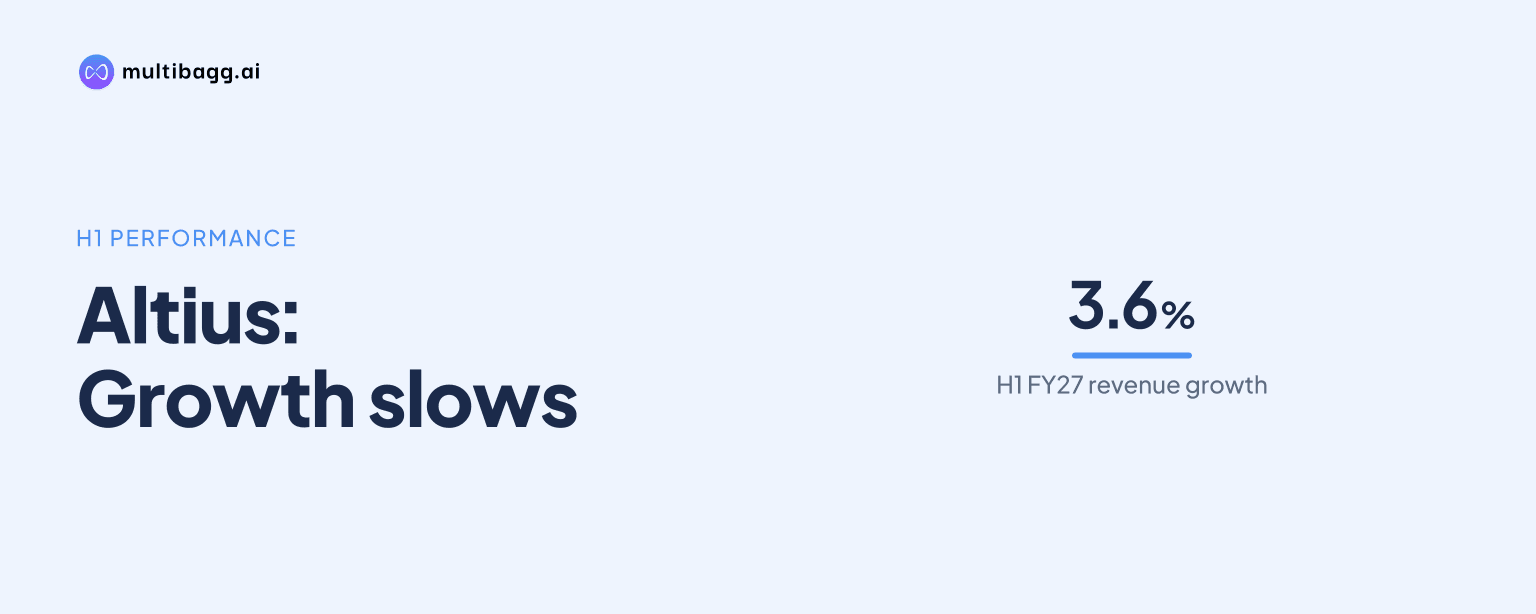
Altius Telecom Infrastructure Trust reported H1 FY27 adjusted revenue growth of 3.6% year on year to Rs 6,320 crore, as timely contractual escalations offset only limited tenancy additions during slower telecom-operator rollouts. Cash EBITDA rose 5.3% to Rs 4,340 crore, while the trust distributed Rs 2,450 crore, or Rs 8.03 per unit.
Know Altius Telecom Infrastructure Trust inside out
Results, valuation, peers and who's buying, in one view.
Why did Altius revenue growth slow to 3.6%?
Altius said H1 FY27 revenue growth was limited because net tenancy additions were modest amid restricted market rollouts by telecom operators. Management told an analyst that adjusted revenue is driven by annual contractual escalations and net tenancy additions, and said escalations occurred on time while additions were constrained by the rollout environment.
The 3.6% H1 FY27 increase was below the 5%-6% annual sector growth range cited by the analyst during the November 13, 2026 call. Management did not cite contract weakness or unexpected churn as the reason, instead describing telecom deployment as a market that can be lumpy because operator network rollouts do not occur evenly across periods.
Altius had about 258,000 towers, in-building solutions and small-cell sites in H1 FY27, with approximately 316,000 tenancies and a tenancy ratio of 1.2x. Its tower base was stable in the half year, compared with approximately 13% compound annual growth between FY21 and FY26, when management said acquisitions were the main driver alongside organic additions.
How did Altius's H1 FY27 earnings compare with Q2?
Altius reported adjusted revenue and cash EBITDA growth in both periods, with Q2 FY27 marginally faster than the first half on a year-on-year basis. Q2 adjusted revenue rose 3.7% to Rs 3,170 crore and cash EBITDA rose 5.7% to Rs 2,190 crore, compared with H1 growth of 3.6% and 5.3%, respectively.
Cash EBITDA, or cash earnings before interest, tax, depreciation and amortisation, outpaced revenue in both periods. Management attributed the difference to cost discipline, stating that operating expenses remained controlled and that economies of scale and changes in the assets deployed at sites could help optimise the cost structure over time.
Altius distributed Rs 2,450 crore in H1 FY27, equivalent to Rs 8.03 per unit. Management said the Rs 8 per-unit H1 distribution was fully backed by operating cash flows and noted that approximately 94% of net distributable cash flow, or NDCF, had been distributed through regular quarterly payouts since FY21.
What contractual protection does Altius have during slower rollouts?
Altius said its long-term contracts provide cash-flow visibility while new tenancy additions are limited. The weighted average lease expiry was about 15.4 years, and more than 55% of tenancies were locked in for up to 30 years with contracted revenue and costs, according to management.
Contractual escalations in master service agreements, or MSAs, were the immediate revenue-growth lever in H1 FY27. Management said these escalations kicked in on time, helping adjusted revenue reach Rs 6,320 crore despite limited tenancy additions from operator deployment activity.
The counterparty mix also forms part of the trust's cash-flow structure. Altius said more than 80% of revenue came from counterparties with credit ratings, while its net debt-to-assets under management, or AUM, ratio was 45%, below the 70% regulatory leverage ceiling cited for an infrastructure investment trust.
Its cost of debt was 8.16%, and 75% of borrowings were fixed rate. Altius also reported an AAA/Stable InvIT credit rating and relationships with more than 40 lending institutions, though management did not provide a timetable or value for any future acquisition or funding transaction.
Got a follow-up? Ask IRIS
What could lift Altius tenancy additions from here?
Altius said a renewed operator deployment cycle, rather than a change in existing contracts, could raise tenancy additions. Management cited an independent research report estimating that the market could add approximately 350,000 tenancies over the next five years, particularly in semi-urban and rural markets.
Management linked that potential to rising data consumption and network requirements across capacity, coverage and 5G. It said India had nearly 935 million smartphone connections, expected to reach about 1.2 billion by FY31, while average data use was close to 28 gigabytes per user per month and could rise above 59 gigabytes in the future.
Altius said it can serve network expansion through in-building solutions in dense urban areas and macro rooftop and ground-based towers in semi-urban and rural locations. Crest Digitel was described as having a market position in indoor connectivity and small-cell platforms, while Summit Digitel has long-term MSAs with key counterparties on its perpetual asset base.
Management did not issue a company-specific tenancy forecast for Summit Digitel or Elevar. When asked about expected growth, it declined to speculate, saying it remained optimistic about capturing part of the projected market expansion but would not make a forward-looking prediction on additions.
How does the current slowdown fit Altius's longer-term expansion?
Altius said its earlier growth came from a combination of contractual escalations, tenancy additions, tower deployment and acquisitions. Between FY21 and FY26, adjusted revenue more than tripled and cash EBITDA nearly tripled, representing five-year compound annual growth rates of 28% and 23%, respectively.
The H1 FY27 outcome therefore represented a change in the mix of growth rather than a reported decline in revenue or cash EBITDA. The tower base remained about 258,000 during the half year, while revenue rose 3.6% mainly through escalations and cash EBITDA grew 5.3% through cost control, compared with the larger historical platform expansion through acquisitions.
Management also identified selective inorganic growth through acquisitions as a future lever, enabled by sector consolidation. However, it gave no acquisition target, transaction timeline or financial commitment, and its comments on the Vodafone Idea and BSNL network-sharing partnership were limited because management said market details had not been disclosed.
Conclusion
Altius's H1 FY27 results show that operator rollout timing constrained tenancy-led growth: adjusted revenue rose 3.6% to Rs 6,320 crore despite contractual escalations, while cash EBITDA grew faster at 5.3% to Rs 4,340 crore following cost control. Its 15.4-year weighted average lease expiry and more than 55% of tenancies contracted for up to 30 years provide the contractual base for its Rs 8.03 per-unit H1 distribution.
The next issue is whether telecom operators convert rising data use and 5G requirements into new site and tenancy deployments. Management cited an independent estimate of roughly 350,000 market tenancy additions over the next five years but gave no Altius-specific target; it also said the trust's listing process remains subject to regulatory procedures and that it will update the market when it has an update.