










Gayatri Rubbers targets ₹55 crore FY27 revenue and ₹9 crore PAT
Key highlights
- Gayatri Rubbers targets ₹55 crore revenue and ₹9 crore PAT in FY27.
- Plant 1 operates at 85% utilisation, with 170 MTPM used out of 200 MTPM capacity.
- Plant 2 is at 35% utilisation and has stated FY27 annual revenue potential of ₹25-30 crore.
- H1 FY27 revenue was ₹27.52 crore, compared with ₹17.33 crore in H1 FY26.
powered by IRIS
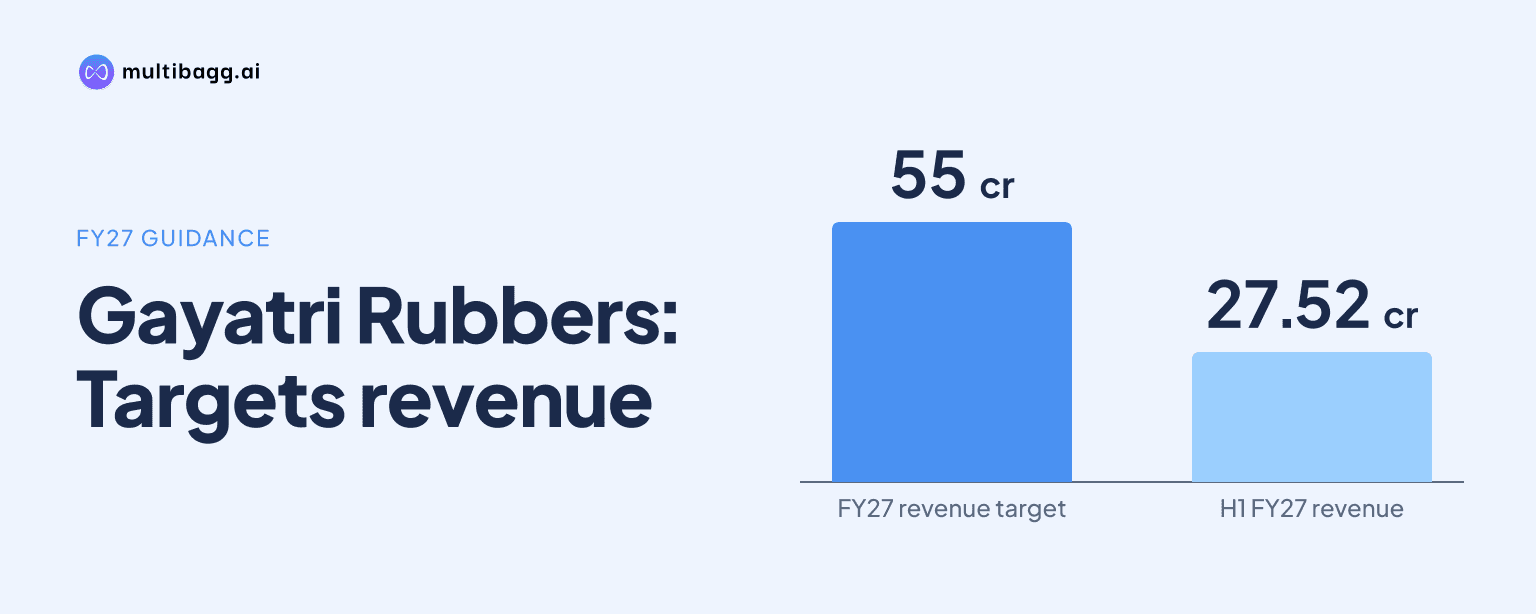
Gayatri Rubbers and Chemicals Ltd targets ₹55 crore of revenue and ₹9 crore of profit after tax (PAT) in FY27, based on management’s plan to take existing plant utilisation from 60% towards 90-95%; it also outlines ₹70-80 crore revenue and ₹14 crore PAT for FY28.
Know Gayatri Rubbers and Chemicals inside out
Results, valuation, peers and who's buying, in one view.
How does Gayatri Rubbers plan to reach ₹55 crore revenue in FY27?
Gayatri Rubbers plans to reach ₹55 crore of FY27 revenue by maximising its existing manufacturing base, pursuing additional volume from railway and industrial customers, entering new high-barrier markets, and developing adjacent products. Management describes the FY27 revenue objective as a path of about 31% compound annual growth rate (CAGR), alongside a ₹9 crore PAT target with a projected CAGR of about 77%.
The stated FY28 objectives extend that plan to ₹70-80 crore of revenue and ₹14 crore of PAT. The three pillars are to raise plant use from 60% towards 90-95%, address large-scale infrastructure and railway opportunities, and continue research and development (R&D) for products such as specialised pipes. The presentation does not provide a product-wise revenue split for the ₹55 crore FY27 target.
The reported annual trajectory provides the starting point for those objectives. Revenue increased from ₹24.4 crore in 2024 to ₹41.82 crore in 2026, while PAT increased from ₹1.6 crore to ₹5.59 crore over the same period. The FY27 revenue target is ₹13.18 crore above the reported 2026 revenue figure.
What existing capacity can Gayatri Rubbers use for growth?
Gayatri Rubbers has Plant 1 in Faridabad, Haryana, operating at 85% utilisation, with 170 metric tonnes per month (MTPM) of use against 200 MTPM of capacity. The facility manufactures 63 of the 75 rubber products used in a single railway coach, placing railway-product volume at the centre of its production base.
Plant 1’s capacity rose by 50 MTPM from 150 MTPM in 2023 to 200 MTPM at present, while utilisation rose by 100 MTPM from 70 MTPM to 170 MTPM. This differs from the company-wide strategic starting point of 60% use cited in the FY27 plan: the presentation identifies Plant 1 separately at 85% and Plant 2 at 35%.
Management’s 90-95% utilisation ambition therefore depends on more than Plant 1, which has 30 MTPM of unused capacity at its stated 200 MTPM level. It also depends on increasing output from Plant 2, securing incremental orders from existing railway and industrial customers, and using the current manufacturing platform before laying groundwork for a third plant.
Got a follow-up? Ask IRIS
What role does Plant 2 play in Gayatri Rubbers’ FY27 plan?
Gayatri Rubbers expects Plant 2 to generate ₹25-30 crore of annual revenue in FY27, compared with an indicated ₹60 crore annual revenue potential at peak utilisation. The Faridabad facility is currently at 35% utilisation and makes two specialised railway products: decoupling rubber flooring and UIC vestibules, also called intercargangway mountings.
The company states that it spent ₹8-10 crore to establish Plant 2 and funded that capital expenditure entirely from internal accruals. The facility’s stated annual tender pool is ₹70-80 crore, and management says it sees a higher probability of securing at least 30% of that value, while retaining capacity to fulfil orders of as much as ₹60 crore.
Plant 2 is material to the FY27 objective because its expected ₹25-30 crore annual revenue range represents a substantial portion of the ₹55 crore company target. That relationship is a comparison of management’s own targets rather than a reported revenue contribution: the presentation does not disclose Plant 2 revenue achieved to date or its order book.
The two specialised products also illustrate the innovation pillar in the plan, which calls for entry into high-barrier markets using existing manufacturing expertise. The next adjacency named by management is specialised pipes, although the presentation gives no launch date, investment figure or revenue target for that product line.
How have Gayatri Rubbers’ revenue and profitability changed?
Gayatri Rubbers reported ₹27.52 crore of revenue in H1 FY27, compared with ₹17.33 crore in H1 FY26, an increase of ₹10.19 crore. Earnings before interest, tax, depreciation and amortisation (EBITDA) increased to ₹6.46 crore from ₹4.02 crore, while PAT rose to ₹4.06 crore from ₹2.63 crore.
The H1 FY27 EBITDA margin was 23.48%, compared with 23.16% in H1 FY26, a 0.32-percentage-point increase. PAT margin moved in the other direction, to 14.76% from 15.20%, a 0.44-percentage-point decrease, even as PAT increased by ₹1.43 crore in absolute terms.
On an annual basis, EBITDA margin expanded from 11.29% in 2024 to 21.11% in 2026, while PAT margin rose from 6.38% to 13.36%. The presentation also reports return on equity (ROE) of 33.05% and return on capital employed (ROCE) of 39.54% for 2026, versus 13.84% and 20.64%, respectively, in 2024.
Conclusion
Gayatri Rubbers’ FY27 outlook combines a ₹55 crore revenue target and ₹9 crore PAT target with a manufacturing strategy built around higher use of installed capacity. Plant 1 had reached 85% utilisation at 170 MTPM, while Plant 2 was at 35% utilisation with stated FY27 annual revenue potential of ₹25-30 crore, making execution at the newer facility central to the plan.
The next measures to watch are Plant 2’s movement towards its ₹60 crore peak-revenue potential, progress towards the 90-95% utilisation objective, and whether specialised pipes advance from R&D into a defined product plan. Management also says it will lay the groundwork for Plant 3 only once current capacity is maximised.