










Gayatri Rubbers and Chemicals reaches 21.06% FY26 margin
Key highlights
- Gayatri reported a 21.06% operating margin in FY26, more than double its FY23 level.
- Gayatri's H1 FY27 EBITDA margin was 23.48%, up 32 basis points from H1 FY26.
- Railways and industrial products represent 75% of Gayatri revenue and have indicated EBITDA margins of 21%-23%.
- Gayatri secured Rs 4.53 crore of Indian Railways orders for execution by May 2027.
powered by IRIS
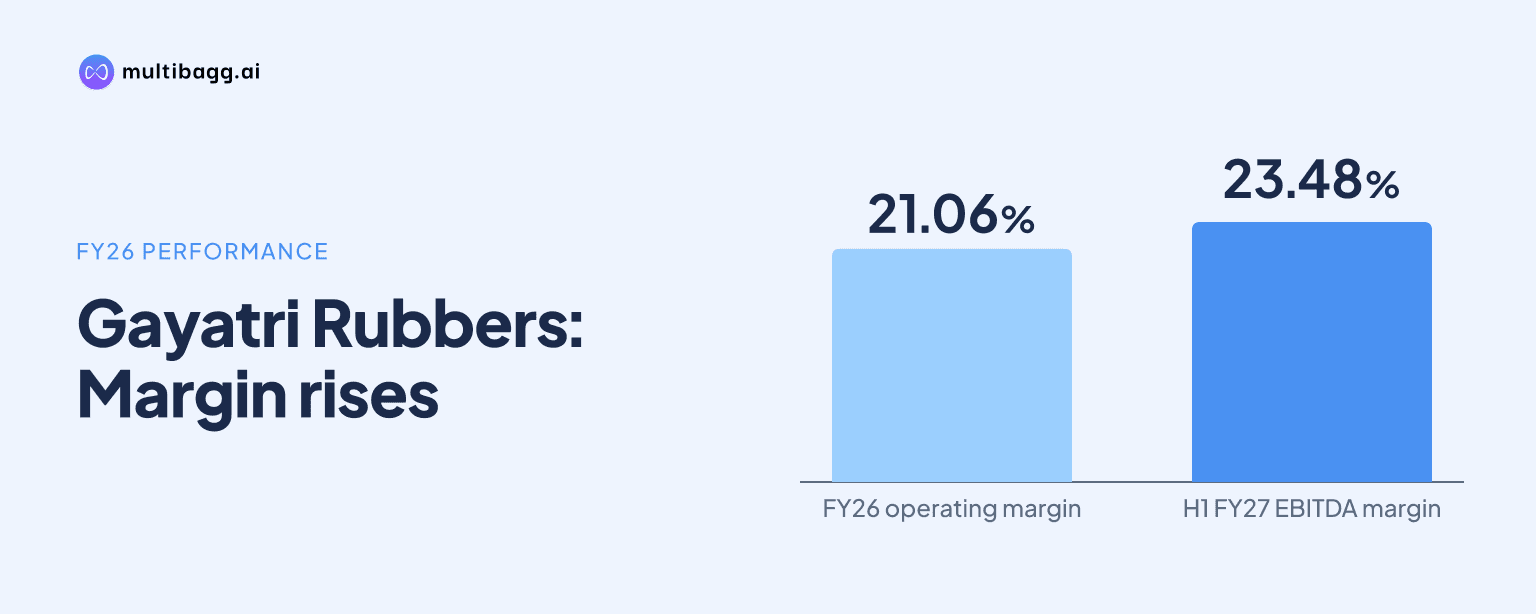
Gayatri Rubbers and Chemicals reported a 21.06% operating margin in FY26, more than double its FY23 level, after shifting from locally focused, volume-led supply towards specialised rubber products. Gayatri also reported a 23.48% earnings before interest, tax, depreciation and amortisation (EBITDA) margin in H1 FY27, 32 basis points above H1 FY26.
Know Gayatri Rubbers and Chemicals inside out
Results, valuation, peers and who's buying, in one view.
How did Gayatri change its margin strategy?
Gayatri changed its strategy from a convenience-based business serving primarily local players through higher volumes to a focus on high-margin, specialised products. The company says it is targeting clients and sectors with high barriers to entry, developing products with higher technical requirements and prioritising margin accretion over pure volume growth. Its presentation identifies the result as a 21.06% operating margin in FY26, more than twice the FY23 level.
The stated product programme includes railway pads, bridge pads and rubber-in-pipe applications. These sit alongside Gayatri’s rubber profiles, compounds and sponge-rubber components for automotive, architectural, industrial and railway uses. The presentation does not disclose a price, raw-material, labour or product-mix bridge between FY23 and FY26, so it does not quantify the contribution of each driver to the margin change.
The FY26 operating-margin figure is distinct from the 23.48% EBITDA margin reported for H1 FY27. Management said H1 FY27 EBITDA margin expanded by 32 basis points, or 0.32 percentage points, from H1 FY26, alongside operating leverage from two plants. The source does not provide annual FY23 revenue, EBITDA or profit figures to calculate the earlier operating-margin percentage independently.
Which revenue sectors support Gayatri’s specialised-product mix?
Gayatri identifies railways and industrial products as the two higher-margin revenue sectors in its portfolio. Railways account for 55% of revenue and industrial applications for 20%, taking their combined share to 75%; both are assigned EBITDA margin ranges of 21% to 23% and profit after tax (PAT) margin ranges of 16% to 18%.
The remaining 25% from architectural and automotive activity has an indicated EBITDA margin of 13% to 15%, compared with 21% to 23% in railways and industrial products. That is a difference of 6 to 10 percentage points between the cited sector ranges. These are presentation-level sector metrics rather than a disclosed audited segment-profit statement.
Railway applications include coach sealing, packing and profiles, while industrial applications include smart meters and engineering products. Gayatri supplies architectural window-rubber profiles through dealers of Jindal, Nalco and Banco. Its automotive activity includes windshield rubber for the secondary market across two-, three- and four-wheelers, as well as indirect supply to Tata Motors through an MSRTC contract and a separate direct contract with KSRTC.
Got a follow-up? Ask IRIS
What H1 FY27 data supports Gayatri’s margin progress?
Gayatri reported total income of Rs 27.52 crore in H1 FY27, up 58.75% from H1 FY26, while PAT rose 54.21% to Rs 4.06 crore. Management reported EBITDA margin of 23.48%, a 32-basis-point expansion from the prior-year half, and attributed the result to operating leverage across its two manufacturing plants.
Plant 1 was operating at about 85% utilisation in H1 FY27, while Plant 2 was operating at 35%. Plant 2 is dedicated to specialised products for Indian Railways. Management described the two-plant structure as a source of operating leverage, but did not disclose the revenue, EBITDA or capital spending associated with moving Plant 2 closer to Plant 1’s utilisation level.
Railway activity provides the clearest order evidence for the specialised-products programme. Gayatri secured two Indian Railways purchase orders worth Rs 4.53 crore for Rubber with Metal components, to be executed by May 2027. Management also said Gayatri, as a Class 1 Supplier, manufactured 65 of the 75 rubber products used in one railway coach.
Which qualifications and orders could extend Gayatri’s strategy?
Gayatri has added specifications, vendor approvals and pilot work in applications it describes as high-barrier. In 2024, it obtained approval for the HL3 EN45545-2 fire-retardant specification and National Accreditation Board for Testing and Calibration Laboratories accreditation. In the same year, it was added to the approved-vendor directory for Intercar Gangway UIC vestibule bellows.
In 2025, Gayatri added BEML as a major client for rubber gaskets, launched fire-retardant silicon mobile holders and secured a pilot order for ethylene propylene diene monomer (EPDM) rubber from the Indian Space Research Organisation. Management said the pilot marked Gayatri’s formal entry into aerospace and space and could provide a qualification reference for mission-critical applications. The presentation does not disclose the pilot order value or a recurring supply commitment.
Gayatri was also onboarded as an official vendor to KSRTC and received its first letter of intent worth Rs 1.29 crore for EPDM rubber glazing. Management said it continues to serve defence customers including BEML and intends to convert pilot engagements into longer-term supplier relationships. The source does not state whether the KSRTC letter of intent has become recognised revenue or whether the Indian Space Research Organisation pilot has progressed beyond its initial stage.
Conclusion
Gayatri’s FY26 operating margin of 21.06% and H1 FY27 EBITDA margin of 23.48% align with its stated move towards specialised products. Railways and industrial applications comprise 75% of revenue and carry indicated EBITDA margin ranges of 21% to 23%, compared with 13% to 15% for architectural and automotive activity.
The next disclosed milestones are execution of the Rs 4.53 crore Indian Railways orders by May 2027, conversion of pilot engagements into long-term supply relationships and development of railway pads, bridge pads and rubber-in-pipe products. Management also plans to enter exports from 2027, while Plant 2 utilisation of 35% in H1 FY27 remains a disclosed capacity measure to watch.